

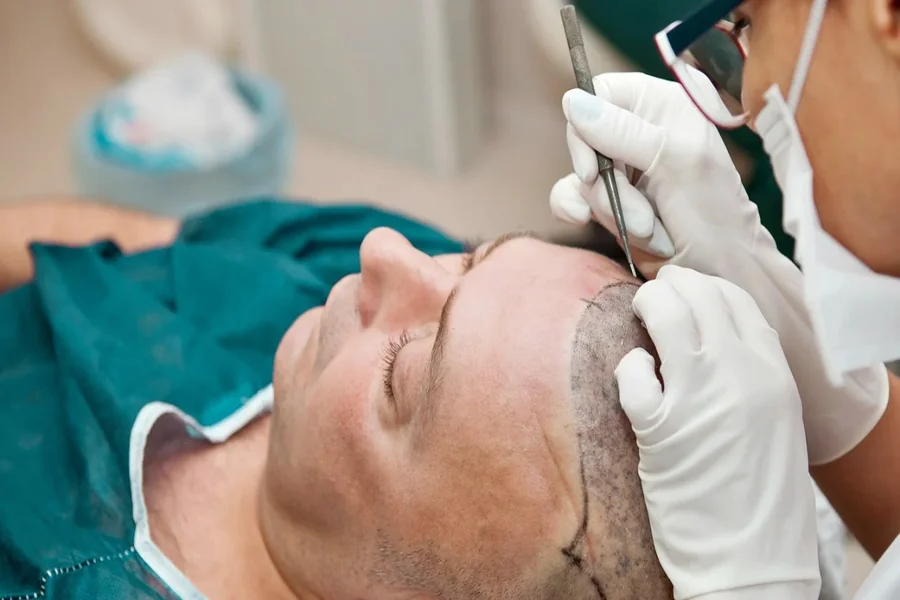
A hair transplant is a surgical procedure that moves hair from an area with strong growth to thinning or bald parts of the scalp. If you are asking what a hair transplant is, the simplest answer is that surgeons redistribute your own permanent hair follicles rather than creating new ones.
With careful planning, the procedure can improve coverage in balding or thinning areas while preserving a natural pattern. Results develop gradually because transplanted follicles need time to recover and regrow hair.
This guide explains how transplantation works, who may qualify, the differences between FUE and FUT, what happens during surgery, recovery, risks, costs, and expected results. It also covers donor limitations, progressive loss, scarring, alternatives, and why long-term surgical planning matters.
How Do Hair Transplants Work?
To understand how hair transplants work, think of the procedure as redistribution rather than hair creation. Surgeons remove donor hair from an area that is more resistant to hereditary thinning, usually the back or sides of the scalp.
They then prepare small hair grafts and place them into recipient sites created within the balding area.
Each graft may contain one or several hair follicles, depending on where it will be placed and the desired density. Single-hair grafts are often placed along the front to create a softer hairline, while larger follicular groups may add coverage behind it.
The goal of hair transplant surgery is to blend transplanted follicles with existing hair while maintaining a pattern that looks natural as the patient ages.
The process generally involves three stages:
- The surgeon evaluates the donor site and planned treatment zones.
- The surgeon removes follicles using FUE or FUT.
- The surgeon inserts prepared grafts into carefully planned recipient sites.
Successful growth depends on gentle graft handling, proper placement, and an adequate blood supply after transplantation. The procedure does not stop future loss in untreated areas of the scalp, which is why long-term planning remains part of the evaluation.
Who Is a Good Candidate?
A good candidate usually has a stable source of healthy hair in the back or sides of the scalp and enough donor density to support the planned procedure.
People with androgenetic alopecia often consider surgical hair restoration when thinning has become noticeable and medical treatment alone does not provide the coverage they want. Age, pattern of loss, hair characteristics, and future progression all affect candidacy.
Your surgeon will also review your medical history before recommending surgery. Certain forms of temporary or inflammatory hair loss may require diagnosis and treatment before you consider hair implantation surgery.
Expectations also matter because surgery can improve coverage, but it cannot recreate unlimited density or restore every lost follicle.
A typical evaluation may include:
- Hair-loss pattern and progression
- Density and quality of the donor area
- Hair shaft thickness, curl, and color contrast
- Previous procedures or scalp scars
- Current medications and health conditions
These factors help determine how many grafts may be available and where they can create the greatest cosmetic benefit. A conservative plan can also preserve donor reserves if another procedure becomes useful later.
FUE vs. FUT Hair Transplants
The two main surgical approaches are follicular unit extraction (FUE) and follicular unit transplantation (FUT). Both move naturally occurring follicular units from the donor region to balding or thinning areas, but they differ in how those follicles are removed. Neither method automatically produces better results in every patient.
With follicular unit extraction (FUE), individual follicular units are extracted through small circular openings in the scalp. It avoids a linear donor scar and can work well for people who prefer shorter hairstyles, although many small extraction marks remain.
The surgeon must distribute extractions carefully so the donor region does not look overharvested.
With follicular unit transplantation (FUT), the surgeon removes a narrow strip of tissue from the donor area and closes the incision. Technicians then separate the strip into individual follicular units for transplantation.
FUT can preserve more surrounding donor hair in some cases, but it leaves a linear scar that may become visible with very short hairstyles.
When comparing the two methods, patients often consider:
- Donor density and scalp characteristics
- Number of grafts required
- Hair length preferences
- Previous transplant procedures
- Scar tolerance and future surgical planning
The right choice depends more on anatomy and surgical goals than on marketing terms. Both methods can support natural results when the extraction pattern, hairline design, and graft placement are handled carefully.
What Happens During Surgery?
Before a hair transplant procedure begins, the surgeon usually marks the treatment area and reviews the planned hairline or density zones. Local anesthesia is commonly used so the patient remains awake while the scalp is numbed. Depending on the technique, hair may also be trimmed in part or across the donor region.
During hair implant surgery, the clinical team must keep grafts protected while the surgeon creates recipient sites that control the angle, direction, and spacing of the transplanted hair. The same principles apply whether the procedure is described as a hair transplantation operation, hair implant surgery, or hair implantation surgery.
The placement stage requires careful attention because transplanted hair should follow the direction of nearby existing hair. Surgeons usually place finer grafts near the front and denser follicular groupings farther back. This pattern can help the result appear less abrupt as new growth develops.
Patients comparing surgeons may benefit from reviewing how much of the procedure the physician performs and how the treatment plan protects the donor supply.
Reviewing the approach used by Dr. Ross Kopelman can also give patients an example of how physician-led care may address hairline design, donor management, and long-term planning rather than focusing only on the number of grafts placed.
Recovery After a Hair Transplant
The scalp commonly develops temporary redness, swelling, crusting, or tenderness during early recovery. Small crusts usually form around transplanted hair grafts and gradually fall away as the skin heals.
The donor site also needs time to recover, whether follicles were removed individually or through a strip procedure.
During the early recovery phase, patients are often advised to protect the grafts and follow specific washing instructions.
Strenuous activity may be restricted temporarily because heavy exercise, friction, and increased swelling can interfere with early healing. Exact restrictions vary by procedure and the surgeon’s protocol.
Common recovery milestones include:
- Early swelling or tenderness during the first several days
- Crusting around grafts during the first week
- Temporary shedding of transplanted hairs in the following weeks
- Early new growth after several months
- Continued thickening over the following year
Temporary shedding usually does not mean the follicle has been lost. The implanted follicles remain beneath the skin and can begin producing new hair as they enter another growth cycle.
When Will Hair Grow?
Hair growth after transplantation takes time because follicles commonly enter a resting phase after surgery. Many transplanted hairs shed before new strands begin to emerge.
Early growth may become noticeable after several months, while density generally continues to improve throughout the first year.
The rate of improvement varies by patient, scalp region, hair characteristics, and healing response. In some cases, crown areas may mature more slowly than the frontal scalp. Patients should evaluate results over several months rather than expecting an immediate change.
A transplant also does not prevent surrounding native hair from thinning later. If progressive loss continues, you may need to discuss medical treatment or another procedure with your surgeon to help maintain visual balance.
Preserving donor follicles during the first operation can therefore be as important as maximizing density in one session.
Risks and Possible Complications
Hair transplantation is surgery, so it carries potential risks even when performed by an experienced medical team. Possible issues include infection, bleeding, swelling, temporary numbness, folliculitis, visible scarring, poor growth, and an unnatural appearance if grafts are poorly planned.
Some patients may also experience temporary shock loss involving nearby existing hair. One way to reduce avoidable problems is to choose a qualified surgeon who evaluates both your current hair loss and its likely future progression.
Patients should also disclose medications, previous procedures, medical conditions, and changes in scalp health before treatment. Clear postoperative instructions can help protect healing follicles during early recovery.
How Much Does It Cost?
Hair transplant costs vary widely because pricing depends on the number of grafts, surgical technique, physician fees, location, and case complexity. Larger areas usually require more grafts and more procedural time. Revision surgery may also cost more when scar tissue or limited donor reserves make planning harder.
Patients should compare more than a per-graft price. A lower quote may not reflect differences in physician involvement, surgical planning, graft handling, or postoperative care.
Patients researching options in New York City may also compare practices such as Kopelman Hair Restoration NYC: Hair Transplant Clinic to better understand how consultation, surgical planning, and follow-up care are structured. Ask for a written estimate that explains what is included before committing to treatment.
Alternatives to Hair Transplant Surgery
Not everyone with thinning hair needs hair transplant surgery. Medical treatments may help slow progressive loss or improve density in some patients, while cosmetic fibers, scalp micropigmentation, hair systems, and styling changes can improve appearance without transplantation.
The best choice depends on the diagnosis, treatment goals, and available donor supply.
Surgery may also be delayed when hair loss is still changing quickly or when the donor area cannot support the desired coverage. In those situations, stabilizing loss first can make future planning easier.
A qualified evaluation should determine whether surgery, medical care, or a combination of approaches fits the patient’s needs.
What Results Can You Expect?
A well-planned transplant can create long-lasting coverage because follicles taken from stable donor regions generally retain their resistance to pattern hair loss.
Results still depend on donor supply, hair characteristics, graft survival, surgical technique, and the degree of future thinning. No procedure can create an unlimited number of follicles.
Realistic expectations are central to successful hair restoration. A well-designed treatment plan aims to improve density while preserving enough donor hair for future needs. When surgery matches the patient’s anatomy and long-term pattern of loss, transplanted hair can blend naturally with the surrounding scalp.









2 thoughts on “What Is a Hair Transplant? Procedure, Results, and Recovery”
Comments are closed.