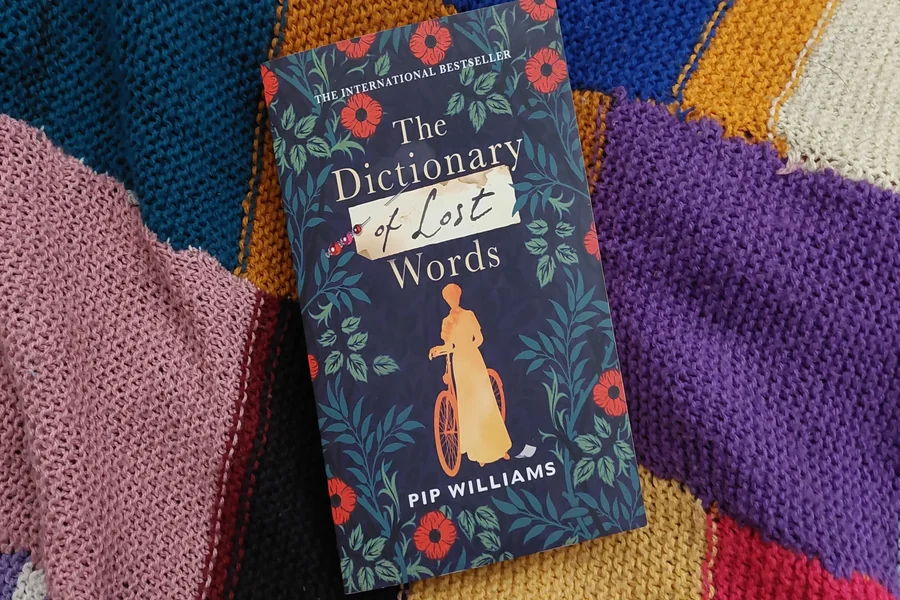
Many of the characters, like Mr. Murray and many of his employees, are fictionalized versions of real people, though Esme and her father, among others, are entirely fictional. This blend of real history and an imagined woman’s life was an interesting balance, and I think Williams did an admirable job of interweaving fact and fiction. Esme is quite a layered character with lots of personality, and watching her grow up was well paced. I also especially liked Gareth and Lizzie and Edith, the latter of whom was especially delightful.
The examination of how elitist academia can be was fascinating. It’s true that in writing, there is a certain way that’s acceptable, and it’s definitely true that for a long time certain words were left out of dictionaries, therefore denying their credibility. It hadn’t occurred to me that the dictionary was mostly created by rich white men, and therefore would have been curated based on their prejudices—whether their choices were deliberate or not. I liked seeing through Esme’s eyes how she sees words coined by women, about women, and for women were dismissed or looked down upon.
This theme can also certainly be applied to today. Things like slang and AAVE are so often looked down on, especially in academic settings, but they are in reality no less valuable or important as “proper” speech. This book doesn’t go into racial issues, being focused more on early feminism in predominantly white circles, and while this might be a bit of a missed opportunity, perhaps that can be a novel by someone else in the future.
So while I really enjoyed the overall theme of this story, I found some aspects of the plot not entirely satisfying, mostly the ending. I thought it both went on a little too long and also lacked the resolution I wanted. I felt the way Esme’s point of view ended was too abrupt—something felt lacking, as if her arc hadn’t quite reached the end. And then the following scenes from Megan’s perspective felt unnecessary (though perhaps that’s simply due to me wanting more from Esme?). Either way, while it wasn’t a bad ending, it wasn’t quite what I wanted. Also, Gareth deserved better, and I’m sad for him.
In the end, though, The Dictionary of Lost Words is a good novel, bridging reality and fiction and exploring the power of language—and how those in power can steer language certain ways. It’s about women, and how despite their marginalization in society, they can still be strong. On a more personal level, it’s a story of how one woman fell in love with words and with the way those of her same gender support one another. There’s friendship and romance, triumph and tragedy, and despite a lackluster ending (for me) it’s a really interesting read!
Leave a Reply