
I received an advance reader’s copy (ARC) of The Lost Story by Meg Shaffer. Since this version is just a proof and not the final version, I won’t quote directly and will keep my comments general.
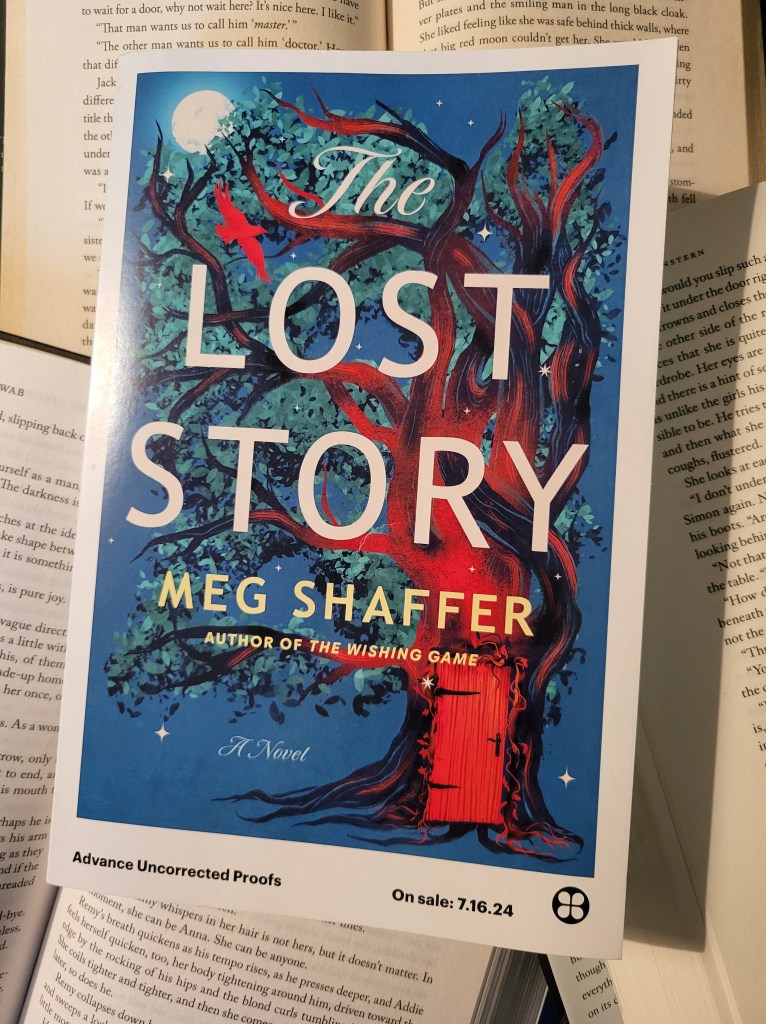
The Lost Story by Meg Shaffer follows Emilie, a young woman who is searching for answers about what happened to her half-sister Shannon, nearly twenty years ago, when she was kidnapped from school and then never seen again. Emilie seeks out Jeremy Cox, a man who has spent the past decade and a half finding missing girls and women. But that’s not really why Jeremy is famous; rather, it’s because of his own disappearance with his friend Rafe Howell. When they were teens, the two went missing in a West Virginia state park, then reappeared six months later, unable to explain what happened to them. Emilie isn’t sure what to make of Jeremy, or Rafe when he’s roped into the hunt for Shannon, but she doesn’t know where else to turn for answers. Little does she know the search will take her to a world she never imagined.
This is a great book, somehow whimsical and dark at the same time. It was apparently inspired by the Narnia series by C. S. Lewis, but I also would also compare this to the Wayward Children series by Seanan McGuire. Seeing the struggles that the characters go through after returning to the “real world” is certainly more aligned with the latter, though this novel has a slightly different take on it.
I really liked Jeremy and Rafe, and the complex relationship they have. The myriad things they feel for each other—childhood nostalgia, bitterness, fondness, and stifled attraction—make for really interesting development for both characters. Their story is truly the heart of this book, and I loved watching them forced to work together again and therefore deal with their shared past.
On that note, there are some serious moments that center around domestic violence and child abuse, both verbal and physical. I wanted to mention it, if this isn’t a topic you want to engage with.
As for Emilie, she’s a decent character, a relatable fish out of water, as we all would be in her situation. Her determination to know her sibling, even if that knowing is just in the form of finding out how she might have died, is moving. And I also enjoyed how her presence shifts the dynamic between Jeremy and Rafe sometimes.
Characters aside, though, the setting is one of the best parts of this book. As becomes clear very early on in the story, the two boys found their way into an otherworldly place through a portal in the woods, and so live for a time in a Narnia-like land. This place is so cool and full of magic and mystery, a fairytale or child’s daydream come to life. I wish that we could have spent more time here, because it feels like as soon as we arrive, the story is barreling toward its final act. I wanted to slow down slightly, take our time getting to know it before the plot moved on. But it was still an effective setting and had decent, if not super deep, world-building.
In the end, The Lost Story is a thoughtful, slightly fanciful novel that explores both the wonder of childhood and the pain of adulthood. It examines how trauma affects people, and also how love empowers. It celebrates creativity and condemns cruelty. The characters feel lively, the setting immersive, and the plot compelling (if imperfectly paced). I don’t know if I preferred this or Shaffer’s previous book better, but I do know that I recommend this one!
The Lost Story is available now!
 Righter of Words