
Buckle up, everyone, Much Ado About Nothing fangirl here with OPINIONS.
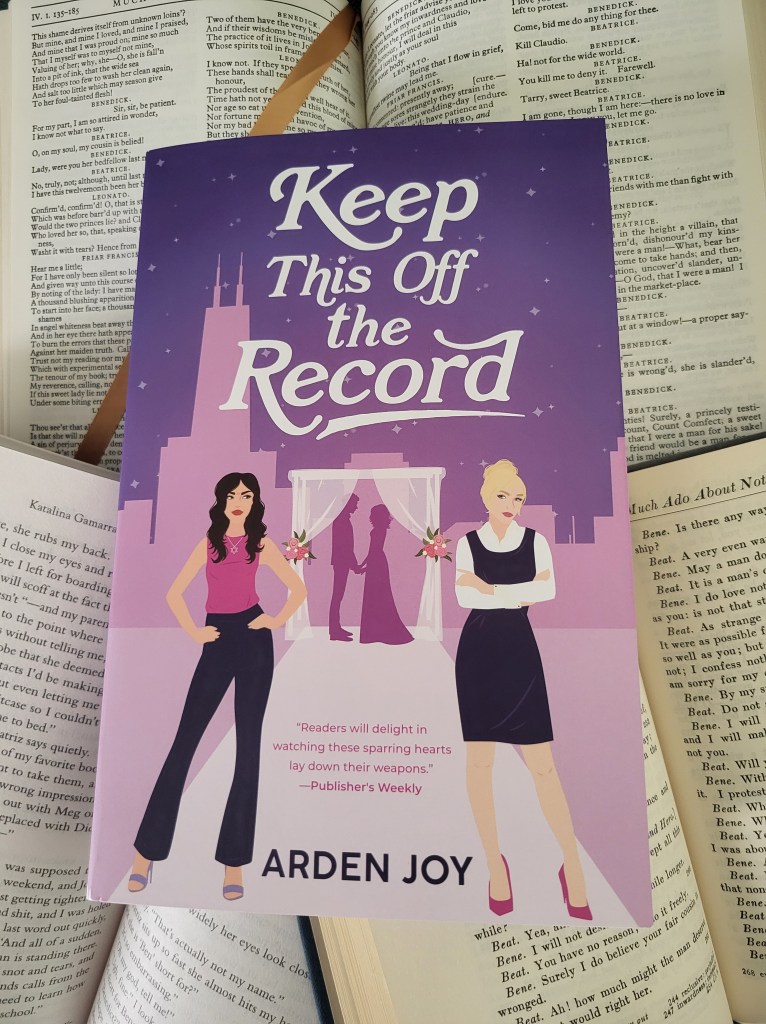
In Keep This Off the Record by Arden Joy, Abby and Freya never liked each other in high school. Now, fifteen years later, they end up back in each other’s lives when Freya’s coworker Will starts dating Abby’s friend Naomi. While both women are happy for their friends, this also means they keep getting drawn back together, forced to exchange barbs and snide remarks again and again. But soon, things start to change, especially when drama surrounding Will and Naomi’s relationship ensues. Perhaps their mutual dislike has been wrong all along, and they’re better together… and maybe are even in love. However, they aren’t sure if a relationship can survive, even if the feelings are real.
Now, when I heard this book is a sapphic modern retelling of my favorite Shakespeare play, I had to read it. And while it’s not bad per se, I have some critiques of it.
(I also want to say that my affection for the original Much Ado is slightly conditional. I mostly just like Beatrice and Benedick. The rest of the play is just… okay. Hero deserved better, and Claudio deserved much worse. I would eat his heart in the marketplace, etc., etc.)
So while this is a quirky and cute story overall, good for fans of the “enemies to lovers” romance trope, I think that the author misunderstood the actual dynamic between Beatrice and Benedick in the original play. Bear with me while I put my English major hat on yet again.
In every other version of Much Ado I’ve ever encountered (Tate and Tennant, Thompson and Branagh, Acker and Denisof, plus a couple local productions), I’ve always walked away with the impression that the two protagonists have always secretly cared about each other. Beatrice even tells Benedick in their first scene together that “I know you of old,” revealing their history and understanding of each other. There was always a subtle affection in their bickering (often helped by the actors’ performances), so when they’re forced to confront the possibility that the other person is actually masking their romantic feelings, it’s easy for them to crumble and accept that they, too, are in love. In short, Beatrice/Benedick is not actually an “enemies to lovers” situation, even though it might appear that way on the surface.
In this book, though, both Abby’s and Freya’s perspectives demonstrate how much they truly dislike each other. Their insults and arguments aren’t rooted in disguised fondness, but actual disdain. So when the inciting incident—their friends sneakily pushing them together—occurs, it doesn’t make much sense to me. Why would their friends try to set them up, knowing how much bad blood there is?
Moreover, when the drama between Will and Naomi ensues, I really wish that it had brought Freya and Abby together more. In the original, it’s a situation that forces them to evaluate their own lives in a new light, acknowledge what they want, and move forward together. In this, Freya and Abby just kiss and say they want each other, but the scene falls flat, perhaps because their entire relationship thus far has been nothing but negative feelings toward each other, punctuated by occasional moments lately of wondering if they’ve been wrong. But there’s not enough of a foundation for their changes of heart, so the confessions don’t feel earned.
This leads, unfortunately, to their entire love story feeling rushed and not believable. I know that weeks, even months, pass in the second half of the book, but I didn’t see enough character development to fully buy their romance. Instead, a lot of the plot focused on resolving Naomi and Will’s fraught troubles. Granted, this is a problem that Much Ado has to an extent, and I do like how this gives some nuance and offers sympathy to victims of abuse. Naomi (the Hero character) is dealing with her ex-husband stalking her while also trying to move on with her life, and she’s never looked down on for it. She does make mistakes, however, and it works to drive the drama forward. This way, Will (the Claudio character) isn’t the only problem in their relationship. I don’t agree with all of Will’s reactions to things, but at least I don’t want Abby to ask Freya to challenge him to a duel to the death.
Still, while a more sympathetic version of Hero/Claudio is a good thing, it takes up way too much time, when Abby/Freya is supposed to be the main focus of the book. Plus, there were a lot of scenes with Abby’s friend Riley and sister Becca, which could have been condensed or shortened to allow for more time with Freya. We could have explored deeper into Freya’s crisis of sexuality (which was barely touched on) or her reluctance to come out as queer since she’s a well-known national news reporter (a plot point that’s introduced and then resolved almost as fast). It was frustrating.
In the end, I clearly had a hard time with Keep This Off the Record. I will say, though, that I love that this book represents minority groups not often shown in the romance genre (in this case, queer Jewish women and nonbinary people). Further, some of the dialogue scenes between Abby and her friends are funny, and the overall structure of the story is good. This is a book that I would say has potential, but I wish the author had done a rewrite to bring the concepts and emotional beats fully to fruition. Additionally, as a Much Ado retelling, I feel that it needs work, and not to be reduced to yet another “enemies to lovers” romcom. All that said, I’m not opposed to reading something else by this author someday; as with this book, I see potential in her. It’s just unfortunate that this book didn’t work for me.
 Righter of Words