
I received an advance reader’s copy (ARC) of What Comes After by Katie Bayerl. Since this version is just a proof and not the final version, I won’t quote directly and will keep my comments general.
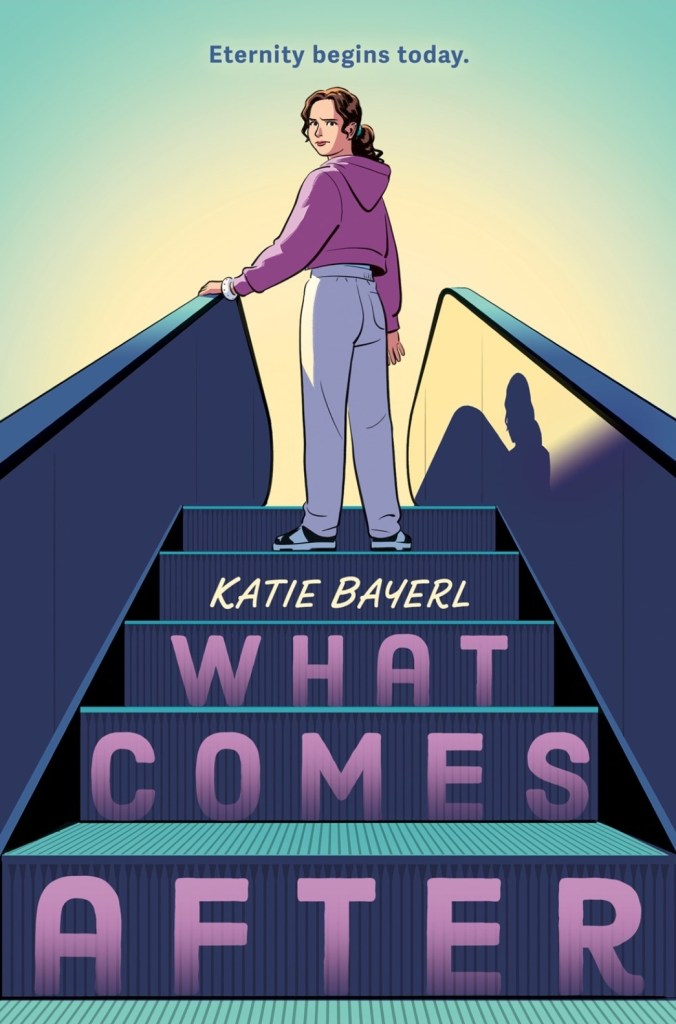
In What Comes After by Katie Bayerl, Mari is a driven sixteen-year-old, determined to make it through high school and get to college no matter what. After years of an unstable life moving around with her flighty, unreliable mother Faye, she’s ready for freedom and safety. But she wakes up in the afterlife after a freak accident, all her plans no longer within reach. Instead, Mari has to learn to navigate existence in a strange place called Paradise Gate, a secular afterlife where residents must prove their inner serenity before they can move on to whatever comes next. Mari’s main obstacle, though, is that she’s assigned to stay with her mother, and how can she possibly have inner serenity with Faye around?
This book caught my attention because of the obvious comparison to The Good Place (one of the best shows of all time; if you disagree, argue with the wall I guess). However, this book is rather different from that show, but more on that later.
Firstly, Mari is a strong character, but then again, she has to be. Her life has been chaotic and difficult, with her mother’s issues with keeping a job and impulsively moving around or falling in love with men who aren’t good for her. Mari has understandably grown up with trust issues (especially with authority) and some serious resentment towards Faye, and so when she’s dropped into Paradise Gate, it makes perfect sense that she struggles. But I really wanted to see her take steps to improve herself, because she’s been through enough and deep down it’s clear she just wants to be safe and loved.
Obviously, her relationship with Faye is one of the strongest threads through this story, and this book does explore the complicated, often unhealthy, dynamic that they have. However, what sort of blindsided me about this book was just how much it was also about the dystopian society of Paradise Gate and the burgeoning rebellion against the leaders thereof. I wish I’d had more of an inkling that this was so much of the plot, because the description of the book barely mentioned it. For what felt like a lot of the middle section of the book, the plot centered on this element, therefore pushing aside the characters’ emotional arcs (the thing I was really invested in). So that felt like a bit of a bait-and-switch.
That said, I will admit that the worldbuilding in this is intriguing. I like the idea of a secular sort of afterlife (again, like The Good Place) that still allows for kind, decent people to “ascend,” and even more than that, I like the themes introduced here. Paradise Gate is far from a utopia, with its surveillance state constantly looming, and its social media influencers constantly pushing toxic positivity on the masses. The social commentary is sharp in this book, but again, I wish I’d known to expect it, because I don’t know how well it meshed with the character development.
Mari does have a romantic subplot with Jethro, a young man who appears to be caught up in the growing rebel movement that wants answers about the real nature of Paradise Gate. While I liked Jethro, I never really felt all that invested in his story, perhaps because it was so wrapped up in the dystopian elements. I was expecting this book to be more about self-reflection, learning how to navigate tangled family dynamics, and figuring out if/how to forgive a parent for not supporting you how you needed. Instead, it was a rebellion that I felt had no clear mission statement, sidelining the Mari-Faye relationship.
In the end, I admit I struggled a little with What Comes After. The characters are good, and the backdrop of Paradise Gate is an interesting one. The themes about second chances, working through regrets, and learning to heal and move forward are all important themes. However, I think the story was unbalanced in its handling of integrating the emotional core with the more action-oriented rebellion vs. dystopian regime elements. But while the tone was inconsistent, I still was invested enough in Mari’s story to keep reading, and her journey was, overall, rewarding. (I still would rather watch The Good Place, though.)
What Comes After is available now!
 Righter of Words