
I read this, quite literally, for the hell of it.
(I received an advance reader’s copy (ARC) of Katabasis by R. F. Kuang. Since this version is just a proof and not the final version, I won’t quote directly and will keep my comments general.)
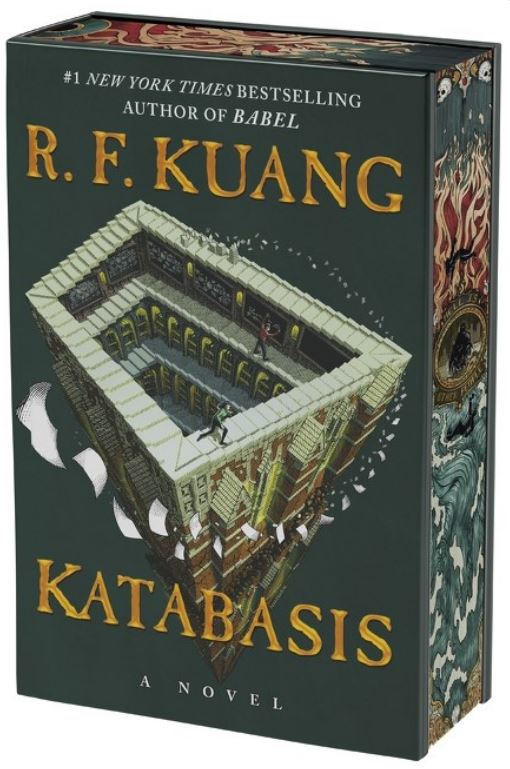
Katabasis by R. F. Kuang follows Alice Law, a Cambridge student going for her PhD in analytic magick. She’s in her final year, about to defend her dissertation, when her advisor Professor Jacob Grimes dies a gruesome death due to a miscast spell. But Alice needs his recommendation letter beyond anything else to get a job in her chosen field, so she prepares for a journey into Hell to fetch his soul back. That’s when a fellow student, Peter Murdoch, decides to come along, as he’s in the same position as she is. Reluctantly, they team up and venture to the Underworld, where they soon find themselves facing dangers they didn’t anticipate and magick they might not be able to fight. And all the way, they grapple with their complex feelings about each other, their fraught histories, and what might lie in wait in the depths of Hell.
Kuang is clearly so much more intelligent than I am, and honestly, I revel in it. Everything about this book, from the magic system to the plot structure to the character work to the narrative voice, speaks to a brilliant mind behind it all. I’m embarrassed to have only read one book by Kuang before this, despite having two others on my shelf waiting, because this was a fascinating ride.
The magic system for one thing is so clever. Staples of higher education—like mathematical proofs, grammar, logic, and philosophy—as the mechanisms by which magic works is an incredible idea, and I love it. It gives the reader something familiar (if still very cerebral) to grasp on when also reading about Latin phrases and pentangles, which are likely less familiar. Plus, it allows the themes of academia to be interwoven with the fantasy elements perfectly. And academia is a significant theme in this story, particularly the exploration of its more toxic side. After all, an intense and often cutthroat setting like Cambridge University surely often leads to rather unhealthy mindsets and habits, as exemplified in Alice’s behavior. She hardly eats, hardly socializes, and is desperate to believe that she’s superior for it. And then there’s the way she justifies how she’s been treated by her advisor, but I’ll come back to that.
Generally, Alice and Peter both are fantastic characters, in that they’re so flawed and—especially in Alice’s case—not entirely likable all the time, yet you feel compelled to see what happens to them, if they succeed in their quest. Alice has lots of attitudes and maxims that I don’t really agree with, exemplified best perhaps by her complicated opinion on the feminist movement (I believe this book is set during the 1980s, though I don’t believe there’s a specific year ever mentioned). Alice’s view of feminism as silly is obviously not a great view, but serves as a brilliant commentary on sexism within academia, and how much Alice is wrapped up in that world. It makes some sense, then, that her negative reaction to feminism pits her against not only the men in her life, but the women too. And while she has a bad attitude, I think that we are to interpret what exists between her and Grimes, not as narrative retribution, but as something that would have happened no matter what. She’s trapped unknowingly between a rock and a hard place. It’s nice to see her ideas challenged later on, too, as are her ideas of what should happen in academic settings, and of social issues.
I guess this means I need to talk about Professor Grimes, as I keep beating around the bush about him, especially in regards to Alice. Basically, Grimes is the prototype for abuse of power, though in a slightly more subtle way. He’s intelligent in a way that causes those around him (namely those he has authority over) to go out of their way to explain away and justify his actions, good and bad. So of course this leads to borderline-abusive behaviors, including a non-consensual kiss between him and Alice, that easily could have escalated had she not extricated herself right away. Another thing about Grimes, though, that I find fascinating, is how he’s barely present in the current timeline of the story, exposed to the reader through memories and flashbacks. Like the ghost he is, Grimes haunts these pages.
On a lighter note, the other major character Peter is just wonderful. The way that Kuang slowly draws back the curtain on what’s going on with him is great. He’s mysterious and aloof at first, but slowly revealed to be much more, full of complexity and secrets and insecurities. I love this character, and the single chapter from his perspective comes at the perfect moment in the narrative to both clarify so much and result in so much emotional devastation as the plot progresses as it must. A fantastic character all around; I love him.
But speaking of the plot, it’s nearly inextricable from the setting. And wow, what a setting! There are, obviously, strong echoes of Dante and Greco-Roman mythology, as well as faint notes of Egyptian, Chinese, and other versions of the Underworld/afterlife. It was morbidly absorbing to explore the different courts (Pride, Desire, Greed, Wrath, Cruelty, Violence, Tyranny, and the final court in which the Lord Rama rules). I do wish we’d gotten a bit more insight into Cruelty, Violence, and Tyranny, though, because I feel like I barely got an inkling of what they were like and how they subtly differed from each other.
That said, this dark setting contributes to the tense tone and urgent pace of the story. Alice and Peter are racing to find Grimes before he decides to move on to his next life, but they face multiple dangers and strange occurrences. I thought the inclusion of the Kripkes, a family of magicians who became trapped years ago and have now devolved into less-than-human creatures, was at first a little distracting from the obstacles of Hell itself, but ultimately liked that they were here. The narrative worked them in pretty seamlessly in the end. And as for Lord Rama (a figure who probably most resembles Hades in my mind), I kind of wish we’d seen more of him. That sounds weird, wanting more of the Devil, but oh well. I felt for a while that we weren’t ever going to get to see him, and his appearance is so late in the game that some of my anticipation had expired. Still cool to see him, if cool is an appropriate word here (and even if it’s not, I still stand by it).
Before I wrap up finally, I do want to note that this book is for adults, and even then, not all of us. There’s violence, gore, some sexual content including the aforementioned non-consensual kiss, the death of an animal, and mental health problems including suicidal ideation, self-harm, and suicide. There’s also some strong language, but when the protagonists are literally in Hell, I think they’re justified in cursing.
In the end, Katabasis was incredible. I can’t say it’s fun, exactly, considering how dark and intense it gets, but it’s so clever and well-written that I can’t say it’s not fun. There’s something so satisfying about reading a book that weaves together different religions and mythologies’ ideas of Hell/the Underworld with strong character development, a cool magic system, and commentary on certain aspects of higher education. This book explores the darker side of people and of academia, which simultaneously lauding intelligence, curiosity, and innovation, at least when those concepts aren’t taken too far or put on too high a pedestal. It’s a fine line to balance on, and I can’t imagine doing so as deftly as R. F. Kuang does. This isn’t an easy book, but it’s a remarkable book, and will definitely haunt me, and that’s just fine with me.
Katabasis will be published on August 26th, 2025!
 Righter of Words
Pingback: Book Review | The Incandescent – Righter of Words
Pingback: Book Review | The Ending Writes Itself (ARC) – Righter of Words
Pingback: Top 10 Books I Read in 2025 – Righter of Words