
To start, I’ll just say “wow.”
In The Spear Cuts Through Water by Simon Jimenez, there is a fearsome empire, ruled by a cruel man and terrorized by his three sons, who are known as the Terrors. But one day, the impossible happens: the empress breaks free from the palace. She ends up recruiting two men to help her: Jun, a former guard on the run, and Keema, an outcast struggling to survive. Their goal, she tells them, is to journey across the land to find and destroy the Throne once and for all. But many obstacles stand in their way, and they will be tested in more ways than they could have imagined.
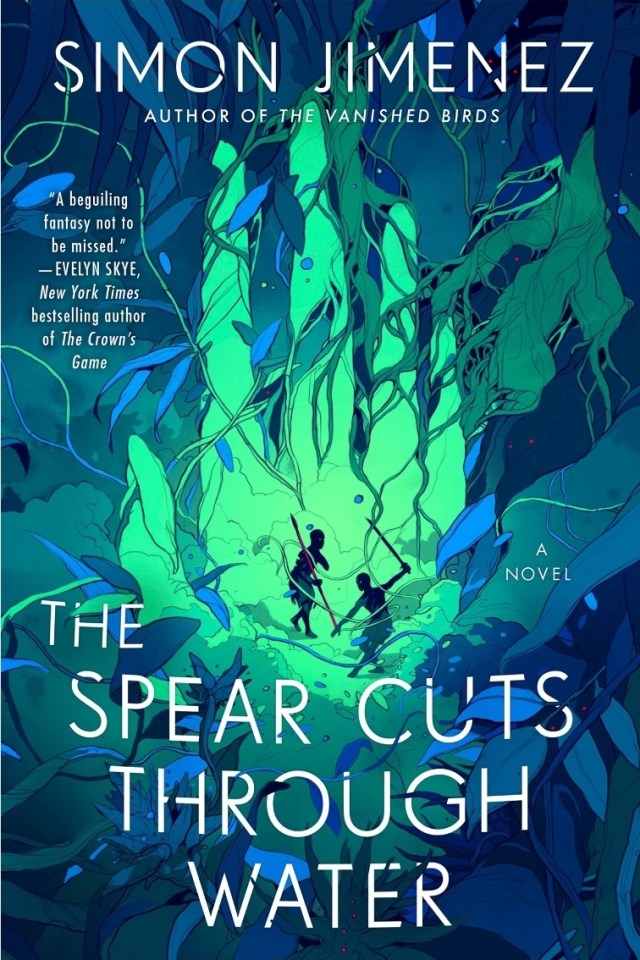
Reading this book is one of the strangest, most fascinating experiences I’ve ever had. It took me ages to finish, because I’ve been pretty busy, and I truly think this book deserves to have hours set aside in your day, so you can read large swaths of the plot in one sitting. It’ll transport you, and it deserves a chance to do so. I think reading it in short spurts just isn’t the way to approach this story, and that’s from personal experience.
First and foremost, the use of perspective in this narration is absolutely incredible. It’s probably the most measured yet fluid version of omniscient POV I’ve ever read. Jimenez flits from voice to voice to yet another voice almost constantly, but in a way that feels both natural and calculated. It takes a while to get used to, and won’t be to everyone’s taste (especially the second-person POV parts), but for me, it really worked. It adds to the narrative structure and the theme of storytelling.
In a way, there are three main levels of narration in this book. First, there’s a young man being told a story aloud by his lola (grandmother) about the history/fables of her homeland. Then, there’s that same young man, watching the story play out on a stage by actors. And finally, there’s the story itself, being related by the characters themselves. At first, I thought of this as three degrees of focus, as if the narration were a camera, zooming in and out on the story from wide angle to closeup. But as the story progresses, even that interpretation was challenged, and I realized that the three “levels” were much more interwoven than I had previously understood. I cannot fathom how Jimenez conceived the idea to write in this way, but I’m so glad he did; the story could have been told in a more traditional way, and I am certain he would have pulled it off amazingly, but it might have lacked this extra richness and depth. Because in a way, this is a story about legacy and heritage, generational trauma and younger people taking lessons from the older ones to create something new. Yet this story is simultaneously about how storytelling can transport you, and how, if a storyteller is good enough, having a tale told to you is nearly the same as having it happen to you. The immediacy of hearing about the events and living them becomes identical, and it’s amazing.
Okay, I could go on and on about the perspective-shifting in this, but that would make this review far too long. Just ask me in person, if you want a really long oration. Oh, but one more thing: this is one of the few books I’ll actually recommend not to engage with via the audio format. The shifting narration was too confusing for me to follow when I started the audiobook, so I had to switch to the print version. Once I did that, though, I was swept away.
Anyway, the incredible use of perspective shifting is complemented by the general tone of the story. It’s a folktale and a historical account, a sweeping epic tale and a family story passed from elder to child. Because of this, it’s very dreamlike yet also visceral at the same time. The settings are vivid, and the action is heart-pounding. A lot of the things that happen are quite violent, not shying away from the realities of cruel people’s actions. Because of these disturbing elements (mostly gore), this is not a book for the faint of heart.
However, if you’re willing to brave the violence, there is a lot of beauty here too, mainly in the bond between Keema and Jun. Sure, they aren’t exactly tender people, and a lot of their interactions aren’t gentle or kind, especially at the beginning, but the ways that they end up being there for each other are really lovely. They’re from such different worlds and are thrown together through insane circumstances, but they find common ground and a connection that’s quite moving. The attraction and yearning between them is of a very physical nature, but with a strong undercurrent of emotion and longing for vulnerability and safety, so it would be very hard not to root for their relationship. There’s a line early on that says “this is a love story, down to its blade-dented bone,” and I think that’s the perfect way to describe it. Many books talk about how love is soft and sweet, but this book reminds us that, at the same time, love is also ferocious and intense.
In the end, I both have a thousand more words to say about The Spear Cuts Through Water, and also zero more because I’m so astounded by it. It is bizarre, but in a good way. The fantasy setting feels unearthly yet simultaneously palpable. It’s a magical land, to be sure, populated by powerful deities and talking tortoises, but also has such a tangible aspect. Its dense jungles, rushing rivers, opulent palaces, and blood-stained roadsides feel real. The characters, and of course the narrative style, along with the intense plot, make this one of the most surreal but stunning books I’ve read all year. I can’t stop thinking about it.
The Spear Cuts Through Water is available now!
 Righter of Words
Pingback: Top 10 Books I Read in 2025 – Righter of Words