
I received an advance reader’s copy (ARC) of The Second Death of Locke by V. L. Bovalino. Since this version is just a proof and not the final version, I won’t quote directly and will keep my comments general.
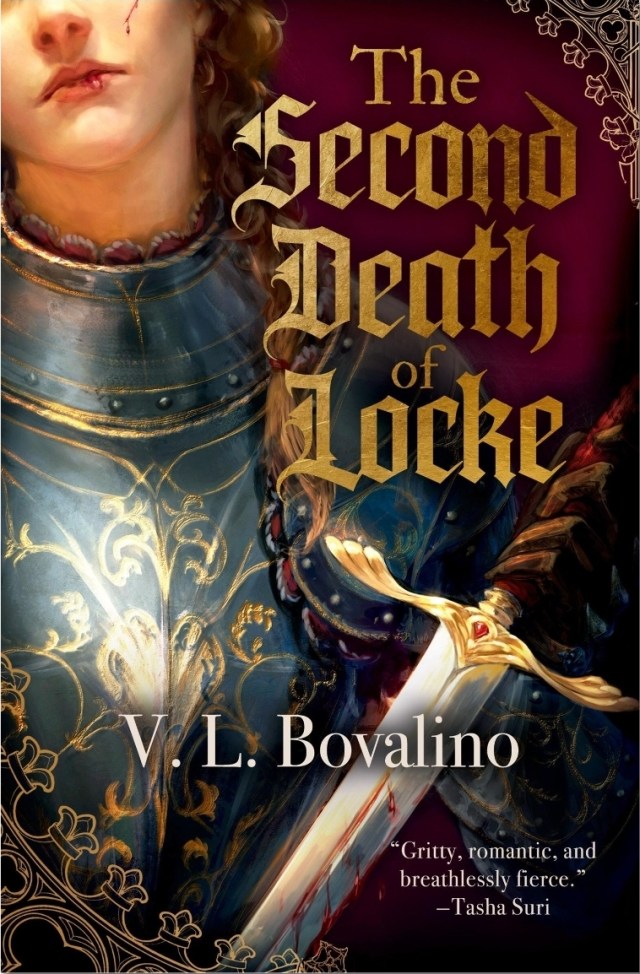
In The Second Death of Locke, Grey Flynn has been fighting in a war for several years now as a well, a channeler of magic power. Every well must work with a mage, a person who can use that magic to affect the world around them. Grey’s mage partner is Kiernan, her closest friend since childhood for whom she’s harbored secret romantic feelings for some time. But war isn’t the place to confess that kind of thing, especially when Grey is often occupied with keeping her real identity a secret. Because the truth is, she’s the last surviving member of the royal family of Locke, an island nation that was destroyed almost two decades prior. So when Grey and Kier are tasked with transporting a political prisoner across the country, Grey worries that entering into her old world of power and wealth will spoil her secret—but perhaps it’s time for that secret to be revealed.
I have a couple more books featuring lady knights on my TBR, and I’m excited to dive into them! Not sure why it’s suddenly a trend this season, but I’m okay with it.
Firstly, I like the relationship between Grey and Kier, which is good since it is the backbone of the whole story. Granted, they lean too far into “I can’t live without you” territory, which in the real world is very unhealthy, but it works for the story well enough (even if sometimes it’s a little tiresome to me). But the best part about them is how affectionate and intimate they are, even before their relationship becomes romantic. You really believe that they’ve known each other since they were very young and know each other better than anyone else. And their casual tenderness and familiarity with each other is very sweet. I actually preferred their relationship before the shift to romantic, because it was a great example of how deep friendship can look. In general, their relationship and the fact that they work so closely together to work magic reminded me of the bond between the Aes Sedai and Warders in the Wheel of Time.
However, I found the plot structure of this book to be a little more difficult to like. The first two-thirds are dedicated to the conflict between nations (or kingdoms, or nation-states, or something like that), then to the transport of Sela, the captured prisoner who is requested by the ruler of Grey and Kier’s nation. It felt like a good medieval-inspired fantasy quest story, but with a lovely casual attitude toward queer identities. The side characters are wonderful, and I loved the scenes that involved the party traveling across the land, gradually getting to know each other better. Even Sela, who has no reason to feel safe at first, opens up and becomes a good addition to their group. This is the best part of the book.
However, I feel like I missed something as we entered the last third or so of the book, because suddenly the story shifted to be more about politicking and the lore of Locke in particular. I don’t think that Grey’s change of heart came across well enough, because to me, it felt like she’d spent a couple hundred pages desperate not to be discovered as a Locke royal, but then suddenly wanted everyone to know. I still am not sure when or why she changed her mind, and I feel like that’s a bad reaction to the protagonist’s character arc.
I also found the magic system and lore of this world to be rather confusing. I mean, wells and mages I understand just fine, but when it came to how Grey’s magic (as the chosen one archetype, because of course) works, I didn’t fully grasp it. That, combined with the rather muddy impression I had of the history and folklore surrounding Locke, made for a confusing few chapters when Kier’s life hangs in the balance. I think there needed to be more depth and explanation about the goddesses and mechanics of the magic for this to make sense, because I felt kind of baffled.
Also, having the book suddenly shift from being a secret identity, quest-across-the-land story to being a more political-powers-fighting-for-dominance power felt strange. I was way less invested in the latter (but that is just my subjective taste), and since Grey and Kier were so caught up with it, I became less invested in their relationship as a whole. I think some people will still be riveted by the story, but by the end, I wasn’t one of them.
In the end, The Second Death of Locke was fine. The characters are excellent, and the magic system is definitely intriguing. The plot structure and lore leaves something to be desired, though, and I felt that the former could have been paced differently and the latter given a lot more detail. However if you like a medieval Europe–inspired setting with a queer-normative society, and a childhood-friends-to-lovers through-line, you’ll probably like this!
The Second Death of Locke is available as of today, September 23rd!
 Righter of Words