
I received an advance reader’s copy (ARC) of The Isle in the Silver Sea by Tasha Suri. Since this version is just a proof and not the final version, I won’t quote directly and will keep my comments general.
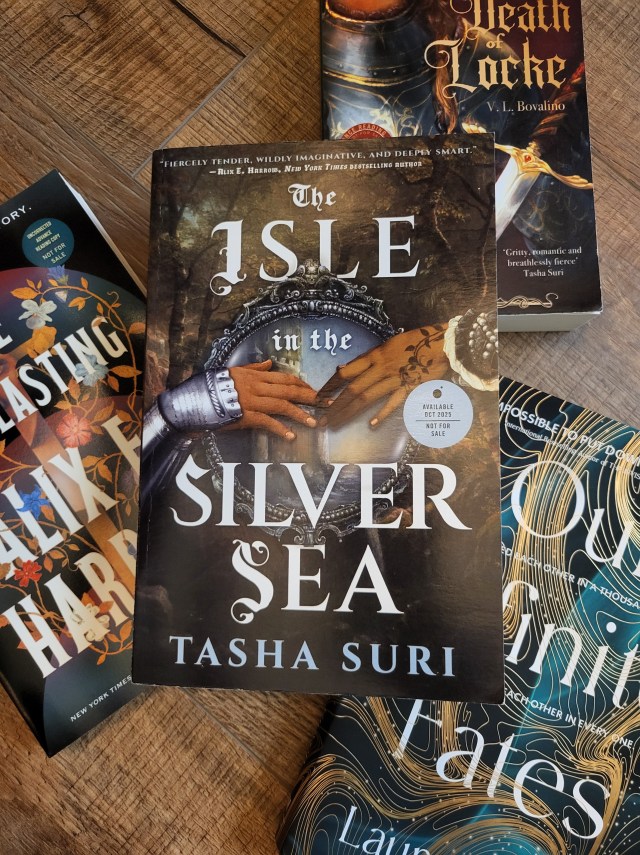
In The Isle in the Silver Sea, Simran is a witch, distrusted by many in Britain due to this and to her Elsewhere heritage (i.e., she’s a non-white immigrant). However, her magic is powerful, and moreover, she’s an Incarnate, one of the people fated to be reborn endlessly, living out the same tale over and over in order to power the Isle. Her counterpart in this tale is Vina, a knight of the realm, who is destined to kill Simran, but only after they fall in love. As they start to do so again in this life, though, they start to wonder if there’s a way to break the cycle. To make matters worse, a mysterious assassin—who seems to be immortal—is targeting Incarnates, and Simran and Vina might be next… unless they can discover the truth of the Isle, and perhaps find a way to free themselves from their fate.
Apparently, lady knights are a small trend in books this year, because this is the third one I’ve read in recent months (and I have another one lined up soon, which I’m super excited for). I guess Chappell Roan’s VMA performance of “Good Luck, Babe” is my new favorite aesthetic.
Anyway, this book was an intriguing idea, but unfortunately, I think the execution of the concept could have been better. For basically the first half of this book, I felt very confused by the worldbuilding. I comprehended the events as they occurred, but not why they were occurring. For example, I never really understood (and I don’t think I missed it; I just think it was never fully explained) why only certain people are Incarnates. Does that mean that everyone else just lives once and isn’t reincarnated? What happens to those people when they die? Do they go to the afterlife, a place from which Incarnates are forever barred? Furthermore, the Incarnate ghosts that Vina and Simran frequently saw (echoes of their past selves whom they could interact with in dreamlike sequences) were strange. I didn’t quite understand how that was happening, or why, or if they are the only Incarnates to experience this. In short, the worldbuilding was pretty lacking and I felt like I was piecing things together as I went along.
Another thing I found confusing was the time period this was supposed to take place. A lot of it feels very medieval (knights on horseback, no electronics, etc.), but so much of the terminology used feels way more modern. Characters are described as “queer” and “trans” which, while those concepts certainly existed in the medieval period, those terms didn’t exist for those identities until much more recently. And then Suri also loves to use the term “wroth” for “angry,” which appears to be an archaic English word. Was this done simply to confuse me further?
And finally in my list of critiques is that the romance felt underdeveloped. I understand on a surface level that, in a way, Simran and Vina have fallen in love and died for each other many times over their various lives, but I didn’t truly feel that. I think it would have been better to see more flashbacks of their previous lives, and for them to have more interactions in the present, to give a strong foundation to their love. As it was, I didn’t feel invested in them as much as I was clearly supposed to. They’ve known each other for, what, barely a week? How are they already so deeply in love?
I was determined to not let all this get the better of me, though, so I pushed through. And I did find the last part of the book pretty engaging and exciting, if quite rushed. I really wanted more interactions between Vina, Hari, and Galath, and had this portion of the story taken more time to be developed, I think that Vina’s and Simran’s reunion would have been much more impactful. This just feels like too much story to have been a standalone; it should have been a duology (and this is coming from someone who loves standalones). That said, the conclusion was pretty tense and intriguing.
In the end, I wanted to love The Isle in the Silver Sea but was somewhat disappointed. There’s a lot of great ideas and intriguing elements, but they were presented in a much too confusing manner. Coupled with an underdeveloped romance, this plot was less investing than it should have been. I liked lots of the characters, though, and some action scenes were pretty good. I think this book will definitely find its audience, though, as romantic fantasy (especially with queer main characters) is quite popular at the moment. It just fell short for me. However, I’m not opposed to reading more of Suri’s work in the future, as I’ve heard good things about The Jasmine Throne!
The Isle in the Silver Sea will be published on October 21st, 2025!
 Righter of Words