How in the world am I supposed to write this review? What can I possibly say about this novel that hasn’t already been said by others, many times? After all, I’m far from the only person who adores this book; there’s little chance anything I say here will be a new or groundbreaking insight. But it’s one of my favorite works of fiction of all time, so I might as well try.
This will be less a review, and more a love letter, in a way.
Frankenstein by Mary Shelley… does it really need a summary? I guess I’ll do it anyway. This novel follows the titular Victor Frankenstein as he starts his studies at Ingolstadt, researching natural philosophy. He becomes fascinated with the idea of defeating death, and constructs a humanoid form from body parts. When his attempt works, however, he is horrified and flees. Then, even as he tries to resume a normal life, he is haunted and hunted by his creation, who insists that he deserves Victor’s attention and help. And when he receives neither, he turns his sights on Victor’s loved ones, and Victor must grapple with the consequences of what he’s done, and what he’s driven this being to become.
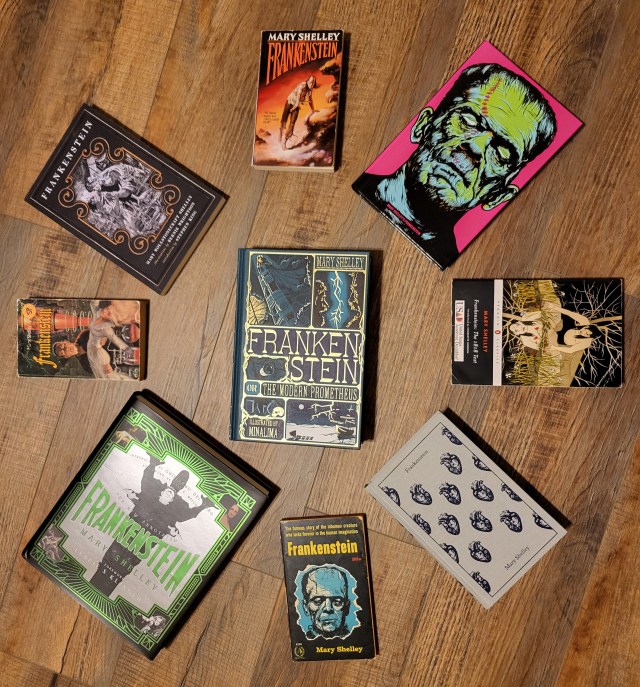
In senior year of high school, when it was assigned reading for my English class, Frankenstein grabbed me (by the hand? The heart? Maybe even the throat?) and it has yet to let me go. Perhaps the grip has slackened from time to time, while I became preoccupied or distracted by other pieces of media. But it’s still always been there, holding on. I even still own the little mass market edition that I first read in that senior year class, tucked among the other editions I’ve acquired over subsequent years. It’s been in my possession for almost half my life now, which is a wild thought. I bet Mary Shelley, at age 19, never dreamed her story would still be so beloved over two centuries later.
But of course it is—Frankenstein is about many things that are still, and likely will always be, relevant to the human condition. What makes someone human? And on the flip side of the coin, what makes someone a monster? Where is that line drawn? What do we owe to our fellow living beings? How does being responsible for another person affect our lives, and how do we take accountability for our actions?
Further, the time in which Mary Shelley wrote her story and the time we’re living in now bear several similarities: bizarre climate conditions and anxiety about advancements in technology to name the most obvious two. Her era was a time of rapid change, and to me that’s why her novel resonates so strongly for us in 2025.
It’s also just a really captivating story.
Victor Frankenstein is a fantastic protagonist. Sure, he’s full of hubris and makes mistake after mistake, and he isn’t exactly what you’d call likeable (he’s way too self-pitying for that). However, his desire to learn isn’t in itself something to look down on, necessarily. It’s the way he chooses to use his drive, and the way he rejects the very creation his work results in, that make him into an antihero-like, near-villanous figure. It’s basically cliché at this point to say that Frankenstein isn’t the monster, but Frankenstein is the monster. However, to me, that is a simplistic interpretation. Victor makes monstrous choices, but as Mary Shelley wants us to wonder, does that make him a monster, or only human? Is he to be pitied?
Maybe a little, but maybe not. Mostly, Victor makes you think, and that’s his best attribute (even if it’s not deliberate on his part).
And as for the Creature, his parts of the narrative are, and always have been, my favorite parts of the story. It’s easy to feel sympathy and even protectiveness toward him at the beginning, since he’s treated so unfairly by the world and genuinely seems full of such innocence at the start. The scenes at the DeLaceys’ farm, where he is treated with kindness, are incredible—even if they’re bittersweet because you know they’re fleeting. And I love how much personality the Creature has, how intelligent and insightful he is. His shift to a more vengeful mindset is devastating, but paced so well that it feels natural.
And, of course, everything about him and Victor both brings up questions regarding the concept of nature vs. nurture, of the inherent goodness or vileness of sentient beings. Nothing is straightforward, nothing is black and white in this novel. Victor and the Creature are both such flawed beings, trapped in a tragic, doomed cycle of harming each other. It’s such a compelling relationship between the two of them, and (obviously) I’m obsessed.
There are, admittedly, some parts of the book that aren’t as interesting to me, such as Victor’s time in England and the fallout of his choices in Scotland, namely more death. (I don’t know why I’m dancing around specifics, considering how old this book is. I guess I’m just in the habit of avoiding spoilers when I write about books here.) Basically, Clerval deserved better.
But even with that, Frankenstein still is one of the best books I’ve ever read (obviously). I don’t really know what else to say. I mean, okay, realistically I could have several thousand more words to say, but I won’t. From the themes to the characters to some of the imagery (the confrontation on the glacier especially sticks out in my mind), it’s clear why this book is widely regarded as Mary Shelley’s magnum opus, a masterpiece, and one of the foundational works of Gothic literature and speculative/science fiction. It’s magnificent. It’s thought-provoking. And even though it’s old, it’s still very much alive.
And as for me, this is where I’m at in life…
Me, contemplating my Frankenstein shelf: Oh, no, you guys. Do you think I own too many editions of this book?
My good friend Katherine from afar, probably: I don’t think so!
Me: Me neither!
 Righter of Words
Pingback: Top 10 Books I Read in 2025 – Righter of Words