
Firstly, wow that’s a good title for this.
If Looks Could Kill by Julie Berry pits Medusa from Greek mythology against the Whitechapel murderer, Jack the Ripper. However, meanwhile in New York City, a young woman called Tabitha is working with the Salvation Army, and has been teamed up with a rather annoying partner, Pearl. Their views don’t always align, nor do their methods when it comes to bringing people to religion. But when they realize a young woman they spoke to days before has found herself under control of a pimp, they feel responsible for helping her. Their search for her has unintended consequences, however, as impossible supernatural things start to occur. And all the while, on the fringes of Tabitha’s and Pearl’s world, Jack the Ripper flees London after a bizarre encounter with a magical, threatening being. But New York City might not prove safe even for one as ruthless as him.
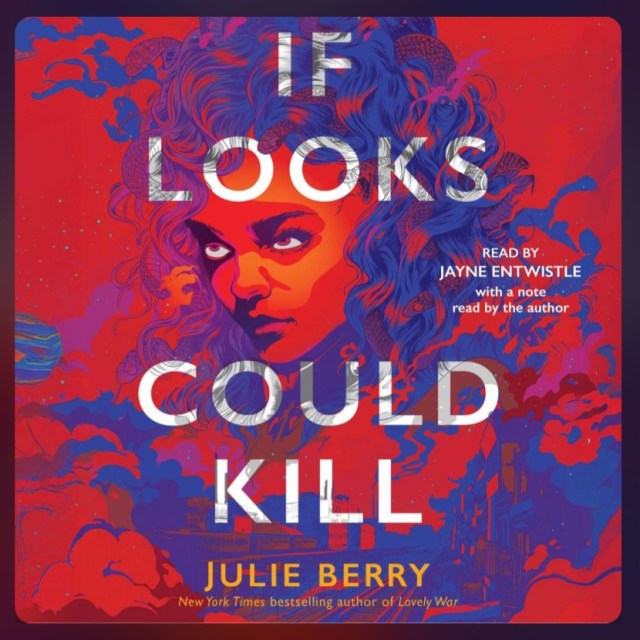
When I heard the basic premise (Medusa vs. Jack the Ripper), I was extremely intrigued. After all, many modern takes on the former myth interpret it as empowering, and give Medusa more dignity and sympathy, often viewing her as a representation of the righteous anger of victimized women. This is a fantastic interpretation, and I can see how it would be interesting when pitted against a murderer like the Whitechapel killer, whose victims were all women.
Granted, I have lots of thoughts about “Jack the Ripper” and his identity. Due to numerous factors, there’s only circumstantial evidence, no matter what suspect one considers. Based on that, it’s somewhat futile to speculate who was responsible—if it was even a single perpetrator at all. And while Barry does put forth an intriguing possibility as to the killer’s identity, I have to ask myself a specific question: why is it even Jack the Ripper in this book?
While reading this, I was continually a little baffled about why the featured murderer/predatory male figure was the Ripper. The actual plot takes place in New York City, so for at least two-thirds of this book, Jack’s activities were entirely divorced from the main story. And for me, the two elements—Tabitha’s situation and Jack’s movements—didn’t mesh or complement one another at all. In fact, I feel that overall, Jack either needed to be entirely removed from the book, or be way more of a character. I wonder if this story should have been set in London instead, or to have it feature an entirely fictional New York serial killer. As it was, having Jack as a character didn’t make much sense.
That is, until I read the author’s note at the end. Berry delves into her research and reasoning behind her version of the Ripper, and once I learned more about the real life suspect her character is based upon, it made a bit more sense why the story was set in New York. However, while I appreciate the attention to detail (it’s clear she conducted extensive research), it shouldn’t have taken the author’s note after the story concluded for me to understand some of the narrative choices. If anything, she could have diverged from history and brought “Jack” to New York sooner, so that he could impact the plot earlier. No one would have known any different, because very few people know about the real-life suspect she chose to focus on/fictionalize. Writers of historical fiction are allowed to tweak things for the sake of the story, and I wish that Berry had done so a bit more.
And as for the Medusa elements, I thought they were interesting, but not really explored to their fullest. I didn’t quite understand what the gorgons’ powers were, as Berry did slightly alter the mythological convention. And also, I think there was just too much going on, between the Salvation Army stuff, the interpersonal drama between Tabitha and Pearl, and the search for the young sex worker, to lend the Medusa side of things as much time and weight as it merited. I just really wanted that to be more of a focus, and how those abilities could be turned toward the defense of women and the defeat of a murderer who specifically targets them. Instead, what felt like half of the book was devoted to the aforementioned other plot elements, and I found myself tapping my fingers waiting for Medusa to matter.
On another note, less important to the story itself, but this is the first time in a long time that an audiobook has been a real struggle for me. The narrator, Jayne Entwistle, generally does a passable job, except in regards to her American accent. She has that issue that some British people have when using an American accent, where all her words sound extra nasally and stilted. Her textbook-precise American English isn’t wrong, technically, but it has no personality or regional distinctiveness. In other words, her Tabitha sounds like no American ever, and it was pretty distracting. That said, Entwistle is not bad overall, and I mean no offense to her.
But in the end, If Looks Could Kill was rather disappointing for me. There was so much potential in this story, but nothing felt as if it quite delivered on what it promised. The characters were okay, and I liked the romantic subplot between Tabitha and Mike, but the conflict felt messily constructed. There was too much going on. And I’m still bummed by how Jack the Ripper was handled, as this could have been such a cool element of the story. Berry clearly is clever and has lots of good ideas, but this could have been two entirely separate books: one book about Medusa-like women in New York getting justice for their fellow victimized and abused women, and one book about a man who could have been Jack the Ripper. Or, this book needed a major overhaul and subsequent draft. However, lovers of Greek mythology and/or true crime will likely still find something enjoyable in this.
If Looks Could Kill is available now!
 Righter of Words