
Why did I wait so long to read this?! The world might never know.
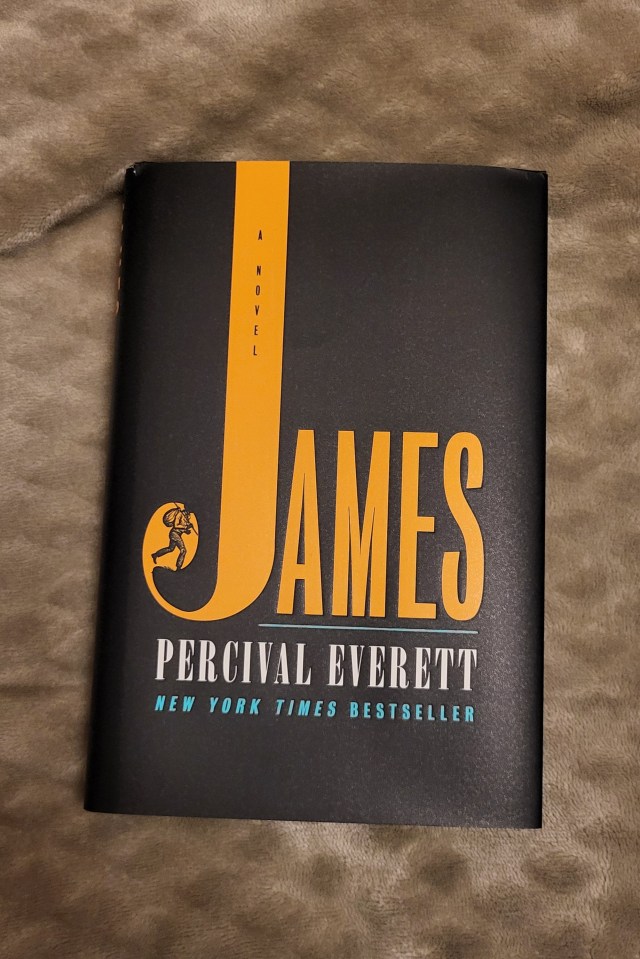
James by Percival Everett, a retelling of Adventures of Huckleberry Finn, follows an enslaved man called Jim. When he learns that he is to be sold and thus separated from his wife and daughter, he decides to flee instead, in the hopes that he can come back for them someday and they can make their way to somewhere safer. As he’s leaving, he finds young Huck Finn, who’s fleeing his abusive father. Together, they set off on the Mississippi River, and their journey will take them far from the familiar, and force them to confront truths about themselves and each other.
This book has been on my shelf for over a year, staring me down. I read Erasure by Everett years ago in college (more on that later) and so have known that he’s a brilliant writer, so I’m not sure why I procrastinated getting to this one. However, I now can gladly say it’s absolutely worth the hype, the glowing reviews, and the awards!
Looking back, I’m certain that I read Huck Finn in high school, yet I’d be hard-pressed to tell you anything that happened in it, beyond “kid and man on a raft on the Mississippi.” Luckily, one doesn’t have to be familiar with the source material to follow this story, and in fact, I feel that this would be an excellent—necessary, in fact—book to assign alongside Huck Finn in school. Of course, James would have to be read second, because I can’t imagine going from James to Huck Finn; talk about a downgrade in quality. Yeah, I said it. Twain is far inferior to Everett. Anyway, I wonder if it actually works better to read this with very little knowledge of Huck Finn, as then you won’t be able to predict anything that happens at all. That way, there would be an added layer of suspense that might be missing if you knew the source material very well. Who knows.
Beyond the source material, I feel that this book very much plays to Everett’s strengths, as far as I can tell. For me, James almost acts as Erasure’s spiritual successor, its sibling, its conversation partner. Both books, after all, deal with code-switching, with the perception of blackness by white people, and with examining literature. In Erasure, we satirized the publishing industry, and here in James, we directly tackle and retell a “classic” piece of literature. The themes and content of the two novels complement each other very well, in my opinion.
But also on its own, James is an incredibly strong novel. Everett finds a wonderfully distinctive voice for his protagonist, giving him dignity and depth that Twain never did for the prototype. Jim (or James as he comes to prefer) is an amazing man, easy to sympathize with as he grapples with the awful circumstances he’s in, and with the myriad difficulties he faces over the course of the story. His character development is paced well and makes perfect sense, so that you’re behind him even when he makes morally questionable choices. And his bond with Huck is fantastic—it’s complex and messy and affectionate and frustrated in equal measure. I love the alterations Everett made to the original relationship, as they serve the themes of this book perfectly. And the plot is completely propulsive; every twist and turn of the river brought me another reason to stop and say “wow.”
Another brilliant element is absolutely the way language functions in this story. To portray the enslaved people as being able to speak as well, often better, than the white slavers, is as incredible as it is devastating. That they might be clinging to any small way to rebel or feel human, even if it means allowing the whites to believe them stupid, is a masterstroke on Everett’s part. If I had energy or time, I’d try to harness my old English major skills and write an essay on the role of language and code-switching as a means of survival and maintaining dignity in this novel… but I don’t think I have the energy or time, alas.
The point is, James is as fantastic a novel as I hoped it would be. It straddles the line between being funny and utterly crushing. It’s complex and thought-provoking, yet written in a style that’s accessible to non–literature majors. Also, I listened to the audiobook (narrated flawlessly by Dominic Hoffman) and read along with the physical book, and the immersion in the story was… honestly, a lot sometimes. It’s not an easy read, but that’s okay; it shouldn’t be easy. Everett has knocked it out of the park, as I knew he would. Everyone should read this.
 Righter of Words
I got to lead a Book Club Discussion about this book. I knew the author was talented, but this is one of the best books I’ve ever read, and it’s an amazing retelling! My favorite part of the novel is how Everett maintained Twain’s dark humor and transcend it slowly into his style.
LikeLiked by 1 person