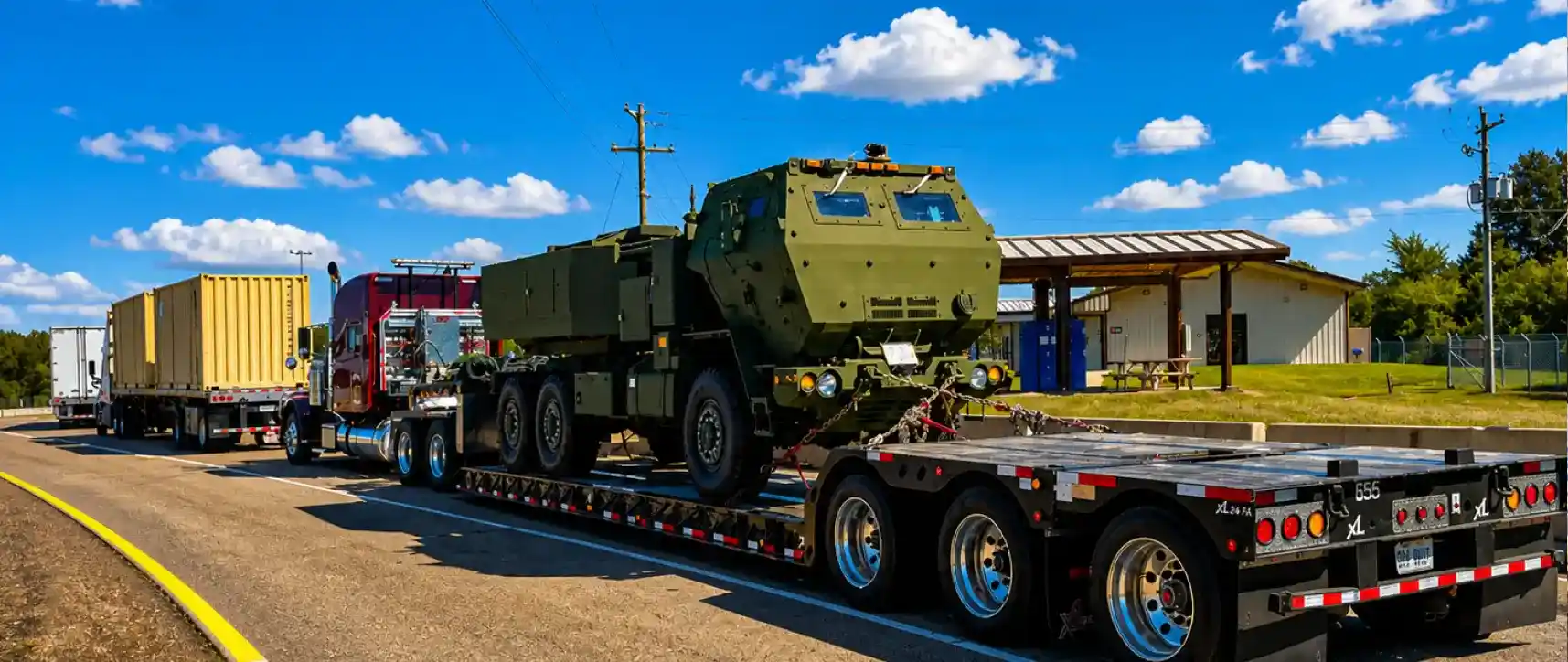
Project cargo is the ultimate high-stakes challenge in logistics. When moving assets that defy standard trailer dimensions—such as industrial turbines, bridge sections, or modular infrastructure—you aren’t just moving freight. You are managing a mobile, multi-jurisdictional construction project where one oversight can halt operations for days. The difference between a successful delivery and a costly project delay lies in the planning. Here is the blueprint for how complex heavy haul operations are engineered.
Phase 1: Route Engineering and Feasibility
 Before a truck is assigned, the logistics team conducts an exhaustive feasibility study. This is not a task for standard GPS; it is an engineering audit.
- Structural Integrity: Engineers map the route against bridge and pavement weight ratings. It is not enough to know your total weight; you must verify that every bridge on the route can handle the specific axle load distribution.
- Clearance Audits: Overhead obstructions are the primary enemy of oversize loads. Teams must identify power lines, traffic signals, and bridge clearances that may require temporary lifting or removal.
- Turning Geometry: Massive loads are not maneuverable. Logistics planners use simulation software to analyze every intersection. If a 150-foot trailer cannot navigate a turn, the route must be re-engineered—sometimes requiring the removal of guardrails or the temporary widening of shoulders.
Phase 2: Mastering the Regulatory Landscape
Equipment is secondary to compliance. You can have the most advanced fleet in the world, but if your paperwork isn’t airtight, you are effectively grounded.
Navigating the web of state, county, and municipal regulations is an administrative marathon. For every jurisdiction your load touches, you must secure a specific oversize load permit. In states with vast industrial corridors and complex permitting frameworks, Titan Worldwide Logistics’ specialized Texas heavy-haul trucking services demonstrate how deep regulatory expertise can streamline this process. This ensures that project cargo moves through one of the nation’s most freight-intensive states without costly compliance delays.
This process involves:
- Weight Declarations: Precise reporting of axle weights to ensure they fall within the specific tolerances of every road segment.
- Time and Window Management: Many jurisdictions prohibit oversize loads at night or during peak traffic. Planners must weave these restrictions into a master schedule that keeps the load moving legally.
- Safety Coordination: The nature of the cargo dictates the requirements. Planning includes determining if you need pilot cars, rear-end escorts, or official police assistance to manage traffic flow.
Phase 3: Operational Synchronization
Once the route is engineered and permits are issued, the “operational sync” begins. This is where logistical planning transforms into field action.
Transporting project cargo is a team sport. Success requires total alignment between the driver, pilot cars, and support crews. If pilot cars arrive on the scene but the utility crew responsible for lifting a power line is delayed by two hours, your entire convoy sits idle, hemorrhaging money. Logistics planning ensures that every stakeholder is synchronized to a precise arrival window.
Phase 4: Agile Pivot Strategies
Even the best plans meet the reality of the road. Road construction, unexpected accidents, or extreme weather can turn a primary route into a dead end overnight.
Professional logistics teams operate with an “agile pivot” mindset. They maintain pre-cleared alternate routes and have an administrative infrastructure capable of modifying and reissuing permits on the fly. You cannot simply “drive around” a closure; you must have the legal authority to deviate. Having the administrative agility to update compliance in real-time is what separates a professional operation from an amateur one.
Phase 5: Post-Transport Audit
The work does not end when the cargo is offloaded. The final phase is the post-transport audit. After every project, successful teams review the data:
- Did we encounter road conditions that were not on the survey?
- How did actual transit times compare to estimates?
- Were there any regulatory hurdles at the county lines?
This documentation is the foundation for future efficiency. By learning from the nuances of every move, logistics teams turn high-risk challenges into streamlined, repeatable processes.
The Bottom Line
In project cargo, horsepower is the cheapest asset in the chain. The real value is in the intellectual capital—the engineers who verify the bridges, the permit agents who navigate the bureaucracy, and the dispatchers who synchronize the convoy.
If your planning is reactive, your project is vulnerable. But when planning is treated with the same engineering rigor as the load itself, even the most massive, complex cargo can be moved with predictable, disciplined precision.