–
The gap between Naples and Positano measures about 34 miles by road — a distance that looks trivial on a map and behaves nothing like it on the ground. What actually decides how the day goes is a small set of variables: how much luggage you are moving, what time you land or arrive at the station, what month it is, and whether anything at the Positano end is booked to a fixed hour. Get those four right and the corridor becomes one of the most enjoyable stretches of travel in Italy.
Quick answer: if you are carrying luggage, arriving early, or travelling as a family or a group, a pre-booked private car door-to-door removes most of the friction. Travelling light, in season, and want the coast from sea level? Take the hydrofoil. If the fare matters more than the clock, train plus bus works. Mileage is not the difficult part of this route.
Route listings put the straight-line distance between the two at 31 miles and the road distance at 34 miles. In practice the corridor has three distinct personalities: the exit from the Naples basin, the crossing of the Sorrento peninsula, and then the road cut into the cliffs above the water. Treat the transfer as dead time and it becomes the least pleasant part of the trip. Treat it as part of the itinerary — with a real buffer and one or two deliberate stops — and the whole day changes shape.
One corridor, two very different arrival problems
Naples is dense, loud and improvisational; Positano is vertical, a village stacked on a slope where the gap between the nearest legal stopping point and the door of your room can involve several flights of steps. Between them sits the peninsula that separates the Bay of Naples from the Gulf of Salerno.
That geography explains most of the logistics. The reason the drive is spectacular is the same reason it is slow, and the reason Positano photographs so well is the same reason its final stretch can be awkward with suitcases. A plan that ignores the terrain tends to get rebuilt on arrival, in the street, with bags in hand.
Your realistic options, and who each one fits
Route comparisons for this journey describe four ways to make it — ferry, train plus bus, car, or taxi. For planning purposes those collapse into three decisions, and the decision depends less on headline price than on how much friction your group can absorb on the day.
- Choose the ferry if you are travelling light, moving in season, and want the coastline from the water.
- Choose train plus bus if the fare is the priority, your luggage is minimal and your arrival time is flexible.
- Choose a private car if you have an early flight or train, children, heavy bags, a tight schedule, or enough people to split one vehicle.
That third case is where door-to-door service earns its cost, and it helps to look at how one such offer is actually structured rather than at the category in the abstract. As a published example, Sorrento Limo Car Service lists a Naples–Positano private transfer from €140, with a stated ride duration of approximately 1 hour 20 minutes in regular traffic conditions, pickup from Naples Capodichino airport, Napoli Centrale station or a Naples hotel, a private car or minivan with an English-speaking driver, taxes, tolls and parking fees included, a maximum group size of 16, and optional add-ons on request such as infant seats and stops en route. Those figures describe that specific offer. Duration, inclusions and capacity vary from one listing to another, so confirm yours in writing before you pay.
The ferry: coastline at sea level, with a seasonal catch
Sailings between Naples and Positano are operated by NLG, Positano Jet and Alicost. Fares on the route start from around $34, and high-speed departures from Molo Beverello appear from €30–€34 depending on the sailing and the operator. In season, frequency is generous: current listings show around 52 weekly sailings.
Crossing times need care, because published durations vary widely. One route listing gives about 1 hour 35 minutes as the typical crossing time; another describes a direct Naples Beverello to Port of Positano service, twice daily, with a journey time of roughly 35 minutes. Treat published durations as sailing-specific: verify the exact departure you book, and confirm the pier.
The calendar matters as much as the clock. From the end of October to the beginning of April there is only one crossing each day on this route, with more frequent trips through the summer. The arrival point is also exposed — the ferry dock at Positano can close for a day when weather conditions turn. One crossing per day plus one closure equals no crossing at all, which is why a sea-based plan needs a land-based fallback decided in advance rather than improvised at the ticket window.
Train plus bus: lowest fare, longest chain
The cheapest combination on this corridor is a regional train followed by a bus, estimated at about 2 hours 32 minutes for $8–12. For one traveller with one backpack and a free afternoon, that is a sensible trade. With two suitcases, a stroller, or a check-in window to hit, the calculation shifts: you are managing a connection, luggage and crowding on a narrow coastal road, and the quoted time assumes the connection behaves.
Taxi and ride-hailing: the unstructured version
A taxi does much the same job as a booked transfer, without the fixed terms agreed beforehand. Estimates for a Naples–Positano taxi put the drive at about 58 minutes and $440–550 — an indication of how a one-way city-to-coast ride can be priced when it is arranged on the spot rather than agreed in advance.
As for ride-hailing apps, the cautious planning position is not to build an arrival around summoning a car in Positano. Positano's Limited Traffic Zone covers most of the town centre and its main access roads and is generally active 24 hours a day, with certain exceptions — residents, service vehicles, taxis, emergency services. A town with that kind of access framework, on a cliff, is not the place to test app availability late at night.
The road itself, before you decide to drive it
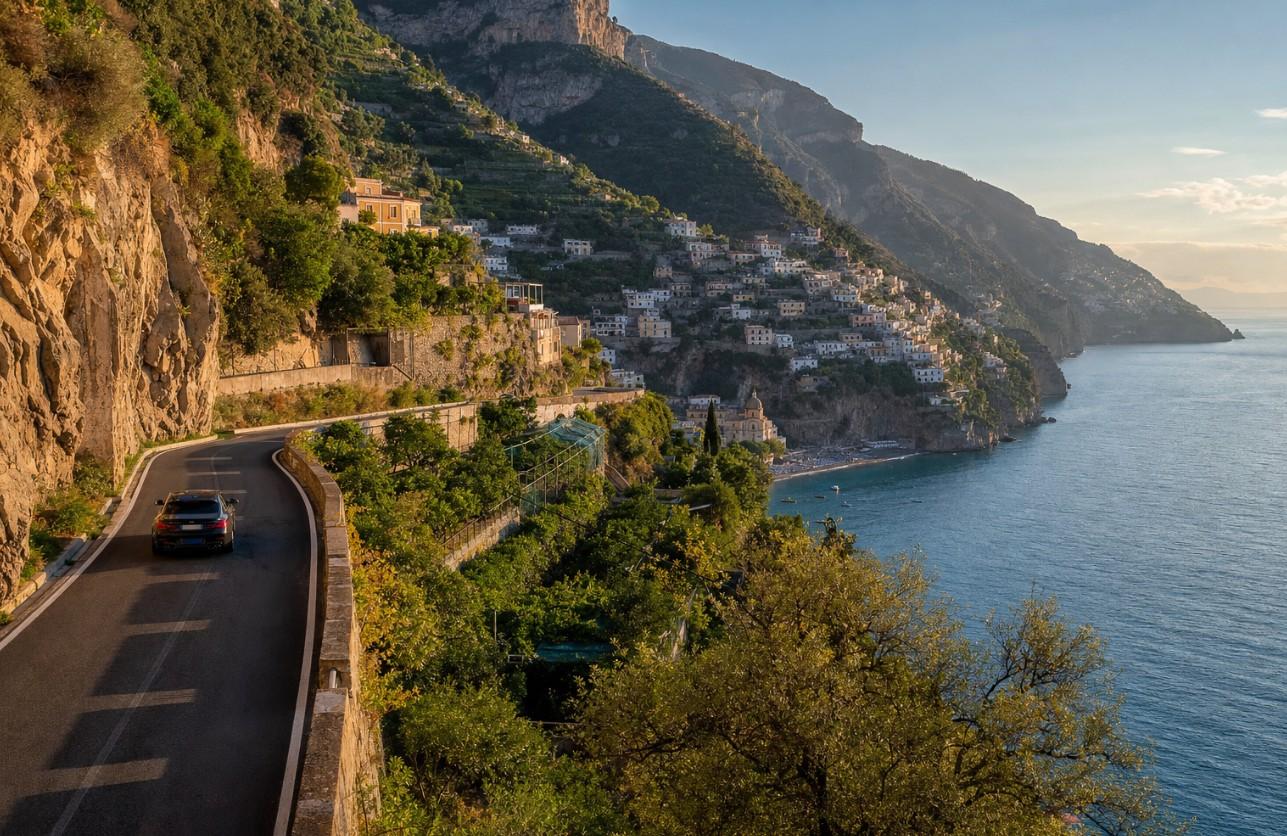
Anyone weighing a rental car should understand what the coast road is. The SS163 is narrow, busy and full of blind bends. Seasonal restrictions can apply, including alternated number-plate rules, and restricted-zone infringements can generate fines that arrive in the post months after the holiday has ended. It is a remarkable piece of engineering and a demanding drive.
None of that makes driving impossible. It does mean the person at the wheel spends the journey watching the road rather than the view — a strange outcome on a route whose whole appeal is the view. If the scenery is the reason you chose the road over the sea, decide who in your party is actually going to see it.
Timing: build the buffer before you need it
Traffic on a two-lane coastal road is harder to forecast than motorway traffic, and any quoted duration describes a stated traffic assumption rather than every possible condition. Two habits help more than any shortcut.
First, leave earlier than the arithmetic suggests. If something at the Positano end is timed — a boat departure, a table with a view, a property with a hard check-in cutoff — add a real margin on top of the quoted duration instead of treating that duration as a promise. Second, decide in advance what happens if the margin disappears: who you will call, and whether your accommodation can hold the booking. That single decision is worth more than an optimistic schedule.
Stops that improve the route without consuming the day
The temptation is to chase every panorama. A more workable approach is one substantial stop and one short one, agreed before departure rather than negotiated en route.
- One site visit. The corridor passes within reach of Pompeii, Herculaneum and Vesuvius, and some transfer offers formalise this. One published example lists a Naples transfer with a Pompeii tour from €200, with an approximate duration of four hours and an English-speaking driver, taxes, tolls, fuel and parking included — a useful benchmark for how much time a genuine site visit adds to a transfer day.
- One short viewpoint stop. Ten minutes, agreed at booking, rather than fifteen improvised requests along the way.
- Luggage changes the exercise. Stopping at an archaeological site with suitcases in the vehicle is not the same as stopping on a day tour. If you want a stop en route, confirm that the offer permits stops, at what cost, and what happens to the bags. In the example above, stops and infant seats appear as optional add-ons on request — exactly the sort of item to settle before departure.
Driver or guide? A distinction worth clarifying
A transfer with an en-route stop is not the same product as a guided visit. A driver may bring you to a site and wait; commentary inside the site and guided access are a separate, separately licensed service. If you want somebody to explain what you are looking at in Pompeii, ask explicitly whether a licensed guide forms part of the offer you are buying, rather than assuming it arrives with the vehicle.
Arriving in Positano: the last stretch
This is where self-drive plans tend to unravel. Beyond the traffic-zone framework already described, parking is the second constraint: typical private garage parking in Positano during peak periods has been reported in the range of €35–€60 per 24 hours, with variation by location and season. Add three days of a rental car sitting unused in a town explored largely on foot and by boat, and the arithmetic frequently favours arriving without a vehicle at all.
Then there are the steps. The walk from a legal stopping point to your door can involve stairs, and how many depends entirely on where you are staying. Two questions to your accommodation before arrival remove most of the improvisation: exactly where can a vehicle stop, and can a porter be arranged for the bags?
Q&A: how long, and how much
How long does it take? By road, one private transfer offer states approximately 1 hour 20 minutes in regular traffic conditions, and a taxi estimate puts the drive at about 58 minutes. By sea, one route listing gives around 1 hour 35 minutes as a typical crossing time, while another cites roughly 35 minutes for a direct Beverello–Positano service. These are examples attached to specific offers and sailings — verify the one you book.
How much does it cost? Ferry fares appear from $34 on the route, and from €30–€34 for high-speed departures from Molo Beverello. Train plus bus is estimated at $8–12. A taxi is estimated at $440–550. One private transfer example is published from €140, and the same operator lists a Naples transfer with a Pompeii tour from €200. All of these are starting points tied to particular offers, not market rates.
Common mistakes on this route
- Planning a winter or shoulder-season arrival around a ferry without checking frequency — a single daily crossing leaves no margin for a weather closure.
- Renting a car for a Positano stay before pricing the traffic restrictions, the garage and the stairs.
- Scheduling a boat tour or a lunch reservation thirty minutes after a quoted arrival time.
- Comparing a per-person ferry fare with a per-vehicle car fare, and drawing the wrong conclusion.
- Assuming the driver is also a licensed guide.
Six things to settle before you book
- Duration and route: what duration does the offer state, under what traffic assumption, and are stops en route permitted?
- Capacity: how many passengers and how many bags does the stated vehicle take, and what is the maximum capacity?
- Inclusions: what exactly sits inside the quoted price — taxes, tolls, parking, waiting time?
- Extras: child or infant seats, additional stops, oversized luggage — confirmed in writing, with the cost attached.
- Conditions: cancellation terms, delay and waiting policy, payment method, and what happens if a ferry you were counting on does not sail.
- The last stretch: the precise pickup address in Naples and, at the other end, where a vehicle can legally stop in Positano and whether a porter can be arranged.
Answer those six and the corridor stops being a logistics problem. What remains is a stretch of coastline that earns its reputation, ending in a village built into a cliff — and the difference between enduring the road and enjoying it comes down almost entirely to decisions made before you leave Naples.