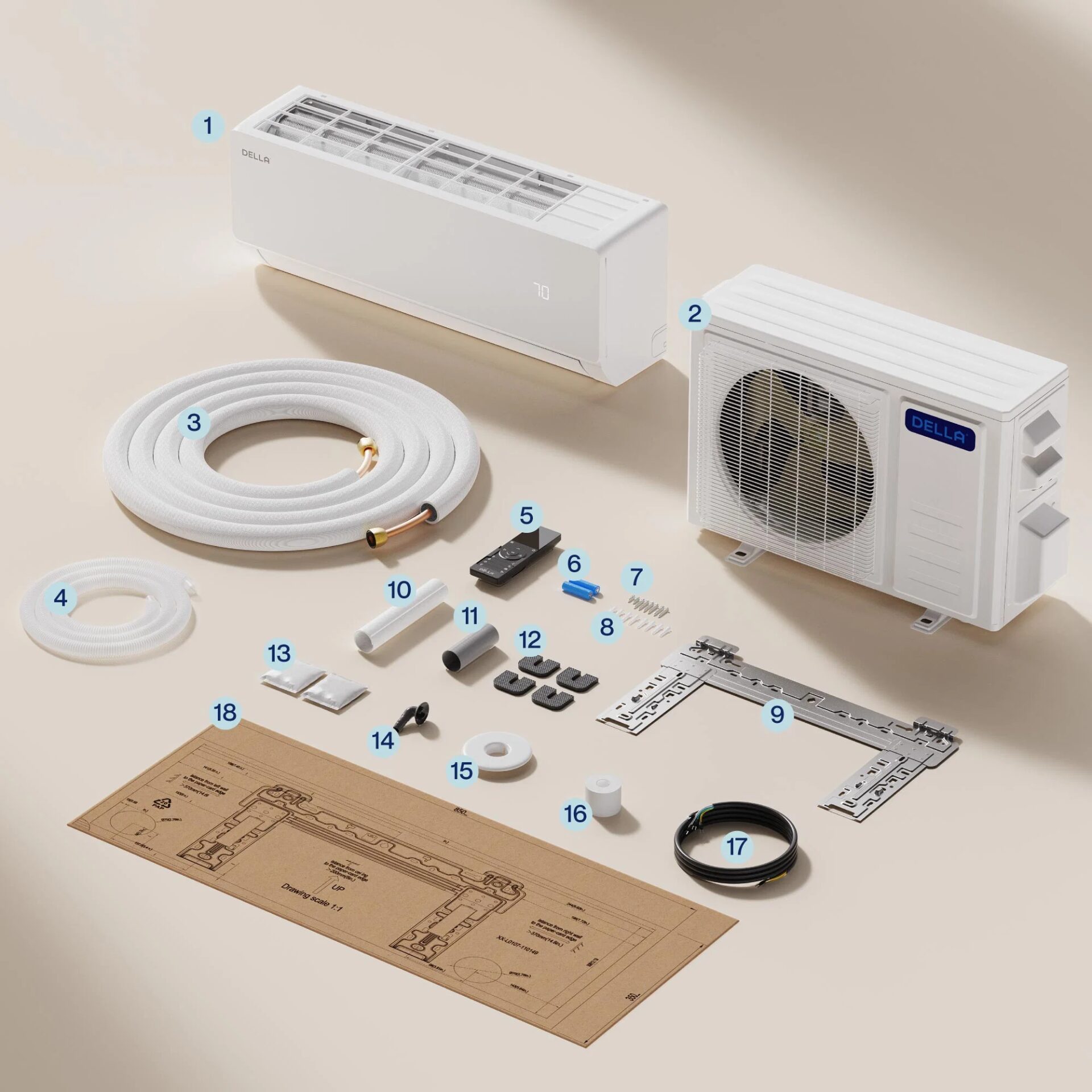
Choosing the outdoor condenser for a 3 zone mini split begins with the heating and cooling loads of the three indoor zones. A DELLA mini split system should not be selected by adding three arbitrary indoor-unit sizes and purchasing the next largest condenser. Multi-zone equipment is designed around approved combinations, operating ranges, and the amount of capacity the outdoor unit can distribute when several rooms call for conditioning.
The right outdoor unit therefore comes after the individual zones have already been sized.
Outdoor Capacity Starts With the Three Zone Loads
Calculate the demand of each room or area first.
For example, a large living space may require substantially more capacity than either of two bedrooms. Those three loads establish the indoor-unit configuration that the outdoor condenser must support.
This is more accurate than beginning with a predetermined condenser size and trying to divide its output between three rooms afterward.
Each indoor unit should be selected because it suits its own zone, not because the numbers create a convenient total.
Indoor BTU Totals Do Not Always Equal Outdoor Capacity
A common assumption is that three indoor units totaling 36,000 BTU automatically require a 36,000 BTU outdoor unit.
Multi-zone systems do not always work that way.
Manufacturers may allow the combined nominal indoor capacity to be somewhat different from the outdoor condenser's nominal rating. This reflects the reality that every indoor zone may not demand full output simultaneously.
The permitted ratio varies by product. Always check the manufacturer's approved combination table rather than applying a universal formula.
Peak Demand Matters When Several Zones Run Together
Diversity between zones can help a multi-zone system operate efficiently, but there are times when all three rooms need significant output at once.
A hot summer afternoon is one example. A living room may have strong solar gain while bedrooms upstairs are also warming beneath the roof.
If the combined demand exceeds what the outdoor condenser can deliver under those conditions, available capacity has to be distributed across the active zones.
That does not mean the system is incorrectly designed, but peak conditions should be considered when deciding how much outdoor capacity is appropriate.
Manufacturer Combination Limits Affect System Selection
Every multi-zone outdoor unit has limits on the number, type, and capacity of indoor units it can support.
Those limits may include:
- Minimum and maximum connected capacity
- Approved indoor-unit combinations
- Maximum refrigerant line lengths
- Elevation limits
- Operating-temperature ranges
A combination that looks reasonable based on BTU arithmetic may still fall outside the manufacturer's approved configuration.
Checking these requirements before purchasing equipment prevents mismatches that can complicate installation or affect system performance.
The Best Outdoor Size Balances Capacity and Efficiency
Selecting a larger condenser simply for extra reserve is not necessarily the best approach.
The objective is to provide enough capacity for realistic peak conditions while allowing the system to operate effectively during the far more common periods of partial load.
A properly designed three-zone setup balances the room-by-room loads, the approved indoor-unit combination, and the performance characteristics of the outdoor condenser.
For simple homes, preliminary sizing can help narrow the options. For larger houses or rooms with very different exposures, a professional load calculation provides a much stronger basis for selecting the final outdoor unit.
The correct condenser is not determined by zone count alone. It is determined by what those three zones actually require.