


Two out of three American fourth-graders are not reading at a proficient level. That number isn’t a projection or a warning about the future. It’s the present, confirmed by the most recent federal data. And for parents who’ve watched a child struggle to decode a paragraph or lose confidence at storytime, it’s a gut punch that turns into a question: what do you do about it at home?
The answer isn’t just more reading time. It’s the right kind of structured practice, delivered consistently and tied to where your child actually is, not where the curriculum assumes they should be. At-home reading programs have gotten remarkably good at doing exactly that. Here’s what actually matters when you’re picking one, and what the research says is working.
Why So Many Kids Are Behind, and Why School Alone Isn’t Enough
Only 31% of fourth-grade students performed at or above the NAEP Proficient level on the 2024 reading assessment, which was 4 percentage points lower than 2019, according to the Nation’s Report Card published by the National Center for Education Statistics in 2024. That slide isn’t just pandemic noise; it reflects a deeper pattern of reading instruction that doesn’t adjust fast enough when a child falls behind.
Classroom teachers manage 25 to 30 kids at once. They can’t give one student five extra minutes on blending consonant clusters while the rest of the class waits. So the struggling reader gets moved along, accumulates gaps, and by third grade those gaps are loud. This is where home practice becomes not optional but necessary.
The problem isn’t that parents don’t care. Most do, deeply. The problem is that sitting down with a book and asking “what happened next?” isn’t structured intervention. It’s conversation, and it’s valuable, but it won’t rebuild the phonics foundation a child missed in first grade. That takes targeted, repeating practice with real feedback.
The Quiet Shift: More Families Are Taking Literacy Into Their Own Hands
Homeschooling and at-home supplemental learning are both growing fast. In the 2024-2025 school year, homeschooling grew across the United States at an average rate of 4.9%, nearly three times the pre-pandemic growth rate of around 2%, according to the Johns Hopkins Institute for Education Policy’s 2025 analysis of homeschool growth trends. Many of those families aren’t abandoning traditional school entirely. They’re supplementing it, especially in reading.
This isn’t a fringe decision anymore. It’s a practical one. When a child’s reading level is below grade level and there are no tutors available or affordable, parents look for what they can control. A structured at-home program is often the most direct path to consistent, daily skill-building.
The market has responded with everything from printable workbooks to app-based programs to full adaptive software suites. The quality varies enormously. Knowing what separates a tool that actually moves the needle from one that mostly looks busy is worth understanding before you spend a dollar on any of it.
What Actually Works: The Science Behind Effective At-Home Programs
Good reading programs share a few clear features, and they’re not the flashy ones. The dopamine hits, badges, and animated characters keep kids clicking. But what produces lasting skill growth is something quieter: continuous assessment, phonics-based instruction, and a learning path that adjusts based on what the child just did.
Personalized adaptive learning is characterized by the use of algorithms to deliver content informed by specific metrics such as quiz results and learning analytics. A 2024 scoping review published in Heliyon via PubMed Central, comprising 69 studies from 2012 to 2024, found that personalized adaptive learning positively impacted teaching and learning outcomes, highlighting its role in offering self-paced learning, real-time feedback, and flexibility.
Real-time feedback is the keyword there. A child who reads “bread” as “bead” needs a correction in that moment, not in a weekly review session. Programs that log responses, identify error patterns, and adjust difficulty accordingly are running a kind of continuous micro-assessment that no parent can replicate by hand. That’s not a knock on parents. It’s just math: software doesn’t tire, doesn’t guess, and doesn’t skip steps to stay on schedule.
“The child reading above grade level moves ahead; the child struggling gets the review they need without humiliation.” This is the core promise of personalized instruction, as described in Structural Learning’s 2024 review of homeschool academic outcomes, a principle that well-designed at-home programs are built to deliver.
The 3-Phase At-Home Reading Check
Before you choose any program, run this quick framework. It takes ten minutes and will save you from buying the wrong thing. Think of it as the diagnostic the software itself will eventually run on your child, done first by you.
Phase 1: Locate the Gap. Have your child read a short passage aloud from a book slightly below their grade level. Listen for hesitation. Are they sounding out letters, or guessing from context? Hesitation on individual sounds points to phonics gaps. Hesitation on longer words with correct sounds points to fluency and vocabulary. These are different problems that need different tools.
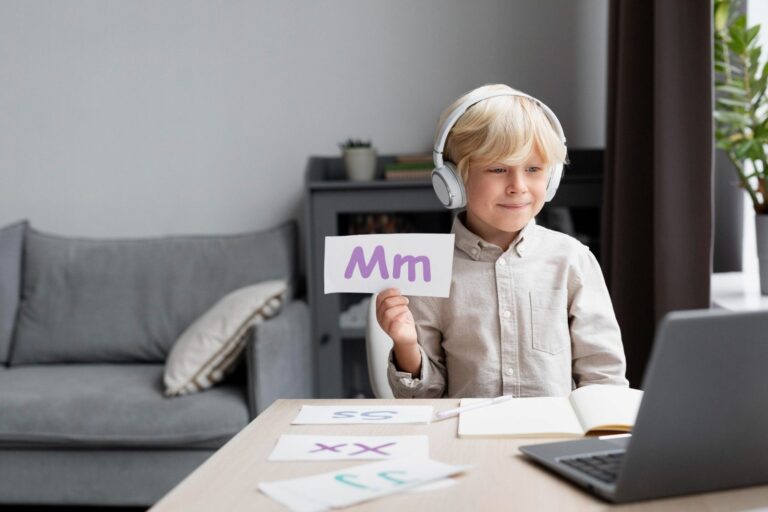
Phase 2: Match the Stage. Programs that start with phonics and blending work best for early elementary kids or any reader who guesses at words. For children with dyslexia, a dyslexia app for kids can provide additional targeted reading practice at home. Fluency-focused programs with longer texts and comprehension tracking work better for kids who can decode but read slowly or miss meaning. Adolescent readers who’ve hit a wall often need vocabulary depth and complex-text exposure more than phonics review.
Phase 3: Check the Feedback Loop. Before committing, ask one question about any program you’re considering: does it tell your child immediately when something is wrong, and does it change what comes next based on that answer? If yes, it’s adaptive. If it just scores a worksheet at the end, it’s not. Adaptive wins every time for skill-building.
Take Maya, a parent in suburban Ohio, as a concrete example of this playing out. Her 8-year-old son was reading at a first-grade level in second grade. His teacher identified it in November, but the school’s intervention slots were full. Maya used Phase 1 above and heard him swap “th” sounds for “f” constantly. That’s a phonics gap, not a comprehension problem. She chose a phonics-first program with daily 20-minute sessions, and by February he’d moved up a full grade level in assessed reading. The tool mattered, but so did picking the right tool for the right gap.
Choosing a Program: What the Options Actually Offer
For K-5 kids working on foundational skills, phonics-based programs with constant placement assessment are the strongest choice. For middle and high school students who read but struggle with complex texts, programs that expose them to academic vocabulary and longer passages close the gap for college readiness. For kids who are already solid readers but read slowly, fluency training with timed passages and comprehension checks pushes them further.
When evaluating any platform, look at whether the program starts with an assessment before placing your child in content. Any good english learning software worth using will begin by finding out where your child actually is, not just what grade they’re in. Grade-level placement without assessment is guessing. Assessment-first placement is instruction.
Price matters too. Most quality programs run under $200 for a yearly license, which is far below the cost of one-on-one tutoring. For families managing multiple kids, look for programs that offer additional-student pricing.
Making It Stick at Home
Even the best program fails without consistency. Twenty minutes a day beats two-hour Saturday sessions. Keep the sessions at the same time each day, treat the computer time as independent work rather than a supervised event, and check the parent dashboard once a week rather than hovering during sessions. Children who feel observed tend to perform for the watcher rather than actually engage.
Reading aloud together still has value. Do it separately from the program sessions. Mix in library books at the child’s interest level, not their assessed level. The program builds the skill. The library books build the love of reading. You need both.
The literacy gap in American kids is real and stubborn. But it’s not fixed at school or nowhere. The best work happening right now is happening at kitchen tables, in home offices, and on tablets before bedtime, where focused, adaptive practice is moving kids forward one session at a time. The question isn’t whether at-home reading programs work. The question is whether you’ve chosen the one that fits your child’s actual gap.






1 thought on “How At-Home Reading Programs Build Real Literacy Skills in Kids”
Comments are closed.