In interior design, surfaces do far more than cover floors and walls. They establish visual hierarchy, influence how volumes are perceived, and help determine which elements recede and which command attention. Stone look porcelain tiles are particularly effective in this role because their mineral character can be interpreted with different levels of intensity.
Depending on color, pattern, format, and placement, the same material language can provide a quiet architectural backdrop or become a defining feature. Understanding this range allows designers to use stone-inspired surfaces with intention, shaping balanced and coherent interiors.
Using stone-inspired surfaces as a quiet foundation
Not every surface needs to compete for attention. In many interiors, the strongest design decision is to create a calm material base that allows furniture, lighting, artwork, or architectural details to take the foreground.
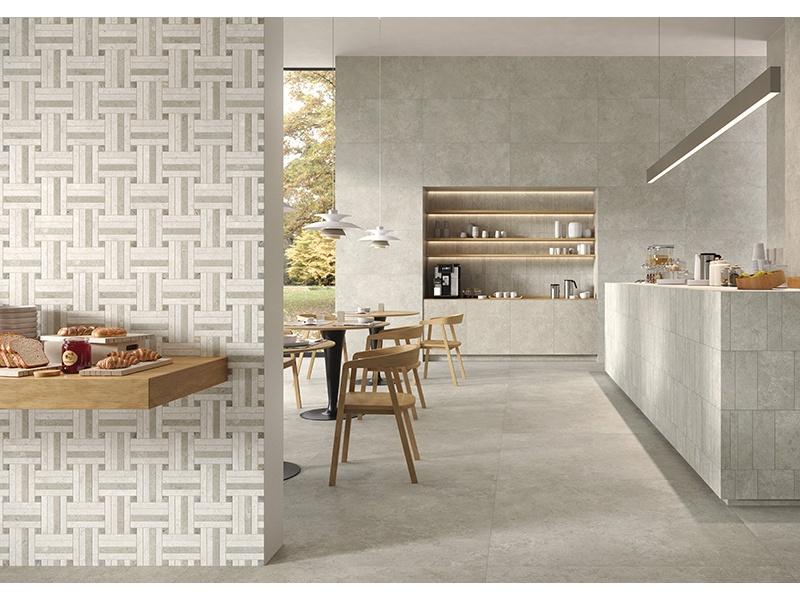
Stone look porcelain tiles can perform this supporting role particularly well. Soft tonal variation, restrained veining, and neutral mineral shades introduce visual depth without becoming dominant. Used across a floor or a broad wall surface, they can establish continuity and give the room a sense of stability.
This approach works especially well where simplicity is part of the design language. A subtle stone effect keeps large surfaces visually engaging without becoming dominant. Its contribution is measured: it connects different elements and gives the composition a consistent foundation.
Turning surfaces into focal points
At the opposite end of the spectrum, stone-inspired porcelain can be used deliberately as a visual statement. Stronger patterns, richer contrasts, pronounced textures, and larger formats can transform a wall or floor into a defining architectural element.
A statement surface can help anchor a room, highlight a specific zone, or direct attention toward an important feature. In a living area, a strongly characterized wall can frame a fireplace or sculptural furnishing element. In hospitality or commercial interiors, a dramatic stone effect can contribute to a more memorable identity.
Working with scale, format, and placement
The impact of stone look tiles depends not only on appearance but also on use. Scale and format can significantly change how the same visual effect is perceived.
Large-format surfaces tend to emphasize continuity and make patterns feel broader and more architectural. Fewer joints allow veining and tonal movement to read across a larger area, strengthening visual unity. Smaller formats, by contrast, introduce rhythm and can help create more articulated compositions or define specific zones.
Placement matters just as much. Extending a stone-inspired surface from floor to wall creates a very different effect from using it selectively on one vertical plane. The design becomes a question of composition: deciding where the material should lead the eye, where it should remain quiet, and how it should relate to the proportions of the room.
Finding the right balance within the overall composition
Successful interiors rarely depend on a single expressive material. Their character emerges from the relationship between surfaces, furniture, light, color, and architectural form. Stone look porcelain tiles are most effective when their role is considered as part of this broader composition.
A restrained stone effect can create the visual calm needed for more distinctive furnishings, while a bolder surface can provide structure to an otherwise minimal environment. The goal is not to maximize impact everywhere, but to establish a clear hierarchy in which each material has a purpose.
This makes stone-inspired porcelain particularly valuable as a design tool. Its versatility lies in the ability to adjust its visual presence according to the needs of the space. Whether acting quietly in the background or shaping the identity of an entire room, it gives designers a material language that can be calibrated rather than imposed.
Ceramiche Keope: material expertise for modern architecture
Ceramiche Keope has built its identity around a precise understanding of materials and their role in contemporary architecture. Since 1995, the company has combined Italian manufacturing expertise with continuous investment in research and production technologies, developing porcelain stoneware surfaces for residential, commercial, and public projects. As part of the Concorde Group, it works with architects and designers seeking materials that can support both creative intent and demanding technical requirements.
Porcelain stoneware is central to this expertise. Its compact structure, low water absorption, and resistance to wear, scratches, impacts, chemicals, and environmental exposure make it suitable for a wide range of applications. At the same time, advanced manufacturing processes allow ceramic to interpret the visual complexity of natural materials with remarkable precision.
Stone-effect porcelain stoneware is a clear expression of this balance. Veining, tonal shifts, and textures inspired by slate, travertine, Lecce stone, and Portland stone translate the character of natural stone into surfaces designed for contemporary use. The result combines material depth with practical advantages, expanding design possibilities across both floors and walls.
Ceramiche Keope also offers a broad spectrum of finishes, formats, and thicknesses. Solutions ranging from 9 to 20 mm allow designers to respond to indoor and outdoor applications with greater flexibility, while slip-resistant finishes from R9 to R11 provide additional options where safety is a key consideration. ULTRAsilky adds an extra-smooth, velvety satin quality with enhanced slip resistance for interior wet areas, while ULTRAmatt combines a deep, extra-matt appearance with a soft, uniform feel and R10 A+B performance for residential and commercial floor and wall applications.
This attention to performance is matched by an industrial model designed to reduce resource use throughout production. Process water is completely reused, fired ceramic waste is recovered, and raw material residues are reintegrated into the manufacturing cycle. Around 75% of production energy is generated internally, with the remaining share supplied exclusively by certified renewable sources.
Certifications including ISO 17889, WELL Building Standard V2, and Declare provide independent recognition of this approach, reinforcing a model in which material expertise is measured not only by aesthetic and technical quality, but also by transparency, efficiency, and long-term responsibility.