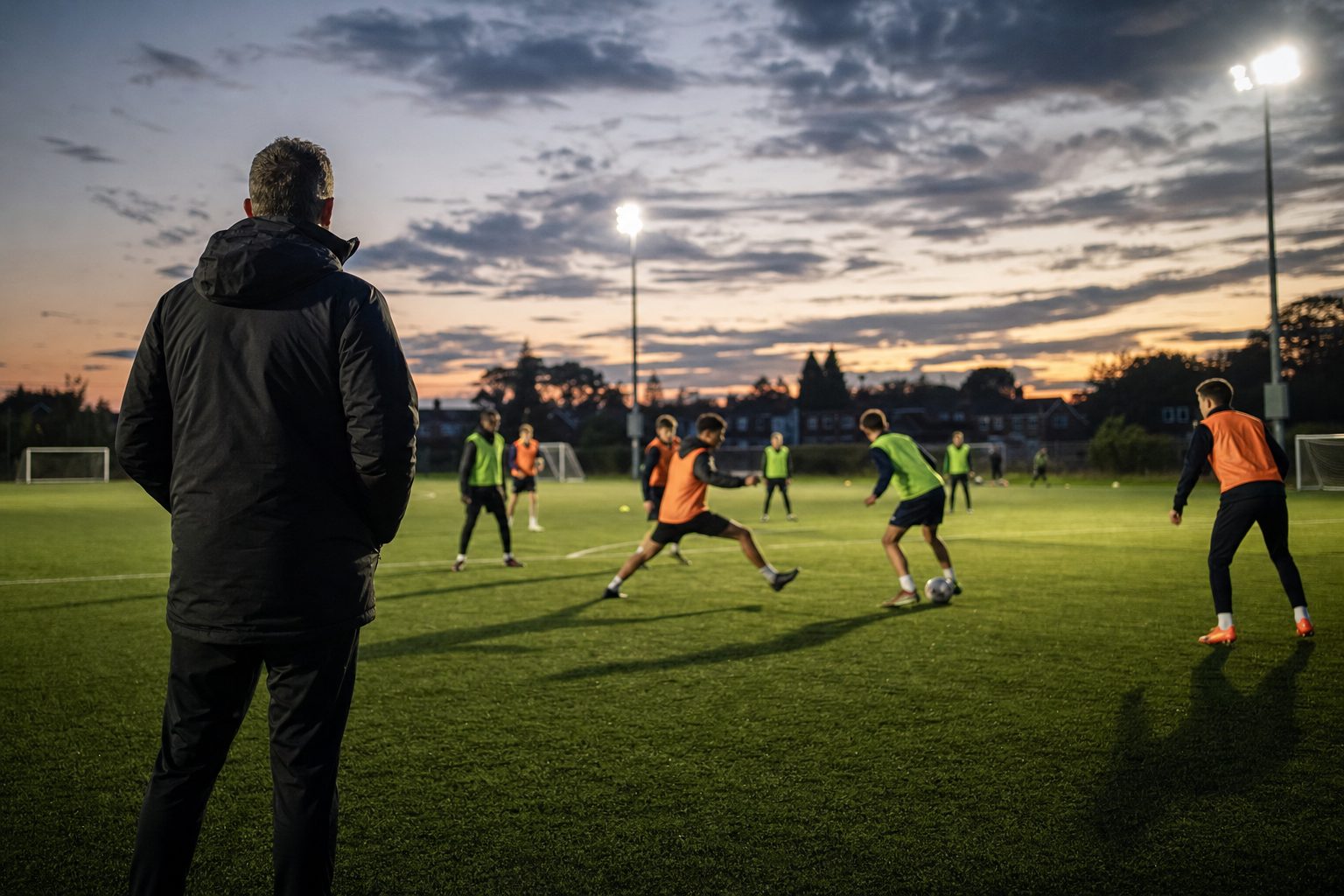
A parent sits on the sideline during a Tuesday evening session, watching a 14-year-old centre-back make the same positioning mistake he made three months ago, and wonders: is this academy actually taking my kid somewhere, or just keeping him occupied until he ages out? The honest answer depends less on the badge on the training kit than on whether training, competition, and evaluation are deliberately linked into stages with clear readiness checkpoints — not left to chance and one good tournament.
What a soccer academy pathway actually means (and what it doesn't)
A pathway, in this context, is a structured progression: a player moves through defined stages of learning, testing, and competing, with feedback loops that tell everyone involved whether the current environment still fits. It is not a brochure promise. It should be visible in how sessions are designed, how fixtures get scheduled, and how progress is documented — not just claimed at the end-of-season meeting.
A few assumptions tend to distort how families approach this, and it's worth naming them. A common observation among youth coaches is that consistency shown across a full season carries more weight in their evaluations than a single standout performance — which may be one reason a showcase or trial rarely changes a player's trajectory on its own. More hours on the pitch don't automatically speed up progression either; extra volume without a clear purpose can add fatigue without adding much development. And talent alone is rarely sufficient — without a structured trajectory, raw ability can stall for years simply because nobody built the next step. A pathway reduces randomness precisely because it tries to keep development, competitive exposure, and evaluation moving together instead of independently. For families trying to judge this from the outside, a structured soccer academy evaluation resource can offer criteria to compare against, rather than relying solely on what one program chooses to show about itself.
Stage 1: building the player, not the highlights
Take that same centre-back. At 12 or 13, what matters isn't whether he looks clean in a passing drill against no pressure — it's whether his first touch, scanning, and basic passing hold up when three players are closing him down at match tempo. Game understanding at this stage is simple but non-negotiable: spacing, quick decisions, and a clear sense of what the role actually asks of him.
Athletic literacy matters just as much as ball skills here: coordination, sound speed mechanics, and early injury-prevention habits often shape how durable a player becomes later, more than how fast he is right now. A useful sign that this stage is working isn't a trophy — it's a player who repeats the same technical actions reliably when the game gets chaotic, not only when the drill is tidy and uncontested.
Stage 2 — turning skills into repeatable match impact
By 15 or 16, many development-focused programs shift training from repetitive drills toward small-sided, constraints-led games, on the premise that these formats push a player to read space, adapt under time pressure, and make decisions rather than execute memorized patterns. A concrete version of this: a 4v4 game where goals only count after three consecutive passes can encourage exactly the scanning and spacing habits that isolated passing drills struggle to teach. Position-specific work can begin here, but locking a young player into one role too early may limit tactical flexibility later; some development-focused environments keep positional rotation through these years for that reason.
Performance habits start to matter more visibly too: sleep, basic nutrition awareness, recovery between sessions, and simple self-review routines, such as watching one clip of a match and noting a single thing to fix. The deliverable at the end of this stage should be concrete — a player profile that honestly states strengths, weaknesses, and likely role fit, not a generic label like promising talent.
Stage 3: bridging the gap to higher-level football
The jump into more competitive football is rarely about a raw skill gap; it's usually speed of play, physical duels, tactical detail, and emotional control under pressure the player hasn't faced before. Choosing the right competition matters almost as much as training quality — a schedule built around opponents and styles slightly above a player's current level tends to push development more than a comfortable, uncontested league.
Minutes need managing carefully. Playing up an age group can accelerate adaptation, but it can also dent confidence and physical readiness if the gap is too wide. A workable support network — honest coach communication, a parent role that stays supportive rather than tactical, and realistic timelines rather than fixed deadlines — tends to make this transition less chaotic for everyone involved, including the 14-year-old who just wants to know if he's actually getting better.
Training, competition, evaluation: the three pillars
Training, competition, and evaluation function as interlocking pillars. Training without matching competition can produce players who look sharp in sessions but freeze in games. Competition without evaluation can produce activity without direction — lots of matches, no clear sense of what's improving. Evaluation without adjusted training mostly documents stagnation instead of addressing it. When progress stalls, the fix is rarely train more; it's usually identifying which pillar is weak and adjusting that one variable first.
Why does documentation matter this much in day-to-day coaching, long before any professional contract is on the table? Because the habit of keeping player reports, training minutes, and registration history up to date is exactly what later gets tested — and rewarded — at the top of the game. Professional football treats the years between 12 and 21 as a window worth recording financially, not just athletically, which is a reasonable argument for any academy to build that habit early rather than retrofit it once a player is already moving between clubs.
Training compensation, under article 20 of the FIFA Regulations on the Status and Transfer of Players and its Annexe 4, is paid by a player's new club to every club that trained him between the ages of 12 and 21, triggered when he signs his first professional contract or moves between clubs of different associations before the end of the season of his 23rd birthday. A linked solidarity contribution, under article 21 and Annexe 5, sends 5% of that amount to every club where the player played between 12 and 23 — rewarding each earlier stage of documented development, not only the club that happens to sign him.
FIFA approved its Clearing House Regulations in October 2022 to run this system through three steps — identifying entitlement, creating an electronic player passport, and transferring payments between clubs — with associations sorting their clubs into up to four investment tiers. None of this changes what a family should look for in a local program, but it explains why serious clubs treat ages 12 to 21 as a documented development window: there's now a financial and regulatory system built around proving that development actually happened.
At federation level, UEFA runs an Elite Youth Player Development Programme that provides all 55 member associations with funding — €100,000 per season currently, rising to €150,000 per season for the 2024–2028 cycle — specifically to invest in development strategy. UEFA also launched Under-15 and Under-16 development tournaments as a pilot project in 2012, giving younger age groups structured international competition earlier than was previously common. These are federation-level investments, but they point toward the same idea at every level of the sport: staged development with documented milestones, rather than isolated talent-spotting.
Readiness signals: four areas to track
Readiness tends to show up across four areas, and it's worth tracking them separately rather than relying on a general impression.
- Technical readiness: execution rate at full speed, weak-foot competence under pressure, and first-touch reliability in tight spaces, not just open ones.
- Tactical readiness: scanning frequency before receiving the ball, consistent off-ball positioning, role clarity, and recognizing pressing triggers without being told.
- Physical readiness: repeat sprint ability across 90 minutes, general robustness, and — often underrated — simple availability, since a player who is reliably fit to play is already ahead of one who is occasionally brilliant but frequently injured.
- Mental readiness: coachability, how quickly a player resets after a mistake, and consistency of effort across easy and difficult matches alike.
Choosing an academy based on pathway fit
A handful of direct questions tend to reveal more than any promotional claim: What does the progression plan look like year over year? What level of competition does the academy schedule against, and how is that chosen? How often is a player formally evaluated, and by whom? Coach-to-player ratio and feedback frequency are practical indicators here — an environment where a coach can genuinely track individual development differs a lot from one where attention is spread too thin to notice anything but the obviously gifted.
It helps to think in terms of flags, mapped against the same three pillars:
- Training — green flag: sessions increasingly built around game-realistic constraints, with one variable progressed at a time. Red flag: the same generic drills across every age group, regardless of stage.
- Competition — green flag: fixtures chosen deliberately against opponents slightly above the group's level. Red flag: a schedule dominated by easy wins, or conversely, constant mismatches with no recovery between them.
- Evaluation — green flag: written or video reviews on a predictable cadence, tied to specific adjustments. Red flag: feedback limited to vague encouragement with no documented trail.
Safeguarding and welfare deserve equal weight. In the United States, for example, U.S. Soccer's safeguarding framework limits one-on-one interactions between adults and minors, requires background screening for program participants, and obliges member organizations to adopt a model policy for preventing abuse and misconduct, alongside clear reporting requirements under its Prohibited Conduct Policy. Families outside that system should still expect — and ask about — equivalent safeguards: a written welfare policy, clear reporting channels, and transparent background-check practices, regardless of jurisdiction.
Coaching credentials are a reasonable proxy for structural quality too. UEFA's Coaching Convention, in place since 1998 and last updated in 2020, sets common minimum criteria across member associations for licences at C, B, A, and Pro level, plus specialist qualifications like Youth B and Elite Youth A; more than 200,000 people currently hold a UEFA-endorsed licence, each valid for three years. Asking which licence level a youth coach holds, and whether it includes a youth-specific qualification, is a fair and answerable question for any serious program.
International training abroad can genuinely accelerate a competitive transition, but it tends to work best for players who already show maturity, some language adaptability, and comfort with unfamiliar environments. Sending a player abroad mainly for exposure, before the foundational stages back home are solid, often doesn't make up for what's missing in the player's development.
Conclusion: a pathway mindset beats a one-off breakthrough
Before committing to any program, ask for the last two evaluation reports on a player similar to yours, and the next eight-week training plan for the group he'd join. If a club can't show either document, there probably isn't a pathway behind the marketing — just a schedule of sessions. Three things to do this month: start a simple quarterly log across the three pillars described above, ask the coaching staff directly how often formal reviews happen, and compare the current competition schedule against what the player actually needs next, not just what's convenient. The single clearest sign of progress isn't a trophy or a scout's phone call — it's a documented adjustment to training or competition that followed directly from an honest evaluation.