In 2024 a peer-reviewed journal published a figure of a rat with anatomy so impossible it became a meme within days. The paper was retracted. Most people laughed and moved on, but the image integrity specialists didn’t. The rat was obvious. What worries them is the western blot that isn’t.
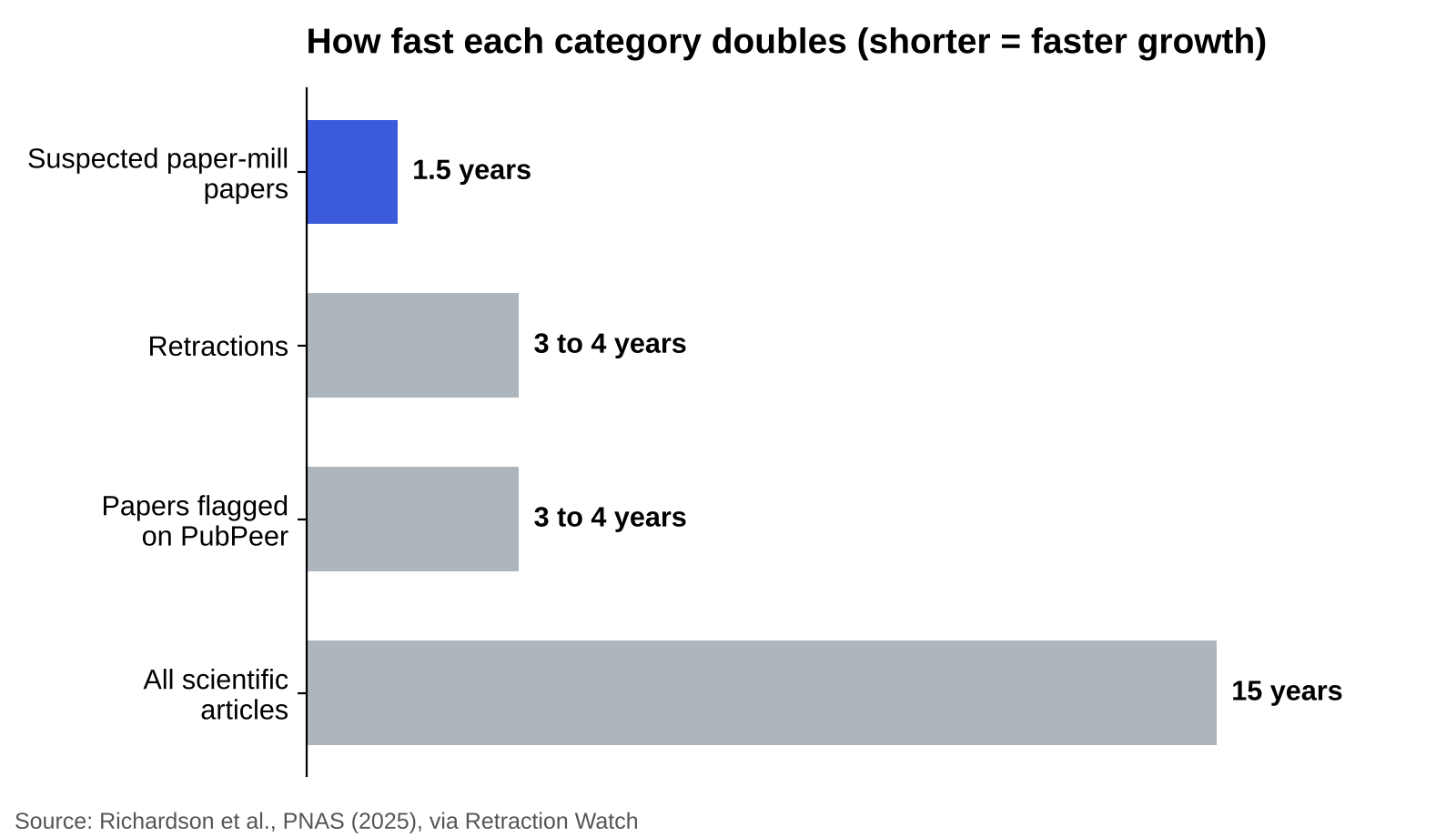
Fabricated figures used to require a skilled hand and a lot of patience. Now a generator can produce a clean, convincing blot or microscopy panel in seconds, and the organized operations that mass-produce fake papers have noticed. A 2025 study in PNAS by Reese Richardson and colleagues found the output of suspected paper mills is doubling roughly every 1.5 years. Science as a whole doubles about every 15.
So the question for editors, reviewers, and research offices isn’t whether AI images will reach their inbox. It’s how to catch them when they do.
Where an AI Image Check Fits in the Review Process
Journals already screen for duplicated and spliced images. Generated images are a different problem, because there’s no original elsewhere to match against. That’s where pixel-level AI detection comes in.
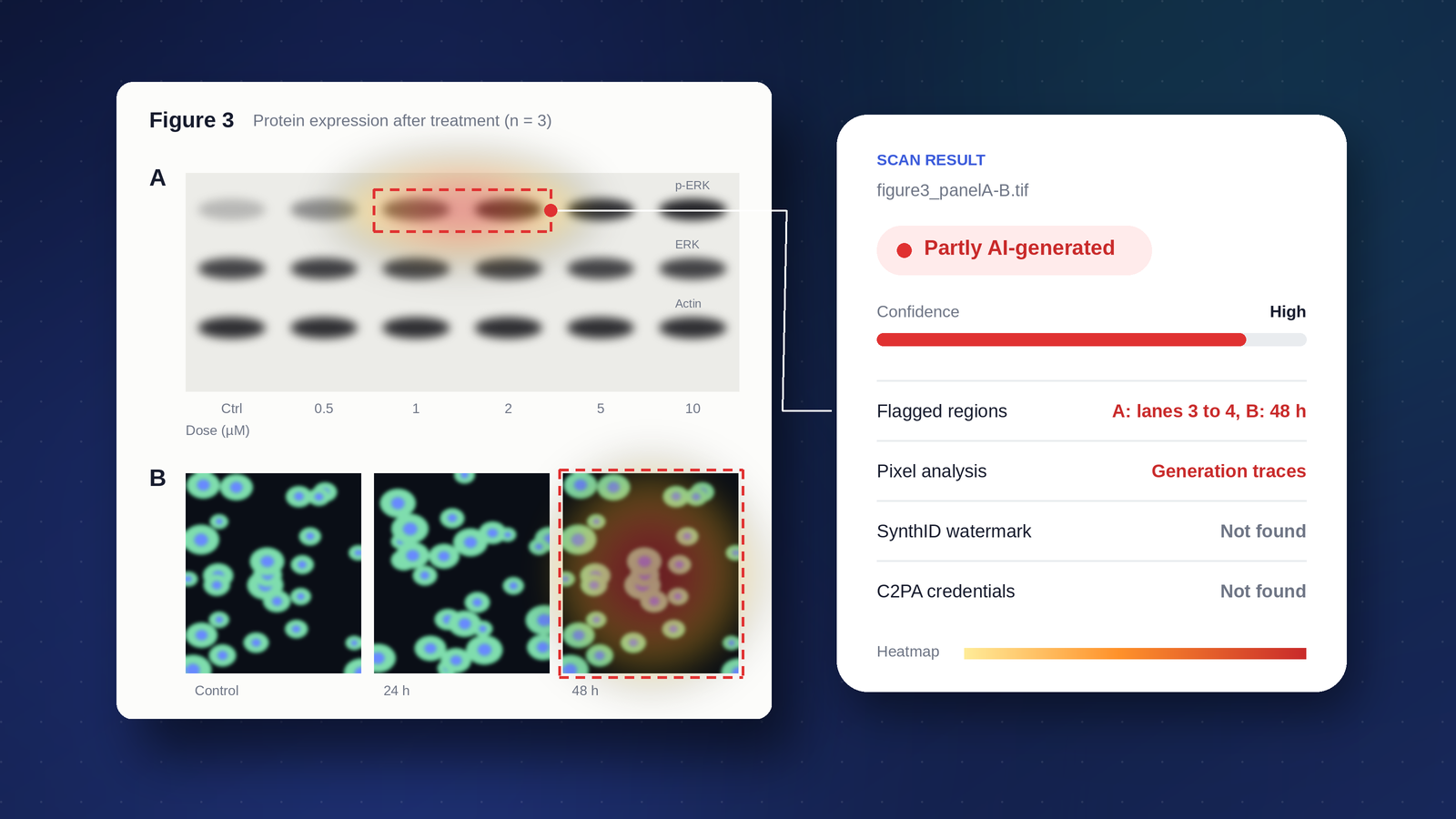
Phrasly’s free AI Image Detector is a quick way to add that check. It takes JPG, PNG, WebP, HEIC, AVIF, or GIF files up to 20 MB, needs no sign-up, and the page says images are never stored. It returns a verdict, a confidence score, and a heatmap showing which parts of an image look generated, and it also checks files for SynthID watermarks and other AI signatures. For a multi-panel figure, that heatmap is the useful part. It tells you whether the whole figure looks synthetic or whether one panel, or one lane, is the problem.
Honesty matters here, though. Scientific images are an unusual test. A 2025 study in PeerJ found that general-purpose detectors struggled with western blots: one widely used tool caught under 19% of AI-generated blots, and another that caught most of them also wrongly flagged many real ones. Treat any general detector as one screen among several, alongside specialist forensics tools and a human expert’s eye. Export panels individually and at full resolution for the best results.
The Scale of the Problem in Numbers
@@IMG@@
Doubling times for suspected paper-mill papers, retractions, PubPeer-flagged papers and all scientific articles. Source: Richardson et al., PNAS, 2025, as reported by Retraction Watch.
The PNAS team’s point was blunt. Fraudulent output is growing far faster than the system built to catch it. Retractions and papers flagged on PubPeer double every three to four years, which sounds fast until you compare it with paper mills doubling every 18 months. According to Retraction Watch’s summary of the study, only 28.7% of suspected paper-mill papers had been retracted, and among papers with suspected image duplication the figure was 34.1%.
The cleanup, when it comes, is huge. Nature reported that retractions passed 10,000 in 2023, a record, with more than 8,000 of them from Hindawi journals. Wiley later said it had retracted over 11,300 Hindawi papers and closed 19 journals.
Images Are a Big Part of It
Problem figures aren’t new. A landmark 2016 study by Elisabeth Bik and colleagues found 3.8% of more than 20,000 papers published between 1995 and 2014 contained problematic figures. That’s the pre-AI baseline, and it was already worrying.
Screening at the submission stage shows how much slips in. When the American Society for Microbiology piloted an AI-based tool across 2,627 accepted manuscripts, it found image duplications in 3.9% of them before publication, according to a 2025 paper in mBio. At the American Association for Cancer Research, an AI screening tool found genuine duplications in 14% of 1,367 manuscripts before acceptance, as reported at the 2025 Peer Review Congress.
MDPI’s own analysis of its 2025 retractions, using Retraction Watch data, found paper mills and compromised peer review accounted for 43%, with image and data manipulation behind another 15%.
What these numbers do and don’t say
None of these studies measures how many papers contain fully AI-generated images. That number simply doesn’t exist yet. What they show is that image fraud is common, screening catches a lot of it, and the tools to produce convincing fakes just got dramatically cheaper.
What AI-Generated Scientific Images Tend to Look Like
Generated figures have their own tells, even when they’re polished.
Blots That Are Too Perfect
Real western blots are messy. Bands vary in shape, background is uneven, and lanes drift slightly. Synthetic blots often show bands with suspiciously uniform edges, a background that looks airbrushed, or noise patterns that repeat across lanes.
Microscopy That Doesn’t Obey Biology
Cells in generated micrographs can merge strangely, show nuclei in odd positions, or have textures that look painted. Scale bars, labels, and inset magnifications sometimes don’t match the image they describe.
Panels That Contradict Each Other
The strongest clues often come from comparing panels. A control that looks identical to a treatment, quantification charts that don’t match the blot above them, or a “different” sample whose background texture matches another panel exactly all deserve a closer look.
A Practical Screening Routine for Editors and Reviewers
|
Step |
What to do |
Why it helps |
|
Request originals |
Ask for raw, uncropped blots and original microscopy files |
Fabricators often can’t produce them |
|
Screen for AI |
Run individual panels through an AI image detector, check the heatmap |
Catches generated content with no source to match |
|
Check duplication |
Use specialist tools that compare against published images |
Catches reuse and splicing |
|
Compare panels |
Look for repeated backgrounds, mismatched scale bars, impossible results |
Catches internal contradictions |
|
Escalate carefully |
Contact authors and the institution before any public accusation |
Protects honest researchers |
The first step is quietly the most powerful. Many journals now require raw data for blots, and paper mills selling fabricated work often can’t supply convincing originals on request.
A note on fairness
A flagged image is a reason to ask questions, not proof of misconduct. Heavy compression, unusual instruments, and legitimate image processing can all confuse automated tools. The detector gives you a lead. Raw data, author responses, and expert review settle it.
Researchers Have a Role Too
Image integrity isn’t only an editor’s job. Researchers protect themselves by keeping raw files organized, documenting every processing step, and avoiding AI image tools for anything presented as data. If you use AI to make a schematic or a graphical abstract, label it clearly and check your target journal’s policy first, since many now restrict or ban AI-generated figures.
Co-authors and supervisors can also screen figures before submission. Catching a problem in-house is far less painful than a public correction later.
Keeping the Scientific Record Worth Trusting
The rat was a warning that came wrapped in a joke. The real threat is quieter: plausible blots, believable micrographs, and figures that pass a tired reviewer’s glance. With paper mills growing about ten times faster than science itself, waiting for retractions to clean things up isn’t a plan.
What works is layering. Ask for raw data, screen panels with an AI image detector, run duplication checks, compare panels against each other, and keep a human expert in the loop. No single tool will catch everything, especially with scientific images. Together, they make fabrication expensive again, and that’s the point.