

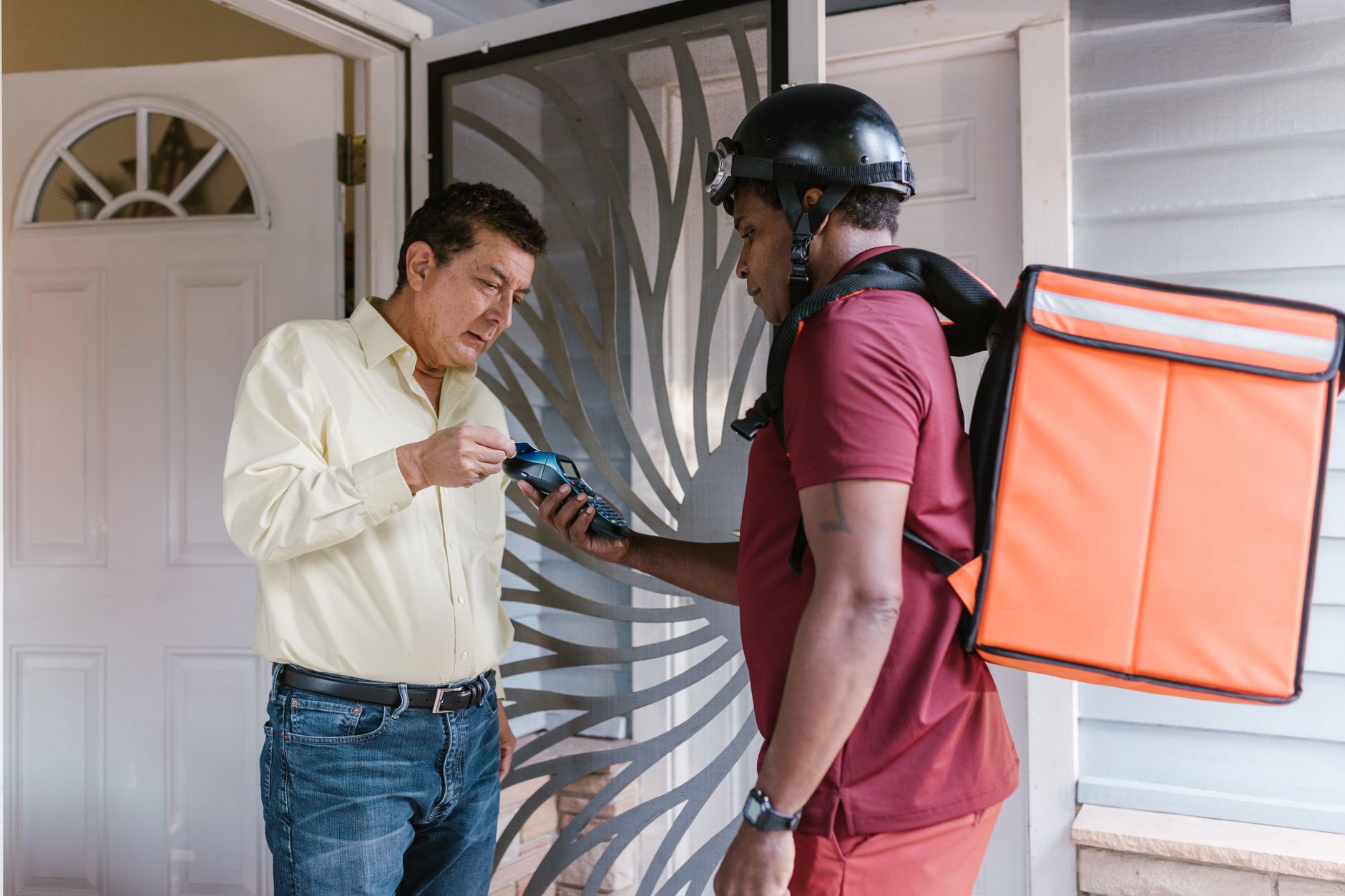
On-demand delivery has moved far beyond pizza and burgers. In 2026, customers expect groceries, medicine, flowers and parcels at their door in under 30 minutes, tracked live and paid for with a single tap.
That expectation has turned delivery into one of the most competitive app categories in the world. Big platforms are becoming everyday "super apps", new entrants are arriving with deep pockets, and margins are tighter than ever.
So what does it actually take to compete? This guide covers the market numbers, the business models that work, the features users now treat as standard, what is happening in the UAE and Qatar, and what it costs to build a delivery app that can hold its own.
The On-Demand Delivery Market in Numbers
Demand is not the problem. The market is huge and still growing; the challenge is winning a share of it profitably.
- ~$1.51 trillion: Statista's projection for worldwide online food delivery revenue (meals plus groceries, measured as GMV) in 2026 (Statista).
- $291.4 billion → $2 trillion: the global quick commerce market in 2026, forecast to reach about $2,013 billion by 2033, a 31.8% annual growth rate (Persistence Market Research).
- 47%: grocery's share of quick commerce in 2026, the category's anchor because people reorder it so often (Persistence Market Research).
- $18.24 billion → $25 billion: Statista's projection for GCC online food delivery revenue from 2025 to 2030 (AGBI).
The market leaders show where the money is moving. Talabat reported first-half 2026 GMV of about $5.6 billion, up 15%, and revenue up 19% to $2.19 billion. Notably, 75% of that GMV came from customers ordering across more than one category (Gulf Business).
The message for new players is clear: single-category apps are being squeezed, and customers reward platforms that cover more of their daily needs.
Choosing Your Delivery Business Model
Your model decides your app architecture, your costs and who you compete with. Pick it before you write a line of code.
|
Model |
How It Works |
Revenue Streams |
Best For |
Main Challenge |
|
Aggregator marketplace |
Lists many restaurants or stores; can use their riders or yours |
Commission, delivery fees, ads, subscriptions |
Well-funded startups targeting a whole city |
Competing head-on with Talabat, Keeta and other giants |
|
Single-brand delivery |
A restaurant chain or retailer delivers its own products |
Full order margin, no aggregator commission |
Chains wanting to cut 25–35% commission costs |
Driving downloads without marketplace traffic |
|
Quick commerce (dark stores) |
Own inventory in small urban warehouses, 10–30 minute delivery |
Product margin, delivery fees, subscriptions |
Grocery, pharmacy and convenience retail |
High inventory and real-estate costs |
|
Courier and last-mile |
Moves parcels for businesses and consumers |
Per-delivery fees, B2B contracts |
Logistics firms and e-commerce fulfillment |
Route density and proof-of-delivery |
|
Niche or hyperlocal |
Focuses on one vertical (flowers, pets, laundry, home services) or neighborhood |
Service fees, subscriptions, premium pricing |
Founders with a clear underserved segment |
Staying profitable at smaller scale |
|
Multi-service super app |
Food, grocery, courier and more in one app |
Cross-category spend, subscriptions, ads, fintech |
Large players and investor-backed ventures |
Huge build and operating complexity |
For most new entrants, a niche or single-brand model is the smarter starting point. It lets you win loyal customers in one segment before expanding.
What It Takes to Compete in 2026
1. Speed you can actually keep
Fast delivery is now the baseline. In the UAE, delivery windows of 11 to 30 minutes hold a 54% share of the quick commerce market (MarkNtel Advisors). The winners are not those who promise the fastest time but those who hit their ETA reliably, every time.
2. AI-powered dispatch and forecasting
Smart dispatch matches each order to the best rider based on distance, prep time and current load. Demand forecasting positions riders before the dinner rush, and route optimization cuts kilometers per order. These systems are what separate profitable fleets from loss-making ones.
3. Multi-category convenience
Customers want one app for many needs. As Talabat's numbers show, three-quarters of its GMV now comes from customers who order across categories. Even a niche app should plan for adjacent categories, such as a restaurant app adding grocery staples.
4. Subscriptions and loyalty
Paid memberships lock in repeat orders. Talabat Pro offers unlimited free delivery from around AED 19 a month, while Noon One bundles free delivery across Noon's shopping, food and quick-delivery services (ResearchAndMarkets). Smaller players can compete with points, streak rewards and member-only offers.
5. Healthy unit economics
Every order has to cover rider pay, payment fees, packaging, promotions and support. Track contribution margin per order from day one, and avoid buying growth with discounts you cannot sustain against larger rivals.
6. Rider experience and supply
Riders are your front line. A clear earnings view, fair incentives, safety features and smooth navigation reduce churn. Without enough riders at peak times, even the best customer app fails.
7. Support for small merchants
Independent restaurants and stores are a growth engine. Keeta reported that more than 60% of its orders in Qatar went to small and medium-sized restaurants in its first year (Gulf Times). Simple onboarding, fair commissions and good vendor tools help you attract them.
8. Readiness for what comes next
Autonomous vehicles and drones are already in commercial use in China, and regional operators are watching closely (Gulf Times). Build a flexible backend so new delivery methods, payment options and markets can plug in without a rebuild.
Must-Have Features Across the Delivery Ecosystem
A delivery business is not one app but four connected ones. Each needs its own feature set, all working from the same real-time data.
|
App |
Core Features |
Advanced Features That Set You Apart |
|
Customer app |
Search and filters, cart, multiple payment options, live tracking with ETA, ratings, order history and reorder |
AI recommendations, scheduled orders, subscriptions, loyalty wallet, buy-now-pay-later, group ordering |
|
Rider app |
Order accept or reject, turn-by-turn navigation, earnings dashboard, proof of delivery, in-app chat |
Multi-stop batching, incentive and surge alerts, safety or panic button, cash-on-delivery reconciliation |
|
Vendor app |
Order alerts, menu or inventory management, prep-time updates, payout reports |
POS and kitchen-display integration, promotion tools, sales analytics, stock syncing for dark stores |
|
Admin dashboard |
User, vendor and rider management, commission settings, refunds, reporting |
Live dispatch map, zone heat maps, dynamic pricing rules, demand forecasting, fraud detection |
Start with the core column for your MVP. Add the advanced features in stages once real order data shows where they will pay off most.
GCC Spotlight: The UAE and Qatar
The Gulf is one of the world's most attractive delivery markets: high incomes, dense cities, near-universal smartphone use and a strong habit of ordering in. It is also one of the most crowded.
The UAE: crowded, but still growing
The UAE food delivery apps market was worth about $1.5 billion in 2025 and is forecast to reach $2.9 billion by 2032, growing 9.88% a year. Roughly 42% of the population actively used food delivery apps in 2025, with Talabat, Deliveroo, Careem Food, Noon Food and Keeta among the main players (Ken Research).
Quick commerce is consolidating too. Talabat bought InstaShop for $32 million in 2025 to strengthen its grocery business (MarkNtel Advisors). For a new UAE app to stand out, it needs:
- Full Arabic and English support with proper right-to-left layouts
- Apple Pay, local card gateways, buy-now-pay-later and cash on delivery
- Compliance with the UAE Personal Data Protection Law and local food-safety and transport rules
- Dispatch that copes with peak demand on weekends and during Ramadan
Working with an experienced On-Demand Delivery App Development Company in UAE helps you build these local requirements into the first release instead of patching them in after launch.
Qatar: high spending, fresh competition
Qatar's online food delivery market was forecast at about $1.6 billion in 2025, rising to $2.8 billion by 2030, according to Statista data reported by AGBI. Statista also estimated user penetration at 55.4% in 2025 (The Peninsula), one of the highest rates in the region.
Competition intensified after Keeta, the international arm of China's Meituan, launched in Qatar in 2025, while Saudi platform Jahez made a strategic investment in local leader Snoonu (IMARC Group). That leaves room for specialists that serve a segment better than the giants do, from premium grocery to pharmacy and B2B courier services.
If you are launching in Doha, partner with a mobile app development company in qatar that understands local payment habits, bilingual UX and the expectations of Qatar's high-value customers.
Cost, Timeline and Tech Stack
Budget depends mostly on how many apps you need and how smart your dispatch must be. Trango Tech's UAE pricing gives a useful benchmark for the three common build levels (Trango Tech UAE).
|
Build Level |
What's Included |
Typical Cost (AED) |
Typical Timeline |
|
MVP |
Customer and rider apps, basic admin, card and cash payments, live tracking |
18,000 – 48,000 |
8–12 weeks |
|
Production multi-vendor app |
Customer, vendor, rider and admin apps, smart dispatch, BNPL, full Arabic support |
48,000 – 120,000 |
12–18 weeks |
|
Multi-category super app |
Food, grocery and courier in one platform, AI dispatch, surge pricing, multi-country setup |
120,000 – 360,000+ |
4–8 months |
Remember to budget for ongoing costs too: cloud hosting that scales with orders, maintenance and OS updates, map and SMS APIs, and new feature releases.
A typical modern delivery stack looks like this:
- Mobile apps: Flutter or React Native for speed, or Swift and Kotlin for native performance
- Backend: Node.js or Go services with PostgreSQL and MongoDB
- Real-time layer: WebSockets or Firebase for live tracking, plus FCM and APNs for push notifications
- Maps and routing: Google Maps, Mapbox or HERE
- Cloud: AWS, Google Cloud or Azure, ideally with a regional data center for data-residency rules
Common Challenges (and How to Handle Them)
- Rider shortages at peak hours: build a rider pipeline before launch and use incentive alerts to pull riders into busy zones.
- Dispatch that breaks at scale: load-test your dispatch logic against far more orders than your pilot needs.
- Cash-on-delivery leakage: automate daily cash reconciliation per rider from the first release.
- Discount-driven growth: compete on reliability, selection and loyalty rather than unsustainable free delivery.
- Poor localization: use native Arabic copy and a true right-to-left layout, not machine translation.
Conclusion
Competing in on-demand delivery in 2026 takes more than a good-looking app. It takes reliable speed, smart dispatch, multi-category convenience, loyalty that keeps customers coming back, and unit economics that hold up after the launch promotions end.
The giants are strong, but they cannot serve every niche perfectly. Start with a focused model, build the four-app ecosystem on a scalable backend, localize properly for your market, and expand once your numbers prove the model works.
Frequently Asked Questions
How much does it cost to build an on-demand delivery app? In the UAE, typical budgets range from about AED 18,000 for a basic MVP to AED 360,000 or more for a multi-category super app, depending on the number of apps, dispatch intelligence and integrations.
How long does it take to launch a delivery app? An MVP can launch in 8 to 12 weeks. A full multi-vendor platform usually takes 12 to 18 weeks, and a super app four to eight months.
Can a new delivery app compete with Talabat or Keeta? Yes, if it avoids a head-on fight. Focus on an underserved niche, a premium service level, a specific neighborhood or a single strong brand, and win on reliability and customer experience.
Which apps do I need for a delivery business? Most businesses need a customer app, a rider app, a vendor app and an admin dashboard. Single-brand businesses can sometimes skip the vendor app.
Should I build native or cross-platform? Cross-platform frameworks like Flutter and React Native suit most delivery startups and reduce cost. Native development makes sense for very high-scale apps that need maximum performance.







1 thought on “On-Demand Delivery Apps: What It Takes to Compete in 2026”
Comments are closed.