

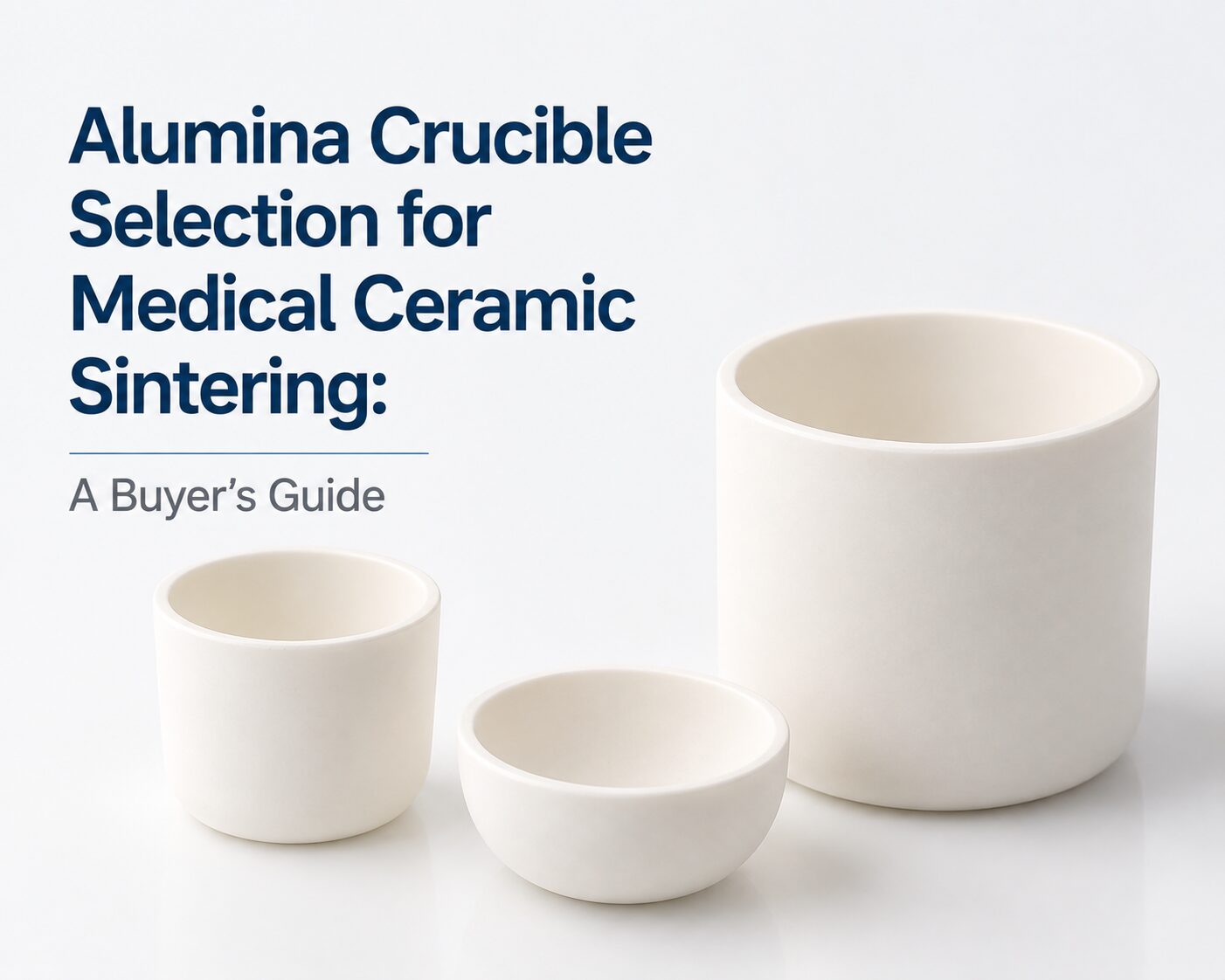
Selecting the right alumina crucible for medical ceramic sintering is not a routine procurement decision—it directly impacts product purity, yield consistency, and overall process economics. For manufacturers of dental zirconia abutments, alumina-based implant components, or advanced bioceramics, the crucible is more than a consumable vessel; it is a critical process variable.This guide walks through five key considerations to help buyers make informed, application-driven decisions.
1. Purity Grade: 99.5%, 99.8%, or 99.99%?
Purity is the primary performance driver for alumina crucibles. The choice depends on your operating temperature and—more critically—your sensitivity to contamination.
|
Purity Grade |
Max Use Temperature |
Best Suited For |
|
99.5% |
≤1750°C |
General-purpose sintering, R&D, standard ceramics |
|
99.8% |
~1765°C |
High-temperature applications with moderate purity requirements |
|
99.99% |
1800°C |
Medical ceramics, electronic materials, LED phosphors—where trace contamination is unacceptable |
For medical ceramic sintering, 99.8% or higher is strongly recommended. The reasoning is straightforward: lower-purity grades contain glassy phases and impurities (e.g., Na₂O, SiO₂, MgO) that can migrate into the workpiece at elevated temperatures. With dental and medical ceramics, even parts-per-million levels of contamination can compromise biocompatibility or mechanical properties.
The trade-off: higher purity crucibles are more expensive, but the cost is justified when product reliability and regulatory compliance are non-negotiable. For standard industrial ceramics, 95–99% grades may suffice; for medical-grade sintering, 99.8% is the practical baseline, with 99.99% reserved for the most sensitive applications.
Suppliers like Stanford Advanced Materials (SAM) offer a full range of purity grades—from 99.5% for general use to 99.99% for ultra-sensitive medical applications—with complete traceability documentation for each batch.
2. Density and Thermal Shock Resistance
Density and thermal shock resistance are closely linked. A denser crucible offers better mechanical strength and chemical inertness but can be more susceptible to thermal shock cracking if not properly designed.
For a 99.8% alumina crucible, typical density ranges from 3.93 to 3.96 g/cm³, with apparent porosity below 0.5%. Higher density translates to:
- Reduced gas permeability (less risk of contamination from furnace atmosphere)
- Superior chemical resistance (fewer grain boundaries for corrosive species to attack)
- Higher compressive strength (typically >2500 MPa for 99.8% grades)
Thermal shock resistance—the ability to withstand rapid temperature changes—is measured by the critical temperature differential (ΔT). For 99.8% alumina, ΔT is approximately 223–225°C. In practice, this means:
A crucible heated to 1700°C can tolerate rapid cooling to ~1475°C before cracking risk becomes significant.
Recent research demonstrates that optimized particle packing—using multi-scale alumina powder gradation—can improve thermal shock resistance significantly. One study showed that a crucible with bulk density of 3.82 g/cm³ achieved a flexural strength retention ratio of 50.1% after thermal shock, compared to 33.9% for a nano-alumina-only crucible. The closed pores within the microstructure effectively absorb thermal stress.
Buyer takeaway: Ask your supplier about both density (g/cm³) and thermal shock ΔT values. A high-density crucible with poor thermal shock performance will fail prematurely in cyclic heating applications.
3. Custom Sizing: Outer Diameter, Inner Diameter, Depth
Medical ceramic sintering often involves non-standard furnace geometries, batch sizes, or fixture requirements. Off-the-shelf crucibles may not fit—or worse, may waste furnace capacity.
Key dimensional specifications to define:
- Outer Diameter (OD): Must fit within furnace chamber with adequate clearance (typically 10–20 mm from heating elements)
- Inner Diameter (ID): Determines usable volume and workpiece capacity
- Depth (Height): Affects thermal uniformity—deeper crucibles can create temperature gradients
- Wall Thickness: Impacts thermal mass and thermal shock resistance; thinner walls heat faster but are more fragile
Standard cylindrical crucibles typically range from 4.5 mL to 1300 mL capacity, with OD from 25 mm to 140 mm. However, many medical ceramic processes require custom dimensions. Suppliers offering custom size capabilities are preferable—they can accommodate:
- Non-standard OD/ID ratios
- Specific depth-to-diameter proportions for uniform heating
- Crucibles with lids for volatile material containment
Shape also matters: cylindrical crucibles offer uniform heat distribution and are ideal for pipe furnace applications, while conical designs facilitate complete sample recovery during ashing or powder calcination.
4. Contamination Risk Control (Metal Ion Leaching)
This is the hidden cost of choosing the wrong crucible. Alumina is generally considered chemically inert, but ion elution does occur—especially at high temperatures or in reactive atmospheres.
A study measuring ion elution from dental ceramics found that while overall leaching was low, aluminium ion release was detectable and raised toxicity concerns for patients with renal insufficiency. For sintering, the concern is different but equally critical: metal ions (Al³⁺, Si⁴⁺, Na⁺, Mg²⁺) can diffuse from the crucible into the ceramic workpiece, altering:
- Sintering kinetics (impurities act as fluxing agents)
- Final grain size and microstructure
- Translucency (critical for dental aesthetics)
- Biocompatibility
Mitigation strategies:
- Select ≥99.8% purity—this minimizes glassy phase content, the primary source of ion migration
- Require leach testing data from your supplier—not all alumina crucibles are equal in ion release behavior
- Consider surface finish: smoother surfaces (Ra ≤ 0.5 μm) reduce contact area and potential for material transfer
- Use a liner or separator for ultra-sensitive materials (e.g., platinum foil, alumina felt)
Ion elution is not typically visible until product testing reveals unexplained property variations. A proactive approach—specifying purity, requesting leach data, and validating crucible performance in your process—is far more cost-effective than batch rejection.
? Brand Mention 2: Stanford Advanced Materials conducts rigorous ion leach testing on every production batch of medical-grade crucibles, providing detailed impurity analysis reports that allow buyers to verify compliance before materials enter the sintering furnace.
5. Supplier Lead Time and Warranty
Crucible failure or delayed delivery translates directly to production downtime—a cost that far exceeds the price of the crucible itself.
When evaluating suppliers, consider:
|
Criteria |
What to Ask |
|
Stock availability |
Are standard sizes in stock? What is the typical lead time? (Industry standard: 1–4 weeks for in-stock items) |
|
Custom order lead time |
10–20 business days for new molds or special dimensions; longer for complex geometries |
|
Inspection protocol |
Does the supplier perform 100% dimensional inspection before shipping? What measurement tools are used? (calipers, CMM, vision systems) |
|
Warranty/guarantee |
What is the policy for crucibles that fail prematurely under specified conditions? |
|
Minimum order quantity (MOQ) |
Can you purchase single units for testing, or is volume commitment required? |
Practical advice: Build a relationship with a supplier that offers both standard stock items and custom capabilities. This allows you to test with off-the-shelf crucibles during process development, then scale with custom specifications for production. Also, request samples for qualification—most quality suppliers will provide samples (shipping at customer expense).
Summary Decision Matrix
|
Consideration |
Recommended Specification for Medical Ceramic Sintering |
|
Purity Grade |
≥99.8% (99.99% for ultra-sensitive applications) |
|
Density |
≥3.93 g/cm³, apparent porosity <0.5% |
|
Thermal Shock ΔT |
≥220°C |
|
Dimensional Tolerances |
Custom capability preferred; confirm fit with furnace |
|
Ion Leaching |
Request supplier leach test data |
|
Lead Time |
1–4 weeks for stock; 2–4 weeks for custom |
|
Warranty |
Written guarantee against manufacturing defects |
For medical ceramic manufacturers seeking consistent, high-purity alumina crucibles with full traceability and technical support, Stanford Advanced Materials (SAM) offers 99.5%, 99.8%, and 99.99% alumina crucibles in standard and custom configurations. With over 20 years of experience and ISO-compliant quality systems, SAM provides materials that meet the rigorous demands of medical-grade ceramic sintering. Download technical datasheets or request a quote at www.samaterials.com.








1 thought on “Alumina Crucible Selection for Medical Ceramic Sintering: A Buyer’s Guide”
Comments are closed.