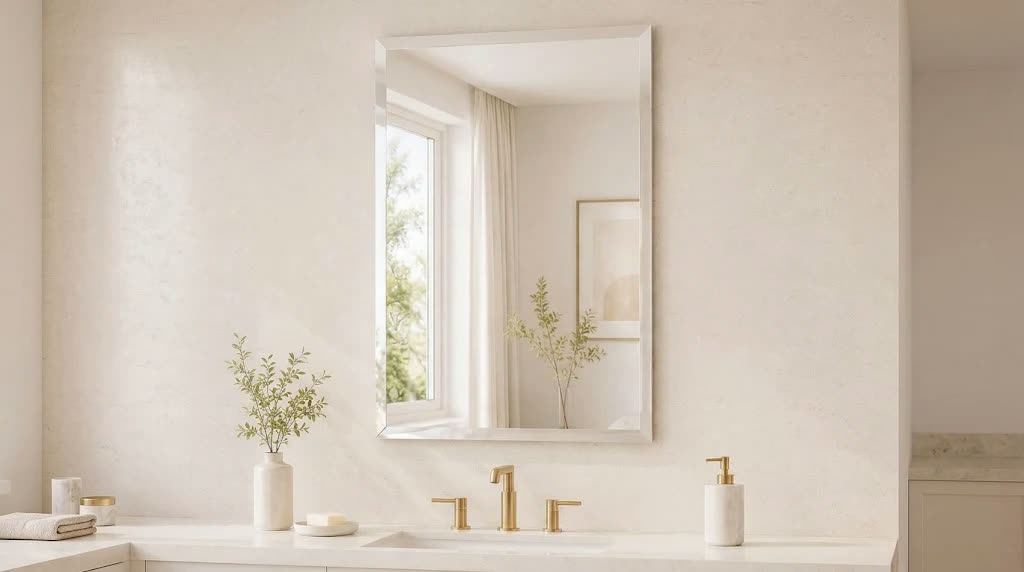
A bathroom mirror does more than provide a reflection. It influences how the room looks, how effectively the vanity area functions, and how natural and artificial light move through the space. The right mirror can make a compact bathroom feel more open, balance a wide vanity, and create a clean visual connection between different design elements. Among the many available shapes, Rectangle Frameless Bathroom Mirror remains a practical choice because they work with a wide range of bathroom layouts, from narrow powder rooms to spacious primary bathrooms with double sinks. Their straight edges complement modern, traditional, minimalist, and transitional interiors without requiring an elaborate frame.
Choosing a Rectangle Frameless Bathroom Mirror involves more than selecting a width and height. Edge finishing, glass thickness, mounting hardware, placement, lighting, and wall conditions all affect the final result. Understanding these details makes it easier to select a mirror that fits the room aesthetically and performs reliably in a frequently used environment.
Why Are Frameless Rectangular Mirrors Popular in Bathrooms?
Frameless mirrors are popular because they offer a simple appearance without adding another decorative border to the wall. Instead of drawing attention to a frame, they allow the reflective surface to become part of the bathroom's overall architecture.
The rectangular shape is particularly versatile. Its horizontal proportions can visually connect a wide vanity and countertop, while a vertical orientation can emphasize ceiling height in a smaller bathroom. This flexibility makes rectangular mirrors suitable for different room dimensions and vanity configurations.
Another advantage is their compatibility with various interior styles. A polished-edge mirror works well in contemporary spaces, while a beveled edge can introduce a subtle decorative detail without the visual weight of a traditional frame.
However, frameless does not mean maintenance-free. Water spots, toothpaste splashes, soap residue, and fingerprints remain visible on reflective surfaces. Regular cleaning and appropriate installation are important for maintaining both appearance and performance.
Choosing the Right Bathroom Mirror Size
Mirror dimensions should be based on the vanity, available wall space, sink placement, and lighting fixtures. A mirror that is too narrow can look disconnected from the vanity, while an oversized mirror may interfere with sconces, cabinets, or other architectural features.
How Wide Should a Bathroom Mirror Be?
A useful starting point is to choose a mirror that is slightly narrower than the vanity or countertop. Leaving a few inches of visible wall on either side often creates a balanced appearance.
For example, a 36-inch vanity may work well with a mirror approximately 30 to 36 inches wide, depending on the surrounding layout. A 48-inch vanity might accommodate a mirror around 40 to 48 inches wide.
These are design guidelines rather than fixed requirements. The actual dimensions should account for faucets, side walls, electrical fixtures, and the distance between the vanity and adjacent surfaces.
Standard Bathroom Mirror Dimensions
Bathroom mirrors are available in numerous dimensions, but certain sizes are commonly used in residential bathrooms.
|
Mirror dimensions |
Typical application |
|
20 x 28 inches |
Small powder rooms |
|
24 x 36 inches |
Compact bathroom vanities |
|
30 x 36 inches |
Standard single-sink vanities |
|
36 x 48 inches |
Wider bathroom vanities |
|
48 x 36 inches |
Larger horizontal installations |
|
60 x 36 inches |
Wide vanities and spacious bathrooms |
The best proportions depend on the wall's available height and width. Before purchasing or ordering a mirror, measure the usable wall area rather than relying exclusively on vanity dimensions.
One Large Mirror or Two Separate Mirrors?
Bathrooms with double sinks present an important design decision: whether to install one continuous mirror or two individual mirrors.
A single large mirror creates a unified appearance and provides a broad reflective surface. It can also make a double vanity feel more spacious. However, its dimensions and weight may require additional installation planning.
Two separate mirrors provide more visual definition around each sink. They also make it easier to incorporate individual wall sconces and create symmetrical arrangements.
The choice depends on the vanity's design, lighting arrangement, available wall space, and personal preference.
Understanding Glass Thickness and Quality
Glass thickness affects the mirror's rigidity, weight, handling requirements, and installation method. Bathroom mirrors are commonly manufactured using different thicknesses depending on their dimensions and intended application.
Common Bathroom Mirror Thicknesses
1/8-inch glass: This is a relatively thin option that may be suitable for smaller decorative mirrors, depending on the manufacturer's specifications and mounting system.
3/16-inch glass: Often used for smaller mirror applications, although larger installations may require a thicker specification.
1/4-inch glass: A common choice for residential wall mirrors because it provides greater rigidity and is suitable for many standard bathroom applications.
For larger mirrors, thickness should be selected according to the overall dimensions, support requirements, and installation method. A larger mirror is not automatically safer simply because it uses thicker glass. Proper backing, secure mounting hardware, and appropriate wall support are equally important.
What Is Mirror Silvering?
Most conventional bathroom mirrors are manufactured using a reflective coating applied to the back of a glass sheet. This coating typically contains a reflective metal layer, protective paint, and additional protective treatments.
The reflective coating is responsible for producing the mirror image. However, moisture can gradually damage the backing if it reaches exposed edges or compromised areas.
This is particularly relevant in bathrooms, where humidity levels can fluctuate significantly during showers and baths.
For better long-term performance, look for mirrors manufactured with suitable protective backing and moisture-resistant edge treatments. Proper ventilation also helps reduce the risk of deterioration.
Edge Finishes: Polished, Beveled, and Seamed
One of the most noticeable differences between frameless mirrors is the way their edges are finished. Since there is no surrounding frame to conceal the glass perimeter, edge quality directly affects the mirror's appearance and handling safety.
Polished Edge
A polished edge is smooth and finished to create a clean, refined appearance. It is particularly popular in contemporary bathrooms because it keeps the design understated.
The glass perimeter is ground and polished to remove sharpness and produce a smooth finish. This is a practical choice for mirrors with exposed edges.
Beveled Edge
A beveled mirror features an angled edge that creates a subtle decorative border. When light hits the angled surface, it produces a small reflective effect that adds dimension without requiring a separate frame.
Beveled edges work especially well in transitional and traditional bathrooms, where a completely plain mirror might look too minimal.
Seamed Edge
A seamed edge has been processed to remove sharp edges but does not have the same refined appearance as a fully polished finish. It may be appropriate for certain installations where the edge is concealed or where a less decorative finish is acceptable. For exposed bathroom mirror edges, polished finishes are generally preferred.
Horizontal vs. Vertical Mirror Placement
The orientation of a mirror changes how it relates to the vanity and the surrounding architecture.
Horizontal Bathroom Mirrors
A horizontally installed mirror is usually the natural choice for wide vanities. It extends across the countertop and can visually connect multiple sinks or faucets.
This arrangement works particularly well in primary bathrooms, family bathrooms, and spaces with long vanity cabinets.
Horizontal mirrors can also make a narrow wall feel wider by extending the reflective surface across more of its width.
Vertical Bathroom Mirrors
A vertically positioned mirror emphasizes height rather than width. This arrangement is useful in smaller bathrooms, narrow vanity areas, and powder rooms with limited wall space.
Vertical mirrors can also accommodate taller users more comfortably, provided the installation height is appropriate.
For a balanced appearance, consider the proportions of the mirror alongside the vanity, ceiling height, and wall lighting.
Where Should a Bathroom Mirror Be Installed?
Mirror placement affects everyday usability just as much as appearance. Even a well-designed mirror can become inconvenient when positioned too high, too low, or too close to surrounding fixtures.
Recommended Installation Height
There is no universal installation height for every bathroom mirror. The correct position depends on the height of the people using the bathroom, mirror dimensions, vanity height, and available wall space.
A practical approach is to position the mirror so that its center is approximately at the average user's eye level. In many residential bathrooms, this results in a mirror center around 60 to 65 inches above the finished floor.
However, this is a starting point, not a building-code requirement.
The mirror should provide a comfortable reflection for the primary users without requiring them to bend down or stretch upward. If multiple household members have significantly different heights, consider a larger reflective area that accommodates everyone.
Distance Between the Mirror and Vanity
The bottom edge of the mirror should generally sit a short distance above the backsplash or faucet area.
A gap of approximately 2 to 6 inches can work in many bathroom layouts, but the actual clearance depends on faucet height, backsplash dimensions, countertop design, and mirror mounting requirements.
Avoid placing the mirror so close to water outlets that routine splashing becomes a persistent problem.
Lighting Considerations for Frameless Bathroom Mirrors
Lighting plays a major role in how effectively a bathroom mirror functions. Poorly positioned lights can create shadows, uneven illumination, and glare, making every day grooming tasks less comfortable.
Side Lighting for Better Facial Visibility
Wall sconces positioned on either side of a mirror can provide more balanced facial illumination than a single overhead light.
When possible, position the light sources around face level and select fixtures designed for bathroom environments. The goal is to reduce harsh shadows around the eyes and chin.
Overhead Lighting
Ceiling-mounted lights provide general room illumination but should not be the only light source near a bathroom vanity. A strong overhead light can cast shadows downward, making detailed grooming tasks more difficult. Combining ceiling lighting with appropriately positioned vanity lighting creates a more functional arrangement.
LED Mirrors and Backlighting
Some bathrooms use LED lighting behind or around the mirror to create a soft glow. Backlighting can provide visual depth and contribute to ambient illumination. However, decorative backlighting should not automatically be treated as task lighting. Its effectiveness depends on brightness, light distribution, color temperature, and fixture design. For makeup application, shaving, and skincare, dedicated vanity lighting remains important.
Frameless Bathroom Mirrors and Different Interior Styles
One reason rectangular mirrors remain popular is their ability to complement different bathroom design approaches.
Modern and Minimalist Bathrooms
In minimalist bathrooms, frameless mirrors help maintain uninterrupted visual lines. They work well with floating vanities, neutral wall colors, simple faucets, and understated hardware. A polished-edge mirror is particularly suitable because it avoids introducing unnecessary decorative details.
Traditional Bathrooms
Traditional bathrooms often incorporate detailed cabinetry, decorative tile, and classic fixtures. A beveled-edge mirror can complement these elements while preserving the simplicity of a frameless installation.
Industrial Bathrooms
Industrial interiors frequently feature concrete-look surfaces, dark metal fixtures, exposed hardware, and textured finishes. A simple rectangular mirror provides a reflective contrast without competing with the stronger architectural elements.
Small Bathrooms
Smaller bathrooms benefit from mirrors that reflect available light and visually expand the room. A mirror positioned across from a window or another light source can help distribute brightness.
However, mirrors do not physically increase room dimensions. Their effect is visual, and the result depends on what they reflect.
How to Install a Frameless Bathroom Mirror
Installation requirements depend on the mirror's size, weight, wall material, and mounting system. Smaller mirrors may use basic mounting hardware, while large glass panels require more careful support.
Mirror Clips and Mounting Brackets
Mirror clips are commonly used to secure glass mirrors to walls. They typically support the mirror along its lower and upper edges while allowing it to remain removable.
The clips must be compatible with the glass thickness and mirror weight. Their placement should also distribute the load properly.
Mirror Adhesive
Specially formulated mirror adhesive can provide a clean installation without visible clips. However, ordinary construction adhesives are not necessarily suitable for mirrors.
Some adhesives contain chemicals that can damage reflective backing or cause discoloration over time. Always use an adhesive specifically approved for mirror installation and follow the manufacturer's instructions.
Preparing the Wall
Before installation, inspect the wall for moisture damage, uneven surfaces, and loose materials. Heavy mirrors should be secured using appropriate anchors or structural support rather than relying on drywall alone.
For particularly large or heavy mirrors, professional installation is a sensible precaution. Tempered glass requirements, handling procedures, and local building regulations should also be considered where applicable.
Cleaning and Maintaining a Frameless Bathroom Mirror
Regular cleaning helps preserve reflection quality and prevents residue from accumulating around the edges. Use a clean microfiber cloth and a glass cleaner suitable for mirror surfaces. Spray the cleaning solution onto the cloth rather than directly onto the mirror. This reduces the possibility of liquid collecting along the edges and reaching the reflective backing.
Avoid abrasive pads, harsh chemicals, and excessive moisture around exposed edges. Bathroom ventilation is equally important. An exhaust fan helps remove excess humidity, reducing condensation and moisture exposure. If the mirror frequently develops fog, improving ventilation may be more effective than repeatedly wiping its surface.
Common Mistakes to Avoid When Choosing a Bathroom Mirror
Several seemingly minor decisions can affect the mirror's appearance and long-term performance.
- Choosing the wrong dimensions: A mirror that does not match the vanity's proportions can make the entire wall look unbalanced.
- Ignoring lighting placement: Poorly positioned fixtures can create shadows and reduce visibility.
- Overlooking edge quality: Exposed, unfinished edges can affect appearance and safe handling.
- Using incompatible adhesive: Incorrect adhesives can damage the reflective backing.
- Ignoring wall support: Large glass mirrors require mounting systems appropriate for their weight.
- Neglecting ventilation: Persistent humidity can contribute to deterioration around mirror edges.
Taking measurements and planning the installation before selecting a mirror can prevent many of these problems.
Final Thoughts
Choosing the right bathroom mirror requires balancing appearance, proportions, lighting, glass quality, and installation requirements. Rectangular frameless designs offer flexibility because they work with different vanity sizes, interior styles, and bathroom layouts.
The most important considerations are accurate measurements, suitable glass thickness, properly finished edges, appropriate mounting hardware, and sufficient clearance around faucets and lighting fixtures.
Rather than choosing a mirror based on appearance alone, consider how it will function in everyday use. A carefully selected and correctly installed mirror can remain a practical and visually appealing part of a bathroom for many years.
Bakery cafés prove that simple materials, light colours and clean counters create an inviting atmosphere. If you are in the UK and want to see what a visit might cost, Greggs Menu Price covers the full menu and current deals.