–
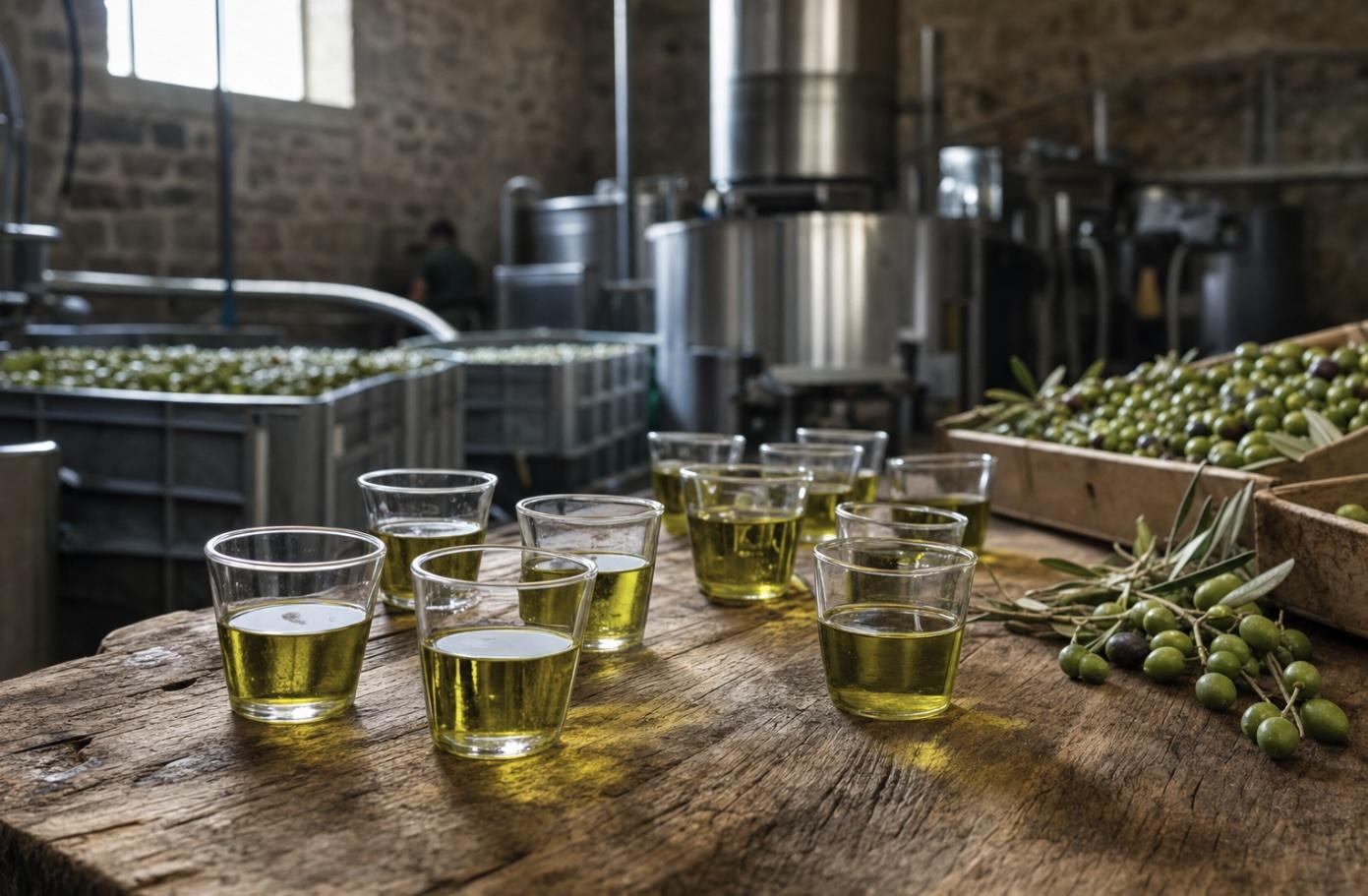
What should you expect from an olive oil tasting in Italy? Expect a short course in agriculture and craft before you expect flavour notes. A well-run visit walks you through the grove, explains how the fruit travelled from tree to mill, then pours two or three oils side by side so you can taste the consequences of those choices rather than simply admire them.
The short answer: what happens at an olive oil tasting
Most sessions combine three elements: time among the trees, a look at the mill — the frantoio — or a straightforward explanation of where milling takes place, and a guided comparison of several oils. You pick up a way of assessing what is in the glass: smell first, then weigh bitterness against pungency, then judge balance and aftertaste. More usefully, you learn to separate the sensations that signal freshness from those that signal a fault. That second skill is the one that lasts.
It matters more than most visitors expect, because the professional classification of virgin olive oils is not a matter of personal preference. The International Olive Council's method for the organoleptic assessment of virgin olive oil, in its 2024 revision, applies only to virgin olive oils and classifies them according to the intensity of perceived defects and of fruitiness, as judged by a trained and monitored tasting panel. A tasting that teaches you those same categories, even in amateur form, hands you a transferable tool.
Tasting is a way of reading decisions, not just flavours
People often arrive expecting a vocabulary lesson: peppery, grassy, artichoke, green almond. The vocabulary is useful, but it names an outcome without explaining it. The more interesting subject available on an olive farm is the chain of decisions behind the bottle — when the fruit was picked, how quickly it reached the mill, how the oil was handled afterwards, how it was kept through the following summer.
Once you can hear those decisions described out loud, the glass starts to make sense. Bitterness stops looking like a flaw and becomes information. A flat, waxy oil stops being merely disappointing and starts pointing towards oxidation. This is also why an on-site session tends to teach faster than solo experiments at the kitchen counter: you attach a sensation to a practice while the practice is still in front of you. If you want an example of a grove-first, method-led tasting format, Love Olive Oil is one place to start looking.
Diversity is what makes the lesson legible. Different olive varieties, altitudes, harvest dates and milling habits sit within a short distance of one another in many Italian growing areas, and hosts will usually explain, without much prompting, how their choices differ from a neighbour's. That contrast is the teaching instrument, which is why side-by-side pouring is more instructive than one flagship bottle poured with ceremony.
The olive oil year: a calendar of questions, not a set of rules
Olive oil is an annual crop worked within a narrow window, and each phase of the year involves choices the producer can talk through. What follows is not a list of agronomic laws — practice varies by variety, region and season — but a sequence of prompts that turn a pleasant outing into a real conversation.
Winter and spring: how the grove is managed
Ask how the trees are pruned and who decides. Ask what happens to the cut wood, whether the ground between the rows is kept bare or under cover, and how the grove has changed over the past decade. You are not fact-checking anybody. You are listening for whether the place is run as an orchard, as a landscape, or as both. Producers who can describe their own trade-offs, including the ones they are still arguing about among themselves, tend to be the ones worth tasting with.
Summer: what the producer is watching
Summer in a grove can look like inaction. It rarely is. Ask what the team monitors between flowering and harvest, what they intervene on and what they deliberately leave alone, and how a difficult season shows up in the finished oil. The answers differ from farm to farm, which is exactly the point: this is the kind of detail a visit can give you and a label cannot.
Autumn: the harvest window
Harvest is the part of the calendar visitors most want to see, and the part with the widest variation between producers. Ask when picking started this year and why, how the fruit travels from tree to mill, and how many hours usually pass in between. That last question is not idle curiosity. Fusty character — fermented, stale flavours — is associated with storing olives too long before milling, and it is one of the faults trained tasters recognise fastest.
Travellers who want to see a working mill often try to align their trip with milling season, which is why an olive oil tasting in Tuscany is such a common autumn plan. Dates shift from year to year with the season, so ask the host directly rather than assuming a fixed week.
After the harvest: keeping the oil intact
Some of the most avoidable damage happens once the oil already exists. Rancid character — a stale, waxy taste — is associated with oxidation from exposure to air, light or heat, which makes storage and bottling legitimate subjects for a visitor to raise. Ask when the specific lot in front of you was bottled. A producer who answers without hesitation is telling you something about the whole operation.
At the mill: the questions that reveal the most
The frantoio is where a tasting turns technical, and where curiosity pays off. Millers make a series of choices — how the fruit is crushed, how the paste is worked, whether the oil is filtered — and each of them tends to be defended with conviction. As a visitor you are not in a position to referee those debates, and you do not need to be. Two lines of enquiry are enough to keep the conversation grounded.
- How long between tree and mill? The question most likely to distinguish careful producers from casual ones, for the reason above: fermented, stale notes are associated with fruit left waiting before milling.
- How is the equipment kept? Unglamorous and decisive. A dirty, earthy taste in oil is associated with contact with sediment or with unclean equipment, so walking through a well-kept mill is informative in itself.
Everything else — machinery, timings, filtration — is worth asking about out of interest, and worth listening to as reasoning rather than as proof. When a host uses a shorthand phrase about extraction, treat it as an invitation to ask what was actually done to that batch.
A tasting sequence you can borrow
There is no single script that every Italian host follows, but the sequence below is close to what many guided sessions use, and it works just as well at home. Think of it as a practical routine rather than an official procedure.
- Pour a small amount into a cup or small glass and warm it gently in your palm.
- Cover the top, then smell. Note the aroma family first: green and herbaceous, or riper and nuttier.
- Take a small sip and hold it at the front of your mouth.
- Draw a little air across the oil through slightly parted lips to release the aromatics.
- Weigh the bitterness on the tongue against the pungency in the throat, then consider balance and aftertaste.
- Write one line per oil: aroma family, bitter and pungent intensity from low to high, and one dish you would use it on.
Tasting several oils in a row, in my experience, builds sensory memory far faster than tasting one at a time over weeks. Contrast is what makes the differences audible.
Bitterness is a quality; rancidity is a fault
This distinction is the most useful thing a visitor can carry home, and it is not a question of taste. The international sensory method defines fruity, bitter and pungent as positive attributes of virgin olive oil. Fruitiness reflects the fresh aroma and flavour of olives and signals freshness and quality; pungency is that throat-irritating sensation, often associated with compounds such as oleocanthal and oleacein. The peppery catch and the bitter edge are not defects to be tolerated politely. They belong to the category's own definition of quality.
The same method allows optional labelling terminology based on the median intensity of those positive attributes: robust when the median is above 6.0, medium between 3.0 and 6.0, delicate below 3.0. Whether a particular bottle uses that terminology, and on what basis, is a perfectly reasonable thing to ask the person pouring.
On the negative side, the method defines a set of faults, among them fusty and muddy sediment, musty-humid-earthy, winey-vinegary, acid-sour, rancid, and frostbitten olives with their wet-wood note. In plain language, the ones a visitor is most likely to meet are these:
- Fusty — fermented, stale flavours, associated with storing olives too long before milling.
- Musty — mouldy or damp notes, associated with improper storage or contamination.
- Winey or vinegary — sour, acidic flavours, associated with fermentation during poor storage.
- Muddy sediment — a dirty, earthy taste, associated with contact with sediment or unclean equipment.
- Rancid — a stale, waxy taste, the result of oxidation from air, light or heat.
Such faults often trace back to handling, storage or processing rather than to the fruit itself. And the consequence is categorical rather than stylistic: the absence of defects is a requirement for the Extra Virgin classification, so an oil can be disqualified from the premium category on sensory grounds alone.
These are not rare curiosities. Competition data published for submissions to the 2024 NYIOOC show a panel recording 627 occurrences of seven defects across the entries; fustiness turned up in 278 samples, 44% of total defect occurrence, and rancidity in 172 samples, 27% of the total. More than ten percent of the entries sent in were defective. Those were oils producers had chosen to put forward for international judging, which is a useful reminder that recognising fustiness is a practical skill rather than a connoisseur's hobby.
Worth adding: the discipline is younger than most people assume. Sensory analysis of olive oil began at the Institute of Fats in Seville during the 1970s. Experts from six countries developed an organoleptic assessment method between 1982 and 1986, it was adopted in 1987, and it entered legislation in 1991.
Bread, and the trouble with judging by softness
Hosts often begin with bread, and they will usually explain why: it carries the oil without competing with it. You may also notice that a mild carrier makes small differences harder to spot, which is why a well-run session tends to move on to food with more character.
Rather than memorise pairing rules, test them. Take the same two oils across three things — plain bread, a boiled white bean, a grilled vegetable — and note where each one gains and where it disappears. That exercise taught me something no tasting note conveys: oil has a function at the table, not only a flavour. Some oils dominate a delicate dish; others vanish under a robust one. Your notebook will tell you which is which faster than any generalisation.
The common mistake is to judge an oil by softness. An oil that offends nobody may simply have lost its aromatics. A better question is which dish it was made for.
Labels, questions and the bottles you carry home
Two habits make a purchase better informed. First, ask in person when the olives were picked and when that lot was bottled; a conversation gives you information a shelf rarely does. Second, treat descriptive wording on the front of the label as a starting point for questions rather than a verdict, and pay more attention to what the producer can tell you about harvest and handling.
Since rancid character is associated with oxidation from air, light and heat, it follows that the bottles of olive oil you carry home deserve a closed cap and a dark, cool spot rather than a decorative one. Personally, I buy in quantities I know I will get through, and keep the interesting comparisons for the first months after opening.
Signals of a tasting worth your afternoon
Not every experience marketed to travellers is designed to teach. A few signals help you choose:
- A walk in the grove and access to a mill — or a clear, unembarrassed explanation of where milling happens when it is done off-site.
- Specific talk about harvest timing and about the hours between picking and pressing.
- Several oils to compare, including contrasting styles, rather than one bottle poured with ceremony.
- Willingness to discuss faults as well as virtues. A host who can describe what a fusty oil smells like is confident about their own.
- Small groups, and unhurried time for questions.
- Practical guidance for home use — how to finish a dish, how to store a bottle — offered before any mention of shipping cases abroad.
Regional reputation is a weak filter on its own. Travellers searching for olive oil Tuscany experiences will find no shortage of options, and one traveller account describes a family-run tasting just outside San Gimignano, with olive groves and vineyards on the same estate and the town centre close enough to walk from if you are staying there. Pleasant, certainly. But the setting is not the deciding factor; the question is whether the specific visit is organised around learning.
Take the method home
Buy two oils in contrasting styles and taste them side by side once a month, same sequence, same short notes. Track how each one shifts as the months pass — since oxidation is associated with air, light and heat, you will meet the rancid note on your own terms, which is an efficient way to understand what the word means in your own mouth. Re-taste both on different foods to grasp function rather than flavour alone.
A week in Italy will not turn anyone into a panel taster. It can, though, replace vague enthusiasm with a working method: smell, sip, aerate, weigh bitterness against pungency, note the aftertaste, and ask when the fruit was picked. That habit outlasts the holiday, and it travels well.