

–
Designing an industrial oven for surface treatments is not simply a matter of selecting a maximum temperature and calculating how long a product should remain inside the chamber. The effectiveness of an oven depends on how energy reaches the surface, how quickly the product responds to heat and how accurately the thermal profile matches the treatment being performed.
Drying liquid coatings, gelling or curing powder coatings, drying inks and preheating components all involve different thermal requirements. In some processes, convection remains essential. In others, infrared heating can offer a more direct approach because radiant energy acts on the exposed surface instead of relying exclusively on heating the surrounding air.
This is why companies such as Infragas develop different infrared gas technologies rather than a single heating solution for every application. Designing the right oven starts with understanding the process.
Start with the surface treatment, not the oven temperature
A common mistake in industrial oven design is focusing too early on temperature. Two applications operating at similar temperatures may need completely different heating strategies.
A water-based coating has to release moisture. A solvent-based coating involves evaporation of volatile components. Powder coating must pass through melting, flow and curing stages. A component being preheated for a subsequent operation may simply need to reach a defined surface or bulk temperature.
The first questions should therefore be: what must happen to the material, where must the energy be delivered and how much time is available?
Once these factors are understood, engineers can evaluate the most appropriate combination of radiant heating, convection, airflow, oven length and process control.
Where convection heating works well
Convection ovens transfer heat through circulating hot air. This makes them suitable for many industrial processes, particularly when the objective is to bring an entire component toward a relatively uniform temperature.
Hot air can reach surfaces with complex geometries and areas that may not be directly exposed to a radiant source. It can also help maintain controlled environmental conditions throughout a thermal chamber.
However, convection first requires energy to heat the air, which then transfers heat to the product. When the main objective is a surface-driven thermal treatment, this indirect route may require longer residence times or larger heating sections than a more targeted radiant approach.
This does not make convection inefficient by definition. It simply means that oven architecture should reflect the physics of the actual process.
Where infrared heating fits best
Infrared heating is particularly interesting when energy needs to be transferred quickly and directly to a surface.
Infrared radiation travels from the emitter toward the exposed product and becomes heat when it is absorbed. Because the energy does not depend solely on warming the surrounding air, the response at the surface can be rapid.
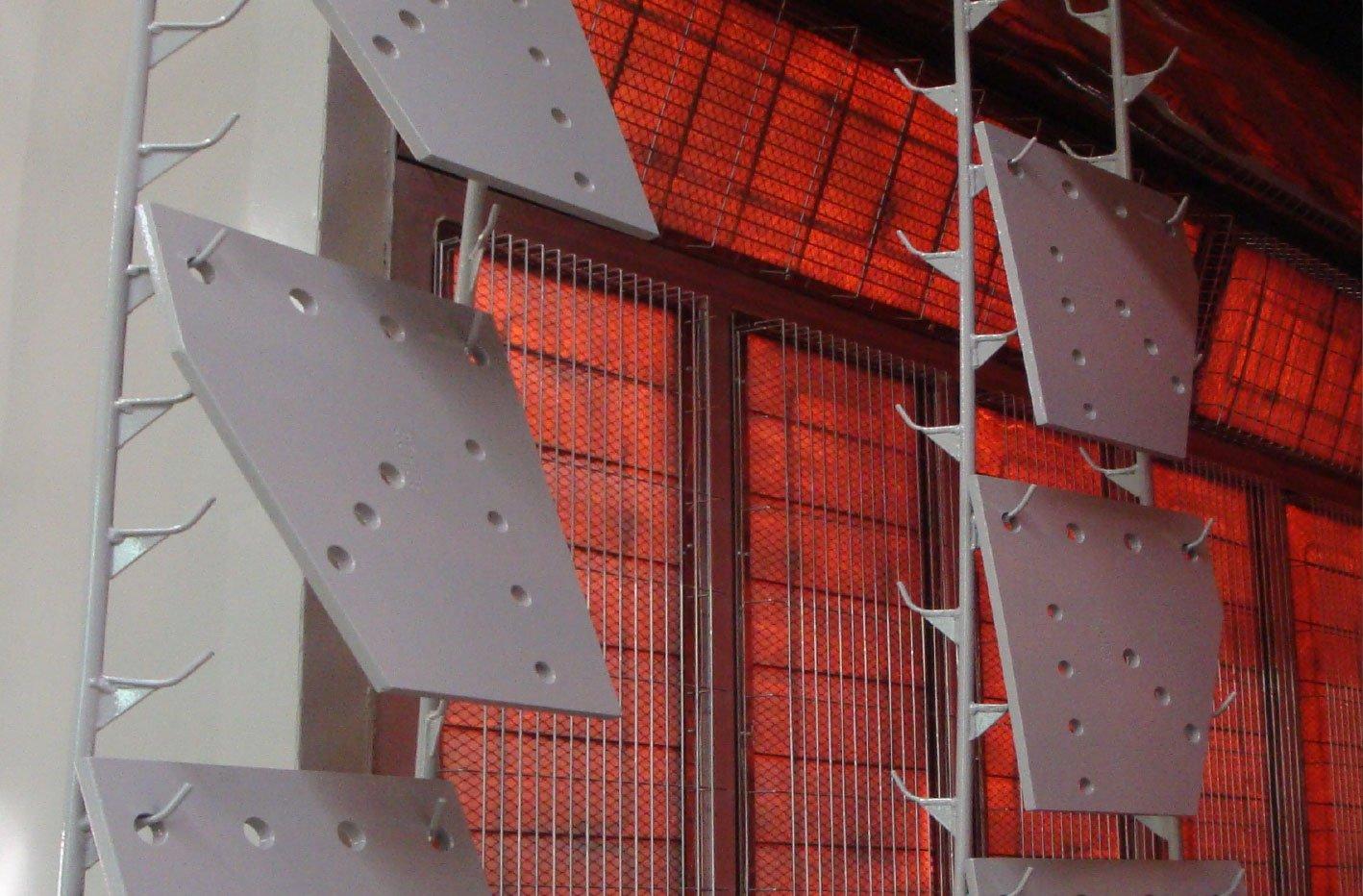
This characteristic makes infrared technology relevant to processes such as paint drying, powder coating treatment, ink drying, preheating and other industrial surface treatments.
The potential benefit is not simply a higher temperature. It is the possibility of concentrating thermal energy where it is needed and designing a heating section around a specific process stage.
For oven manufacturers, this can open the door to shorter treatment zones, quicker thermal response and more precise zoning.
Infrared zones within an industrial oven
An infrared system does not necessarily have to replace the entire oven. In many designs, the most logical position for radiant heating is at a particular stage where rapid energy transfer creates the greatest process advantage.
For example, an infrared zone may be used to preheat a component before another treatment. In a coating line, radiant energy can act on the surface during a critical heating phase. In other configurations, the oven can include several independently controlled heating zones to create a more appropriate thermal profile.
This modular approach is important because industrial thermal processes rarely remain constant from beginning to end.
The initial heating phase may require fast energy input, while later stages may require temperature maintenance or a different heating intensity. Designing separate zones makes it possible to treat each stage according to its real thermal function.
Material absorption changes the design
Infrared heating cannot be designed only according to emitter power. The material being processed must be considered because different surfaces absorb radiant energy differently.
Colour, coating composition, thickness, surface finish and substrate characteristics can all affect thermal behaviour. Product geometry also matters. A flat panel presents a very different radiant target from a three-dimensional component with recesses, corners and partially shielded areas.
Distance between the emitter and the product, conveyor speed and exposure time must therefore be evaluated together.
This is one reason why testing is important when designing infrared ovens. A configuration that works effectively for one coating or component may need adjustment when the product changes.
Choosing between INFRACAT, BOOSTERCAT and RHT
Infragas offers different infrared gas technologies for different thermal requirements.
INFRACAT uses catalytic infrared heating and is designed for surface thermal treatments requiring controlled radiant energy. BOOSTERCAT belongs to the catalytic family but provides a higher level of thermal intensity for processes where greater infrared power density is required.
For higher-temperature applications, RHT Radiant High Temperature systems use a premixed air-gas technology and provide a different radiant solution from catalytic panels.
The existence of these different technologies highlights an important principle in industrial oven design: the best emitter is not necessarily the one capable of reaching the highest temperature.
The correct solution is the one whose radiation characteristics, power level and control capabilities match the material and the required thermal cycle.
Line speed and residence time must be designed together
Production speed has a direct effect on oven design. Increasing conveyor speed reduces the time available for each component to absorb the energy required by the process.
If the residence time becomes too short, the designer may need to increase heating intensity, extend the oven or reorganize the thermal stages.
Infrared heating can become particularly valuable when manufacturers want to increase line speed without simply extending the oven footprint. A properly engineered radiant section can deliver significant energy during a relatively short exposure period.
However, this must remain compatible with the material. Adding power without understanding absorption and temperature development can create surface defects or uneven treatment.
Line speed, energy density and residence time therefore have to be treated as interconnected design variables.
Uniformity remains as important as power
Industrial oven performance should never be evaluated only in kilowatts. A high-power heating section offers little advantage if energy distribution is inconsistent across the working width or between different areas of the component.
Emitter arrangement, spacing, orientation and control are essential for creating repeatable thermal conditions.
This becomes especially important in wide production lines, coating applications and products where surface quality must remain consistent from one batch to another.
For companies designing infrared sections, the objective is therefore not maximum radiant output, but controlled and uniform energy transfer.
Infragas also supports oven and plant manufacturers through application analysis and testing, helping determine which infrared configuration is suitable for specific thermal treatments.
Designing the thermal process around the product
The best industrial oven is not necessarily the largest, hottest or most powerful one. It is the system that delivers the required energy to the product in the right way and at the right stage of the process. Infrared heating fits best where surface-focused energy transfer, rapid thermal response and controlled treatment zones create a real production advantage. By combining process analysis with technologies such as INFRACAT, BOOSTERCAT and RHT, Infragas provides oven manufacturers with different tools for designing thermal systems around the material, line speed and quality requirements rather than around temperature alone.











1 thought on “Designing Industrial Ovens for Surface Treatments: Where Infrared Heating Fits Best”
Comments are closed.