

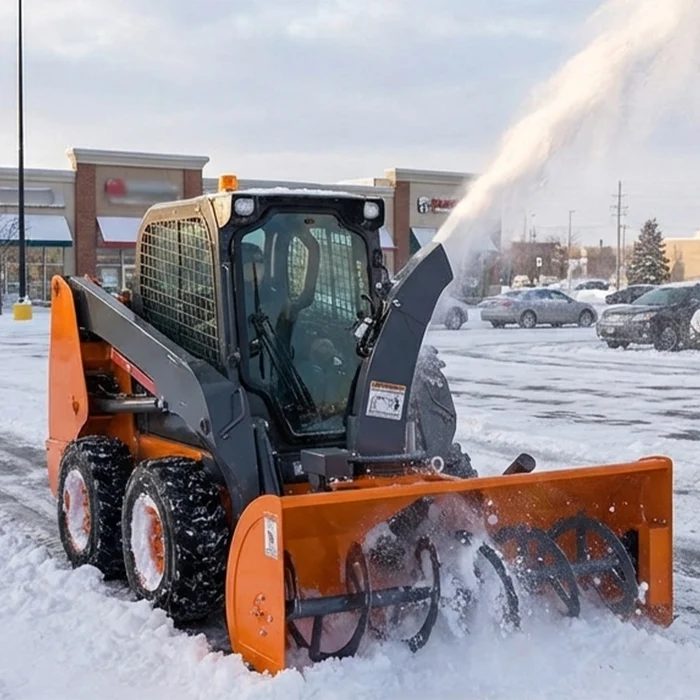
A six-foot head on a machine that cannot feed it is slower than a four-foot head on one that can. Clearing width sets the theoretical capacity of a snow blower attachment, and hydraulic flow from the carrier sets what fraction of that capacity is actually available on a wet midwinter morning.
This is why two operators running the same skid steer snow blower report different throughput. One has a loader delivering flow near the top of the stated range and the other is at the bottom, and the auger speed, impeller speed, and discharge distance all scale with that difference rather than with the badge on the housing.
Hydraulic Flow Is the Real Capacity Limit
Manufacturers publish a loader horsepower range for a snow blower attachment, and that figure is a proxy for flow. A unit specified for a forty-five to seventy-five horsepower carrier is really asking for the auxiliary flow that class of machine typically supplies, because the motor driving the auger needs a given volume per minute to maintain speed under load.
Underfeeding shows up as plugging rather than as a slow machine. The auger slows, snow stops being fed to the impeller fast enough to keep the housing clear, and the whole head packs solid. The operator then has to reverse out and clear it by hand, which costs more time than the slower pass would have.
Impeller Diameter Versus Discharge Distance
Throw distance from a snow blower attachment comes from impeller tip speed, which is a function of diameter and rotational speed together. A larger impeller at the same rpm moves its outer edge faster and launches snow further, which is why diameter appears in the specification alongside the clearing width.
Distance is also what separates this approach from a blade or a snow pusher, which relocate snow rather than removing it and therefore need somewhere to put the pile. On a confined site that somewhere runs out by the third storm of the season.
Distance matters more than it sounds on a narrow driveway or a laneway bordered by trees. Snow that lands six feet from the edge becomes next week's problem, since the windrow narrows the path and eventually has to be moved a second time. Throwing it twenty feet instead removes that second pass entirely.
Wet snow changes the calculation. Dense, high-moisture snow absorbs far more energy per cubic foot and will not travel as far at any given tip speed, so a head that throws thirty feet in dry powder may manage half that in slush. Specifications quote the favorable condition, which is reasonable but worth reading as an upper bound.
Chute Rotation and Where the Snow Ends Up
A chute that rotates through a full circle lets an operator discharge to either side without repositioning the machine, and on a parking lot that single feature changes the route plan. Clearing can proceed in one direction while always throwing away from the building, rather than alternating passes to keep snow off the doors.
Hydraulic rotation is the usual implementation and the usual maintenance item. The swivel joint sits in the weather, collects salt spray, and seizes if it is never greased, at which point the operator loses the capability without the machine showing any other symptom. It belongs on the weekly list rather than the annual one.
Deflector adjustment handles the vertical half of the problem. Throwing high carries snow further; throwing low keeps it from blowing back over the cab in a headwind. Having both available from the seat matters more on a long route than any single specification.
Why Cutting Edges Wear Unevenly
The cutting edge on a commercial snow blower head contacts the surface across the full width, but wear concentrates where the operator habitually carries the weight. On a crowned driveway cleared in one direction every time, one end of the edge disappears while the other looks new, and the head then rides at an angle that leaves a strip behind.
Skid shoes are what prevent this from becoming damage. Set correctly, they carry the head a fraction of an inch above the surface so the edge works snow rather than grinding pavement, and they are consumable in a way that the housing is not. Checking them before the first snowfall is a five-minute job that protects a much larger part.
Surface type decides the setting. On gravel the shoes should be set high enough to leave a thin layer of snow and keep stones out of the impeller, while on concrete a closer setting gives a cleaner finish. Operators clearing both surfaces usually compromise toward the gravel setting, because a stone through the housing is the more expensive outcome. TMG Industrial lists required loader flow alongside impeller diameter and chute rotation, and matching those to the carrier on hand is what separates a head that keeps up from one that plugs.









1 thought on “Loader Flow, Not Width, Limits What a Snow Blower Attachment Clears”
Comments are closed.