

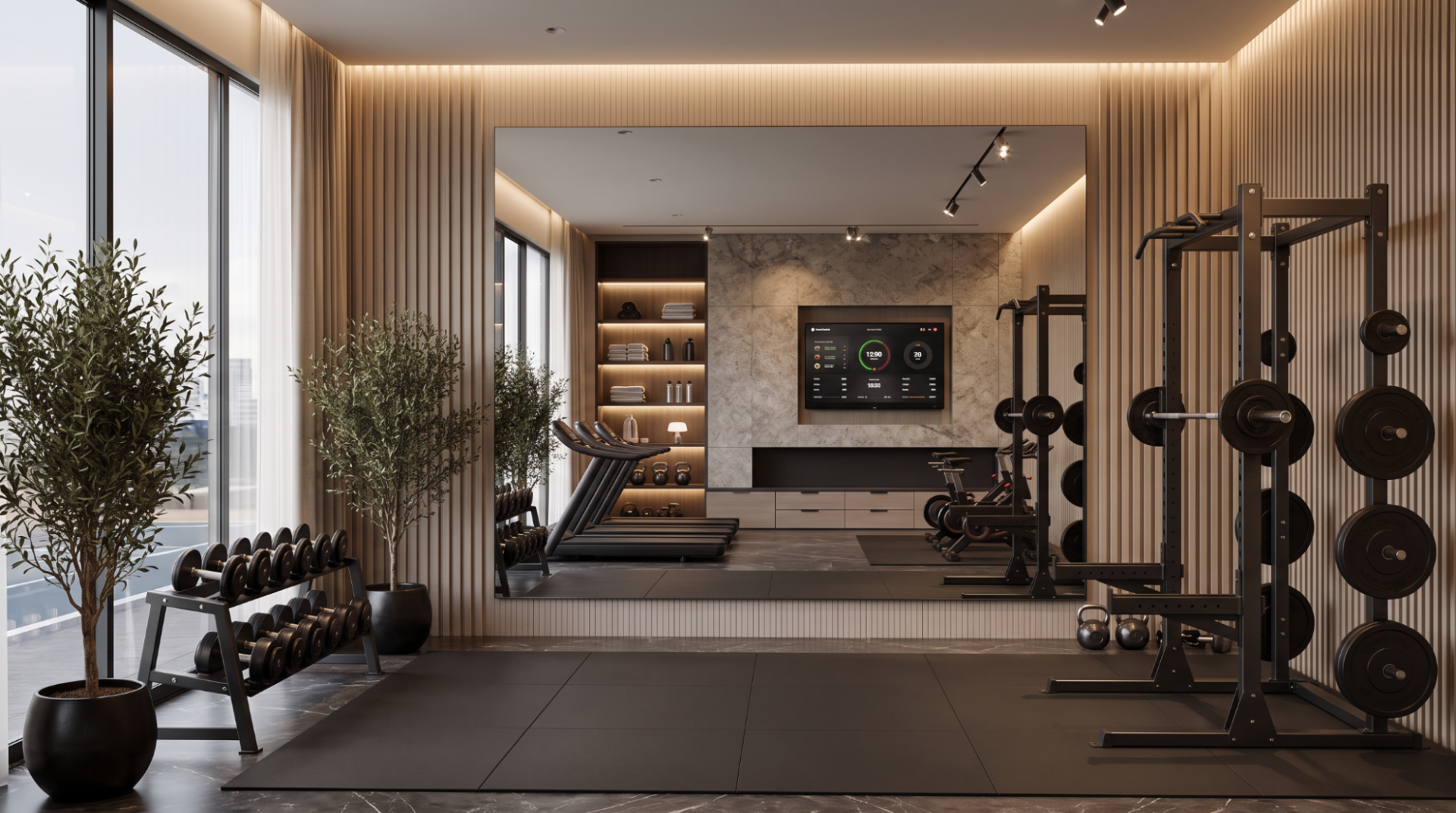
A well-placed gym mirror does more than make a workout room look bigger. It can help you check exercise form, monitor alignment, improve spatial awareness, and make a small training area feel more open. But choosing the right frameless mirrors for home gym requires more thought than simply buying the largest mirror that fits on the wall.
Glass thickness, dimensions, wall construction, mounting method, seams, safety features, and lighting all affect the final result. Frameless designs are especially popular because they create a clean, uninterrupted appearance and can be installed across multiple panels to create a larger reflective surface.
Why Use Mirrors in a Home Gym?
The primary reason to install a mirror is visual feedback. During strength training, yoga, Pilates, mobility work, and other exercises, being able to see your body position can make it easier to identify obvious form problems.
For example, a mirror can help you observe whether your knees are tracking properly during a squat, whether your back position changes during a deadlift setup, or whether your shoulders remain level during certain movements.
That does not mean a mirror replaces professional coaching. It simply provides another source of visual feedback.
Mirrors can also influence how a workout room feels. A large reflective surface can make a compact garage gym, basement workout room, spare bedroom, or studio appear substantially more open. When several panels are installed closely together, the reflection can create the impression of a much larger room.
Frameless vs. Framed Gym Mirrors
The biggest visual difference is straightforward: framed mirrors have a visible border around the glass, while frameless mirrors expose the polished glass edge. For a home gym, the frameless approach can be particularly useful when the objective is maximum visual coverage. Multiple panels can be positioned beside one another without thick frames interrupting the overall reflection.
Framed mirrors can still make sense when the design calls for a more decorative appearance or when the frame is part of the room’s aesthetic. They may also provide additional rigidity depending on the construction.
The important point is that “frameless” describes the appearance and construction around the mirror. It does not automatically tell you whether the glass is appropriate for a gym environment. Glass type, thickness, backing, edge finishing, and mounting method still need to be evaluated separately.
What Size Mirror Is Best for a Home Gym?
There is no universal best size. The correct dimensions depend on the type of exercise, available wall space, ceiling height, and how far you normally stand from the wall. A full-body mirror is generally more useful for activities where you need to see your entire movement. Strength training, dance, yoga, Pilates, martial arts, and mobility exercises can all benefit from greater vertical coverage.
A common approach is to prioritize height first and width second. A mirror that extends from roughly eye level toward the floor can provide useful feedback for lower-body exercises, while additional width increases the viewing area.
For a large wall, several panels may be more practical than one enormous piece of glass. Current U.S. listings demonstrate that gym mirrors are commonly sold in configurations ranging from individual panels to three-, four-, and five-piece systems.
Measuring the Wall
Before purchasing a mirror, measure the actual wall rather than estimating from photographs. Measure the total wall width and height, then account for baseboards, outlets, switches, doors, equipment, and any other objects that could interfere with installation.
It is also important to measure the path into the room. A mirror may fit perfectly on the wall but be difficult or impossible to move through a narrow staircase, doorway, or hallway.
For large installations, dividing the reflective surface into multiple panels can simplify transportation and handling.
What Type of Glass Should a Gym Mirror Use?
Safety should be considered before appearance. A conventional mirror is manufactured differently from ordinary clear window glass because it has a reflective coating on its rear surface. The glass substrate and any safety backing or protective treatment therefore matter when selecting a mirror for a workout space.
Tempered glass is frequently used in gym-mirror products because it is stronger than ordinary annealed glass and is designed to break into smaller, relatively blunt fragments when it fails rather than producing large, sharp shards.
U.S. home-improvement listings currently show numerous gym mirrors marketed with tempered glass, including frameless and oversized configurations.
However, tempered glass should not be treated as indestructible. It can still break from impact, edge damage, improper handling, manufacturing defects, or installation problems.
For a gym environment, specifications should be evaluated as a complete system rather than focusing on the word “tempered” alone.
Is Safety Backing Important?
Safety backing can provide another layer of protection. A backing material or safety film can help hold broken glass together if the mirror is damaged. Some gym-mirror products are specifically marketed with safety backing, demonstrating that this is an established consideration in the category.
The exact construction varies between manufacturers, so homeowners should check the product specification rather than assuming every mirror includes the same protection.
This becomes especially relevant in workout rooms where equipment such as dumbbells, kettlebells, resistance bands, benches, and barbells may operate close to the mirror wall.
How Should Gym Mirrors Be Mounted?
Installation is one of the most important parts of the project. A large mirror is heavy, fragile, and unforgiving of poor installation. The wall structure, fasteners, mirror dimensions, weight, and mounting system all need to work together.
Depending on the product and wall construction, mirrors may be installed using mechanical clips, channels, specialized mounting hardware, or manufacturer-approved adhesive systems.
Mechanical mounting can provide physical support at designated points, while adhesive systems can create a cleaner appearance when they are specifically rated for the application.
The right method depends on the mirror manufacturer’s instructions and the substrate. Drywall, wood framing, concrete, masonry, and other wall types can require different fastening approaches.
Do not assume that a mounting method that works for a small decorative bathroom mirror is automatically appropriate for a large gym mirror.
Why Wall Construction Matters
A mirror does not attach to an abstract “wall.” It attaches to a specific substrate. Drywall over wood framing, concrete block, poured concrete, and other construction types have different fastening requirements. The weight of a large mirror must be supported by hardware appropriate for the wall.
The wall should also be reasonably flat. Significant irregularities can complicate installation and may create unwanted stress on large glass panels.
If the installation involves multiple oversized panels, professional installation can be worthwhile simply because handling large sheets of glass safely is difficult.
How Far Should a Gym Mirror Be from Exercise Equipment?
There is no single clearance distance that works for every exercise area. The mirror should be positioned so that normal movement does not repeatedly bring equipment into contact with the glass. This is particularly important for free-weight areas. For example, a bench, squat rack, dumbbell rack, or cable machine placed directly against the mirror can create unnecessary impact risk.
Think about the complete movement path rather than just the equipment’s resting position. A barbell, weight plate, resistance band, or person’s hands can occupy significantly more space during an exercise than when the equipment is stationary.
A useful planning method is to mark the intended equipment footprint on the floor before installing the mirror. Then consider the maximum movement envelope around each piece of equipment.
Creating a Continuous Mirror Wall
For larger home gyms, multiple frameless panels can create a more continuous appearance than several individually framed mirrors.
The quality of the seams becomes important here. Even relatively small gaps between panels can become visually noticeable when the mirrors cover a large wall. Misaligned panels can also make horizontal and vertical lines appear uneven in the reflection. Professional layout and accurate wall measurements become increasingly important as the number and size of panels increase.
Frameless Mirrors and Home Gym Lighting
Lighting can dramatically affect how a mirror installation looks. Overhead lighting may create reflections and glare that make it harder to see your form. Bright fixtures positioned directly opposite a mirror can also produce uncomfortable reflections.
A better approach is to think about the direction of light before finalizing mirror placement. Natural light can be useful, but it changes throughout the day. Adjustable LED fixtures can provide more predictable illumination, particularly in basements and garages.
The mirror should help you see yourself clearly rather than simply reflecting the brightest light source in the room.
Common Installation Mistakes to Avoid
One common mistake is choosing a mirror based solely on appearance. A beautiful mirror that is too small for the intended exercise area does not solve the actual problem. Another mistake is ignoring the wall structure and assuming any adhesive or hardware will work.
Homeowners also sometimes underestimate the difficulty of handling large glass. A 36-by-72-inch mirror is already a substantial object, while larger panels can become considerably more difficult to transport, position, and secure safely. Retail listings show 36-by-72-inch mirrors as a common gym-mirror size, alongside substantially larger configurations.
Another mistake is installing the mirror before deciding where the workout equipment will go. The equipment layout should influence mirror placement, not the other way around.
How to Choose the Right Configuration
The best approach is to work backward from how the room will actually be used. If the room is primarily for weight training, prioritize enough vertical and horizontal coverage to observe major lifts and movement patterns. If it is used for yoga, Pilates, dance, or mobility work, full-body visibility becomes even more important.
For a narrow wall, vertically oriented panels may make sense. For a wide garage or basement wall, multiple panels can provide broad coverage while remaining easier to transport and install than one enormous sheet.
The goal is not simply to maximize mirror area. It is to create useful visibility while maintaining safe clearance from equipment and choosing a mounting system appropriate for the wall.
Are Frameless Mirrors Worth It for a Home Gym?
For homeowners who want a clean, modern appearance and broad reflective coverage, frameless mirrors can be a practical choice. Their biggest advantage is visual continuity. Without prominent frames interrupting the surface, several panels can read as one larger mirror wall. That makes the design particularly suitable for dedicated workout rooms, garage gyms, basement gyms, dance spaces, and multipurpose fitness rooms.
But the absence of a frame does not make installation simpler. In fact, large frameless glass requires careful attention to handling, edges, mounting, wall structure, and safety. The best result comes from treating the mirror as part of the gym’s architecture rather than as a decorative accessory added at the end.
Final Considerations
Choosing a home gym mirror comes down to more than finding a large reflective surface. Size, glass construction, safety features, wall condition, mounting method, equipment clearance, lighting, and panel layout all affect performance.
The current U.S. market shows strong interest in large frameless, tempered, shatter-resistant, and multi-panel gym mirrors, which reflects a broader preference for full-wall visibility rather than small decorative mirrors.
For most serious home workout spaces, the smartest approach is to measure the wall first, map the equipment layout, determine the amount of full-body visibility required, and then select the glass and mounting configuration accordingly. That process produces a better result than choosing a mirror simply because it looks good in a product photo.










1 thought on “Frameless Mirrors for Home Gym: Size, Safety & Setup”
Comments are closed.