

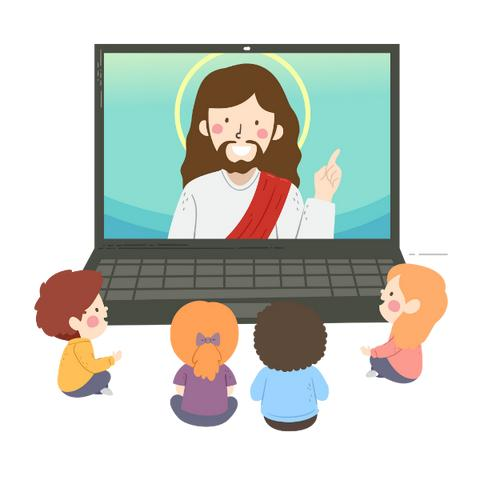
My daughter asked me last week if Noah “had wifi on the boat” to check the weather. I laughed so hard I had to sit down. Then it hit me — she’s been picturing the ark like some kind of cruise ship for two years now, and I never corrected it. Because I never actually sat down and showed her what any of it looked like. We just talked at her. And talking at a five-year-old about a flood that lasted forty days doesn’t land the same way as her watching it happen.
That gap? Kids’ Bible story videos have quietly closed it in our house. Not because reading is bad — we still read most nights. But there’s a kind of understanding you only get from watching a story move.
Why Video Helps Kids Connect With Bible Stories
Little kids think in pictures before they think in sentences. That’s not some parenting hack I read somewhere. It’s just how their brains work at three, four, five. So you tell a three-year-old David fought a giant, and you get a polite little nod, the kind you give someone when you’re not really listening. But she watches it — sees how small David actually is next to Goliath, hears the crowd go dead quiet — and suddenly it’s not a sentence she’s supposed to remember for Sunday. It’s a thing that happened.
We tried flashcards. For like three weeks. They live in a drawer now, mostly untouched. Nobody’s ever asked me to pull out a flashcard. She has, more than once, asked to watch “the boat one” again.
How Visual Storytelling Makes Scripture Click
Here’s what nobody tells you about reading Bible stories to little kids: half of it is invisible to them. A sea that splits in two. A bush that’s on fire but doesn’t burn up. A stone rolled away from a tomb. That’s a lot to picture when your brain still gets confused about whether dinosaurs and dragons are technically the same thing.
Animation just… solves that. You don’t have to explain what manna looked like — she sees it falling out of the sky like snow, and now she knows. That’s not skipping the work. That’s a bridge to it.
I used to think this was kind of a cheat, honestly. Like we were letting a screen do the imagining her brain should be doing. I don’t think that anymore. If anything, her imagination went the other direction — I found her lining her stuffed animals up two by two on the stairs last month, narrating the whole thing to herself, adding details that weren’t even in the video. So.
Keeping Kids Actually Engaged, Not Just Distracted
Attention span is the real fight here. Anyone who says otherwise hasn’t tried reading a bedtime story to a three-year-old who’s just discovered the ceiling fan is more interesting than Jonah. Short videos — five, six minutes, built for this age, a character talking right to her — hold attention in a way the printed page sometimes can’t. Especially at 7:40pm when everyone’s running on fumes.
This is where AbbaKid earned its spot on our tablet. Not just because the videos are short. There’s a little quiz after each one — nothing serious, just a few questions that make her think back through what she watched instead of it sliding out of her head the second it ends. She gets a small reward for finishing. Is that a bit of a bribe? Yeah. I’m not going to pretend otherwise. It works, though, and it’s ad-free — which mattered more to me than I expected once I actually sat and watched what plays before some of the “free” kids’ videos out there. Ugh.
We don’t use it every night. Some nights it’s just a book, and that’s fine. It’s a tool, not a replacement. We reach for it on the nights we need one.
Turning the Video Into an Actual Conversation
Here’s the part I got wrong for a while: the video by itself isn’t the whole thing. You can let a kid watch it, move straight into bath time, and by morning the whole story’s just gone. What actually sticks is the two minutes right after — when you ask something small. Not “what did you learn,” because that question makes every kid go silent and stare at you like you just asked them to do taxes. Something smaller. “Why do you think David wasn’t scared?”
My daughter’s answers are never the ones I expect. Once she told me David wasn’t scared because “he had a good breakfast.” Which — honestly, not wrong, at her age.
Some nights that turns into a real conversation. Most nights it’s four sentences and then she’s asking what’s for snack. Both count.







1 thought on “How Bible Videos Can Make Scripture More Engaging for Children”
Comments are closed.