If your air conditioner cools quickly, but rooms still feel sticky, or your furnace blasts hot air, then shuts down, leaving the house feeling uneven again, the problem often traces back to sizing and airflow. Equipment capacity and duct design work together. When they do not match the home’s actual heating and cooling load, you get short-cycling, poor humidity control, noisy registers, and higher utility bills. This article explains why oversizing and restrictive ducts create these problems, how professionals diagnose them, and which field adjustments can improve comfort without immediately replacing every component.
The Oversizing Trap: Fast Cooling, Sticky Rooms, and Uneven Heat
Oversized cooling systems drop the thermostat setpoint quickly but do not run long enough for the evaporator coil to wring moisture from the air. That leaves indoor relative humidity high, even when the supply air feels cold at the registers. Telltale signs include clammy bedrooms, fogged windows on mild days, and an AC that runs in short bursts. Proper testing and right-sizing start with a load calculation rather than guessing by square footage. Local contractors, including Legend Air Conditioning & Heating, can evaluate capacity, duct static pressure, and runtime patterns to pinpoint whether the root cause is tonnage, airflow, or both.
Consider a small one-story home where a 2.5-ton unit was replaced with a 4-ton system to “fix” a warm back room. The larger compressor cools the hallway quickly, so the thermostat stops the cycle before the coil removes much moisture. The home then feels cooler yet sticky. In many cases, the better fix is to restore airflow to that back room by adding a return path, repairing a crushed flex duct, or balancing dampers. A room-by-room load check may confirm that the original capacity was closer to correct than the upsized unit, and a staged or variable-capacity system paired with proper ductwork can extend runtimes for better dehumidification.
The Ductwork Bottleneck: Static Pressure, Airflow, and Noise
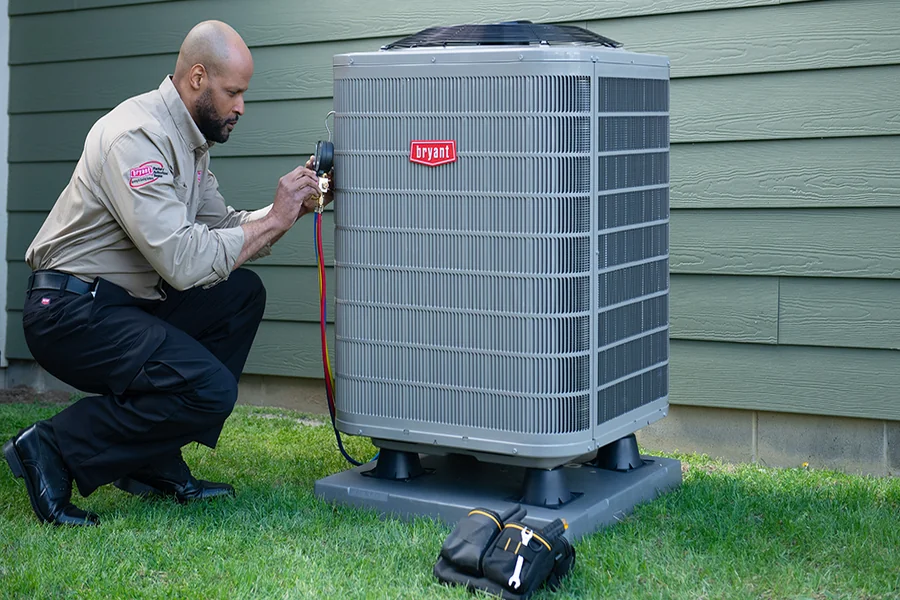
Even perfectly sized equipment will struggle if the duct system is restrictive. Undersized returns, tight filter cabinets, and long runs of kinked flex duct push external static pressure above the blower’s rating. The results include whistling supply grilles, rooms at the end of a branch that never quite reach the set temperature, and evaporator coils that can ice over due to low airflow. Technicians verify this by taking a manometer reading across the air handler or furnace and measuring cubic feet per minute at key registers. Fixes might include adding a second return, upsizing the return plenum, replacing a high-resistance pleated filter with a lower-resistance media, or straightening and supporting long flex runs to reduce friction.
What Good Evaluation Looks Like: Manual J Loads and Return Paths
A credible evaluation begins with a Manual J load calculation that accounts for window area and orientation, insulation levels, air leakage, interior shading, and occupancy. Instead of assuming “one ton per X square feet,” Manual J shows how solar gain on west-facing glass or an uninsulated attic can drive loads in specific rooms. From there, Manual S aligns the equipment to that load curve, and Manual D translates supply and return airflow into duct sizes, trunk layouts, and register counts that the blower can handle without excessive pressure.
Return air is the unsung hero. Closing bedroom doors without dedicated returns starves the air handler and pressurizes the rooms, pushing conditioned air out through cracks. Transfer grilles, jumper ducts, or additional returns relieve that pressure and bring more air back to the filter and coil. On the supply side, balancing dampers in branch ducts help fine-tune delivery, but they cannot fix a trunk that is too small or a branch strangled by a tight bend. Measuring actual CFM at the registers and comparing it with the room’s calculated BTU load verifies the design in the field.
Field Checks That Change Results: Charge, Blower Speed, and Thermostat Placement
After the load and ducts are addressed, small field adjustments can produce outsized comfort gains. Refrigerant charge set by superheat or subcooling ensures the evaporator coil operates at the right temperature for both sensible cooling and humidity removal. Overcharging can drive head pressure up and increase power draw; undercharging can cause freezing and poor latent performance. Blower speed matters too. Variable-speed ECM motors allow for lower airflow during mild conditions, lengthening runtimes and removing more moisture. Set too low, though, the coil can ice and block airflow entirely. Thermostat placement rounds this out. A thermostat on an exterior wall, next to a supply register, or in a sunlit hallway will misread conditions and end cooling or heating cycles prematurely.
Filtration, Sealing, and the High-MERV Trade-off
Air quality goals sometimes collide with airflow reality. A deep-pleated, high-MERV filter can capture finer particles but also adds resistance the blower must overcome. In a tight filter rack or with a marginal return, that extra restriction can spike static pressure, cause a furnace to trip a high-limit switch, or make the blower sound like a jet. A better path is to test pressure, then upgrade to a larger media cabinet, add return capacity, or select the highest MERV filter that still keeps total static pressure within the manufacturer’s limits. Duct sealing with mastic at joints, repairing a leaky plenum, and eliminating flex duct kinks reclaim the airflow you already paid for and reduce the amount of dust pulled from attics or crawlspaces.
When Replacement Is Not the First Fix
Plenty of comfort complaints respond to basic maintenance and small corrections. Replace clogged filters regularly, clear the condensate drain to prevent backups, and have the outdoor condenser coil cleaned so the compressor can reject heat efficiently. A technician can clean a dirty blower wheel or evaporator coil that is restricting airflow, verify that the contactor and capacitor are healthy, and confirm that the thermal expansion valve is metering properly. In homes with stubborn pressure imbalances, adding a return in the primary bedroom or a transfer grille between rooms can calm hot spots without touching equipment size.
When troubleshooting persistent comfort issues or considering upgraded heating and cooling solutions, homeowners often benefit from comparing professional evaluation options. Homeowners looking for specialized heat pump solutions can view our service details to better understand how proper diagnostics support long-term energy efficiency and indoor temperature stability.
Balancing static pressure and equipment capacity often requires a comprehensive evaluation of the entire system structure. Working with regional heating and cooling professionals such as Metro Mechanical Services Inc can help homeowners identify hidden airflow restrictions and restore consistent indoor temperatures throughout every room. Addressing these mechanical details early supports system efficiency and protects vital components from unnecessary wear over time.
Ongoing care and routine inspections help keep systems running smoothly year after year. Working with an experienced contractor like Coastal Air Technologies Inc ensures airflow issues, mechanical wear, and refrigerant balance are evaluated correctly, preventing unnecessary strain on system components and helping maintain consistent indoor temperature throughout every season.
Comfort is not just about tons and thermostat setpoints. It is the relationship between capacity, runtime, and airflow. Right-sized equipment paired with ducts that actually deliver the designed CFM will run longer, quieter cycles and remove more moisture or distribute heat more evenly. If your home feels clammy after short AC bursts, or rooms yo-yo between too hot and too cool in winter, ask for testing rather than a guess. Load calculations, static pressure readings, and a few targeted adjustments can often solve the problem you feel, not just the one the thermostat sees.