

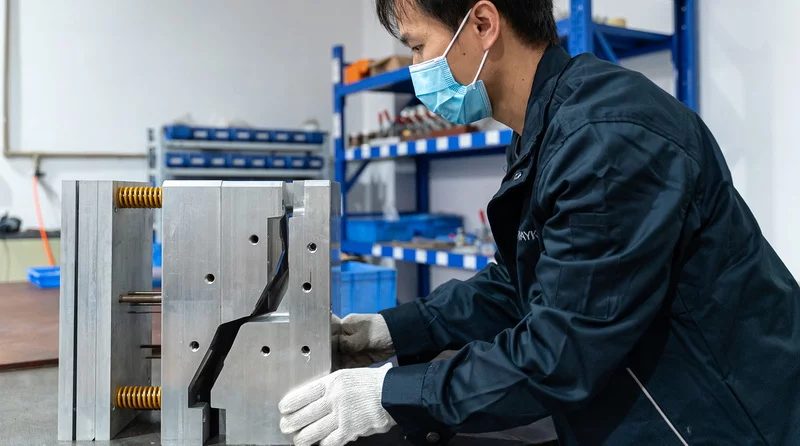
A rapid tooling service delivers production-grade molds in days to weeks, and an overmolding service bonds soft TPE to rigid parts in one process.
Most product delays don't come from design. They come from waiting on a mold. A traditional steel injection mold can take weeks to build and costs a lot before you've sold a single unit, which makes every design change expensive. A rapid tooling service attacks that problem directly, and an overmolding service solves a different one: how to combine a rigid body with a soft, grippy or sealing layer without a separate assembly step. Used together, they let small teams test and launch parts that feel like finished products.
What Is a Rapid Tooling Service?
A rapid tooling service builds injection molds quickly and at lower cost by combining prototyping methods, such as CNC machining or 3D printing, with conventional mold-making practice. The result is a tool that makes real parts in real production resins, but without the long lead time of a full hard tool. Providers also call it prototype tooling or bridge tooling.
How Fast Is Rapid Tooling?
Lead times vary by provider and part complexity. One manufacturer's case study for an electric kettle base reports a 14-day tool build in NAK80 steel, and other providers quote roughly 3 to 15 working days for prototype molds and a few weeks for production-oriented ones. Compare that with the many weeks a conventional tool commonly takes, and the schedule benefit is obvious.
Treat vendor numbers as ranges, not promises. Slides, lifters and tight cosmetic requirements all add time.
When Rapid Tooling Makes Sense
Rapid tooling suits three situations well:
- Design validation, where you need parts in the actual production material to test fit, strength and appearance.
- Low-volume production, with runs typically in the hundreds to the low thousands.
- Bridge production, where you need to ship product while the permanent steel tool is still being built.
It isn't the right call for everything. Aluminum and soft-steel tools wear faster, so if you already know you'll need hundreds of thousands of parts and the design is frozen, a hardened production tool will cost less per part in the long run. Some vendors claim rapid tools can last up to 100,000 shots, but actual life depends heavily on the resin, especially glass-filled grades, which are abrasive.
What Is an Overmolding Service?
Overmolding is an injection molding process in which one material, usually a thermoplastic elastomer (TPE), is molded over another part, called the substrate. The substrate can be a rigid plastic or a metal insert. Think of the rubbery grip on a power tool, a toothbrush handle or a waterproof seal on an electronic housing.
An overmolding service handles the material pairing, the mold design and the process control that make the layers actually stay together. That last part is where projects succeed or fail.
Insert Molding vs. Two-Shot Overmolding
There are two main routes. In insert molding, a finished substrate is loaded into a second mold, by hand or by robot, and the soft material is shot over it. In two-shot (multi-shot) molding, both materials are molded in one machine cycle.
Material suppliers generally report better adhesion from two-shot molding, because the substrate is still warm when the second material hits it. The trade-off is cost. Two-shot tooling and machines are more complex, so insert molding often wins for prototypes and low volumes, particularly when the design might still change.
Why Does Overmolding Fail?
The most common cause is a bad material match. Not every TPE bonds to every substrate, and a grade that sticks well to nylon may peel off polycarbonate. Standard TPEs also tend to bond poorly to engineering plastics like ABS and PC, so bonding grades matter.
Contamination is the second culprit. Mold release, oils and even fingerprints on the substrate can ruin adhesion. Poor shut-off design is third: thin, feathered edges of elastomer peel up with use. Material suppliers recommend crisp, well-defined shut-offs rather than rounded ones, plus mechanical interlocks like ribs and undercuts to reinforce the chemical bond.
How Rapid Tooling and Overmolding Work Together
Overmolding is unforgiving, which makes it a strong candidate for rapid tooling. You rarely know on the first try whether a TPE grade will bond to your substrate, or whether your shut-off geometry will hold up. Rapid tools let you run those trials cheaply, adjust the interlock or edge detail, and cut a second iteration in days rather than months.
A sensible sequence looks like this:
- Choose a substrate and two or three candidate overmold grades.
- Build a rapid tool for the substrate and run trial shots.
- Overmold using an insert approach and test peel and shear adhesion.
- Revise geometry, then commit to production tooling once the bond is proven.
[link to related post on choosing between aluminum and steel molds]
How to Choose a Provider
Ask for specifics rather than slogans. Does the provider offer design-for-manufacturing feedback before cutting metal? Can they show adhesion test data for your substrate and elastomer combination? Do they handle both the tool and the molding, or will you juggle two vendors? And what happens to the tool afterward: who owns it, and can it move to a production run?
If you're working on a medical or regulated product, check certifications such as ISO 13485, since the molding environment matters as much as the mold.
Conclusion
Rapid tooling shortens the path from CAD file to molded part, and overmolding turns a plain plastic component into something that feels finished. The two work best as a pair: use fast, low-cost tools to prove your material bond, then scale. Before you request quotes, settle your substrate material and expected volume. Those two answers shape nearly every decision that follows.








1 thought on “Rapid Tooling and Overmolding Services: A Practical Guide”
Comments are closed.