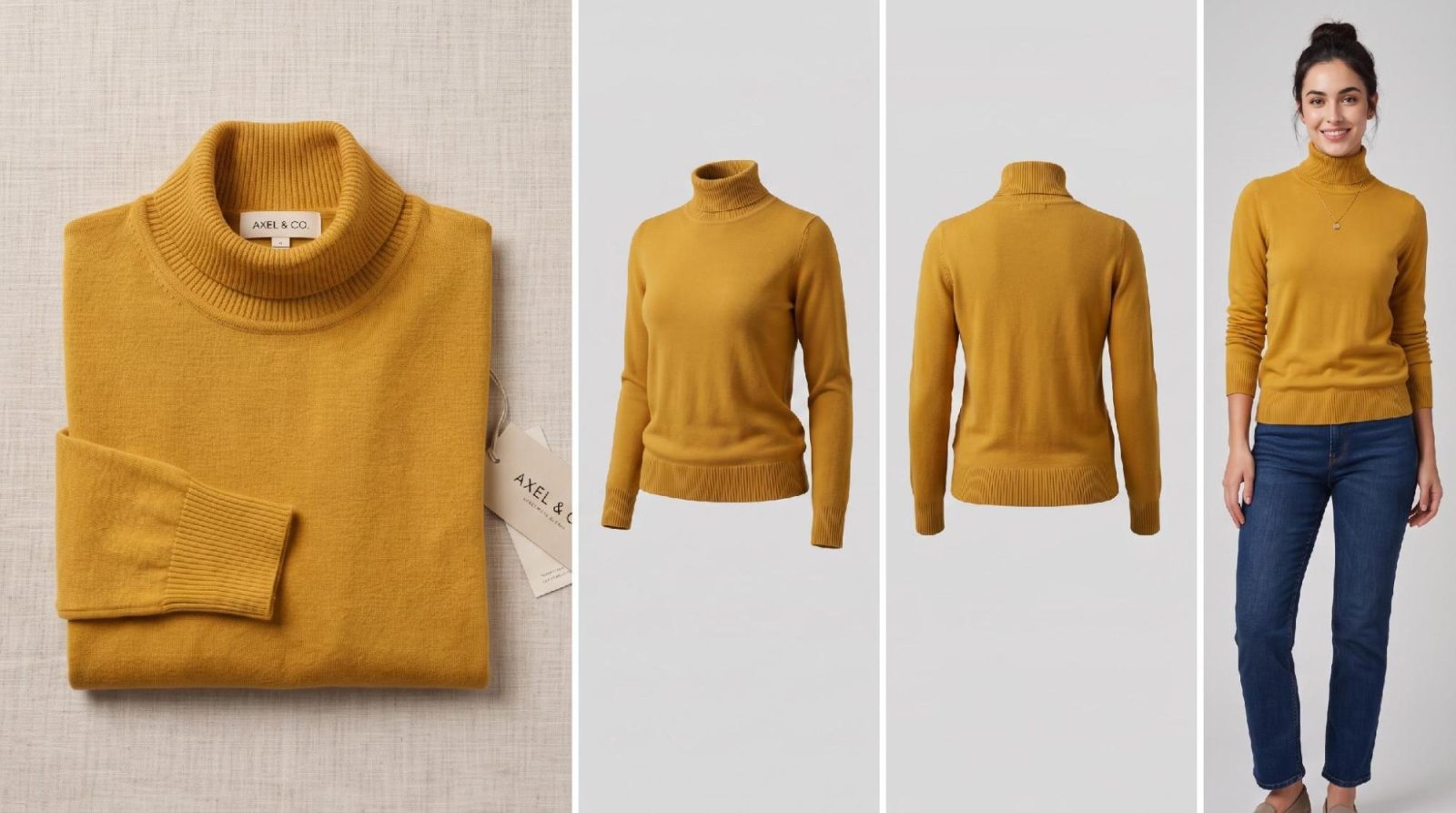
Ghost mannequin photography and AI on-model imagery solve different catalogue problems. Here is how fashion teams can choose the right workflow.
Fashion product photography has a practical problem: shoppers need enough visual information to understand a garment, while brands need imagery that works consistently across large catalogues. Ghost mannequin photography and AI on-model imagery address that problem in different ways.
Ghost mannequin photography shows the garment without a visible model, preserving its shape and structure. AI on-model imagery starts with an existing product photograph and adds human context. The useful question is which workflow gives shoppers the right evidence for a particular product.
What Ghost Mannequin Photography Does Well
In ghost mannequin photography, you shoot the item on a mannequin and edit the mannequin out. The final image maintains the item’s three-dimensional form but the focus remains entirely on the garment.
It suits well-cut pieces and items that require structure and form for sale. Shoppers need to see the fit and shape and be able to browse the neckline, sleeves, waist and hemline. They can do this better without a model. Studio and lighting can also match a company’s aesthetic and support an easily searchable online catalogue.
Some setup and editing are required. Clothes need to be pinned to the mannequin, and ghost mannequin photo-editing will pay close attention to linings, straps and complex materials. A ghost mannequin service can form part of a repeatable product-image workflow.
What AI On-Model Imagery Adds
AI on-model imagery starts with an existing product image, such as a flat lay, packshot or ghost mannequin photograph, and creates a view of the garment being worn. This adds context around proportion, styling, length and silhouette.
That can be useful when a product is easier to understand on a body. It can also help brands extend existing catalogue assets without arranging a new model shoot for every item. This is one use of virtual models for clothes in modern e-commerce workflows.
A workflow such as On-Model’s flat-to-model tool can use an existing product photograph as the starting point for an on-model presentation. The source image remains important because AI must work from the evidence contained in it.
Clarity And Context Serve Different Purposes
Ghost mannequin images isolate the product, while on-model imagery places it in context. The first can establish shape and construction; the second can help shoppers understand how that shape translates to a body.
The balance can vary by category. A tailored jacket may need construction-focused imagery early in the gallery, while a flowing dress may benefit from an on-model view sooner because length and silhouette matter.
Choosing A Workflow For E-Commerce
The choice depends on the product, existing assets and production setup. Ghost mannequin photography can provide consistent product-focused imagery, while AI on-model imagery can extend strong source assets by adding worn views or refreshing older listings.
Teams should consider sample preparation, studio scheduling, editing and review time. Garment complexity matters too: transparency, reflective finishes, unusual construction and layered pieces require careful checking in either approach.
Quality Control And The Hybrid Approach
Ghost mannequin images can lose natural depth when garments are poorly prepared or heavily retouched. AI on-model images can look convincing while changing a seam, print, hem or fastening. Generated imagery should therefore be checked against the source photography and actual product before publication.
Fashion teams do not need one method for every product. Ghost mannequin photography can provide shape and construction imagery, while AI-generated model views can add human context. Traditional model photography can remain useful for campaign or priority images requiring precise styling.
The goal is a catalogue where each image supplies useful evidence and the workflow remains consistent. For fashion e-commerce, clarity, context and quality control can work together.