

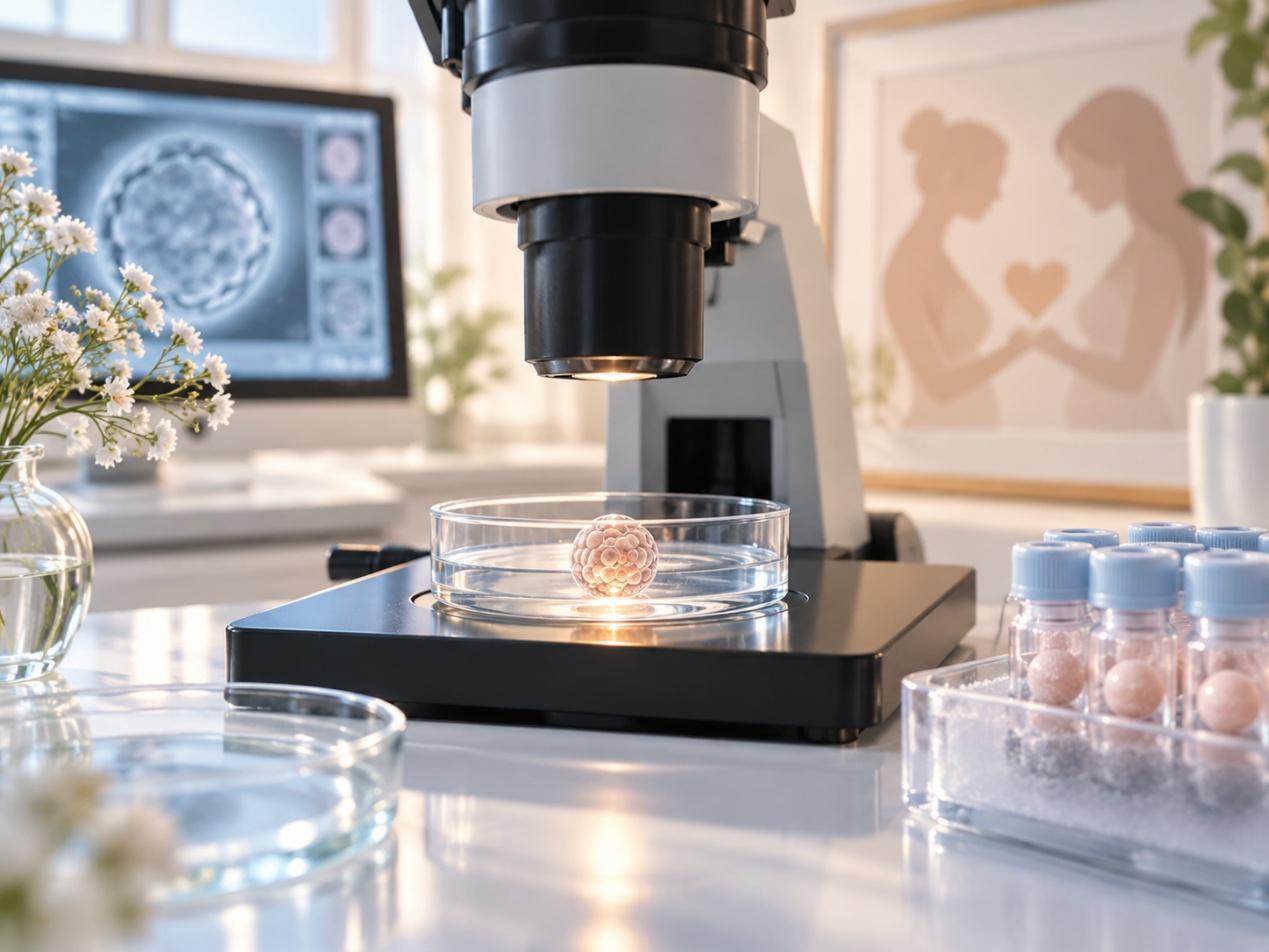
Fertility treatment can involve different approaches depending on a woman’s reproductive health, ovarian reserve and medical history. Two important options within assisted reproduction are IVF and egg donation. Although each treatment follows a different pathway, both require careful monitoring, laboratory expertise and an individualised approach.
How does an IVF cycle work?
An IVF cycle generally includes four main stages: ovarian stimulation, egg retrieval, fertilisation in the embryology laboratory and embryo transfer into the womb.
During a natural menstrual cycle, usually one follicle develops and releases one egg. IVF can be performed using this egg, but ovarian stimulation is more commonly used to encourage the development of multiple eggs.
Gonadotrophin medication is usually administered through daily subcutaneous injections for approximately 12 days. During this period, ultrasound scans and, when required, hormonal blood tests are used to monitor the ovarian response.
Around 36 hours before egg retrieval, human chorionic gonadotrophin, or hCG, is administered to support the final stage of egg maturation. Accurate timing is important, as egg collection is generally planned 34 to 36 hours later.
Egg retrieval and fertilisation
Egg retrieval is carried out under sedation with the assistance of vaginal ultrasound. A fine needle is guided into the ovaries, and fluid is collected from the follicles. This fluid is examined immediately to identify the eggs. The procedure usually lasts approximately 20 minutes.
In the laboratory, the eggs are placed in culture medium under carefully controlled conditions. Prepared sperm is then placed with the eggs for fertilisation. When sperm concentration or motility is significantly reduced, ICSI may be recommended. During ICSI, an embryologist injects a single selected sperm directly into the egg.
Embryos are monitored as they develop. By day five, some may reach the blastocyst stage. Their development and quality help the medical and embryology teams select the most appropriate embryo for transfer.
Embryo transfer and freezing
Embryo transfer may take place three days after egg collection or at the blastocyst stage. The procedure is performed under ultrasound guidance, is generally painless and does not usually require sedation.
Good-quality embryos that are not transferred may be frozen using vitrification. This ultra-rapid freezing method allows embryos to be stored for possible future use.
When may egg donation be considered?
Egg donation may be suitable for women with premature ovarian insufficiency, low ovarian reserve, repeated unsuccessful IVF cycles or certain genetic disorders. It may also be considered when the ovaries do not function normally.
In Greece, egg donors are altruistic and anonymous. Donors must be younger than 35 and undergo detailed medical and laboratory screening. This includes infectious disease testing, chromosome assessment and screening for selected inherited conditions.
Donor-recipient matching also considers physical characteristics. Once a suitable donor is selected, ovarian stimulation and egg retrieval are performed. The donated eggs can then be fertilised using sperm from the recipient’s partner or a donor. The resulting embryos may be transferred directly or cryopreserved for transfer at a later stage.
Individualised fertility care
Both IVF and egg donation involve several clinical decisions that depend on the woman’s age, medical history, ovarian response and individual circumstances. Personalised monitoring can help determine the most appropriate medication doses, timing of egg retrieval and embryo transfer strategy.
For personalised guidance regarding IVF, egg donation and other fertility treatment options, you can contact Dr George Christopoulos, Gynaecologist specialising in Reproductive Medicine, to discuss the approach that best suits your individual reproductive needs.









1 thought on “IVF and Egg Donation: Understanding the Main Steps of Fertility Treatment”
Comments are closed.