

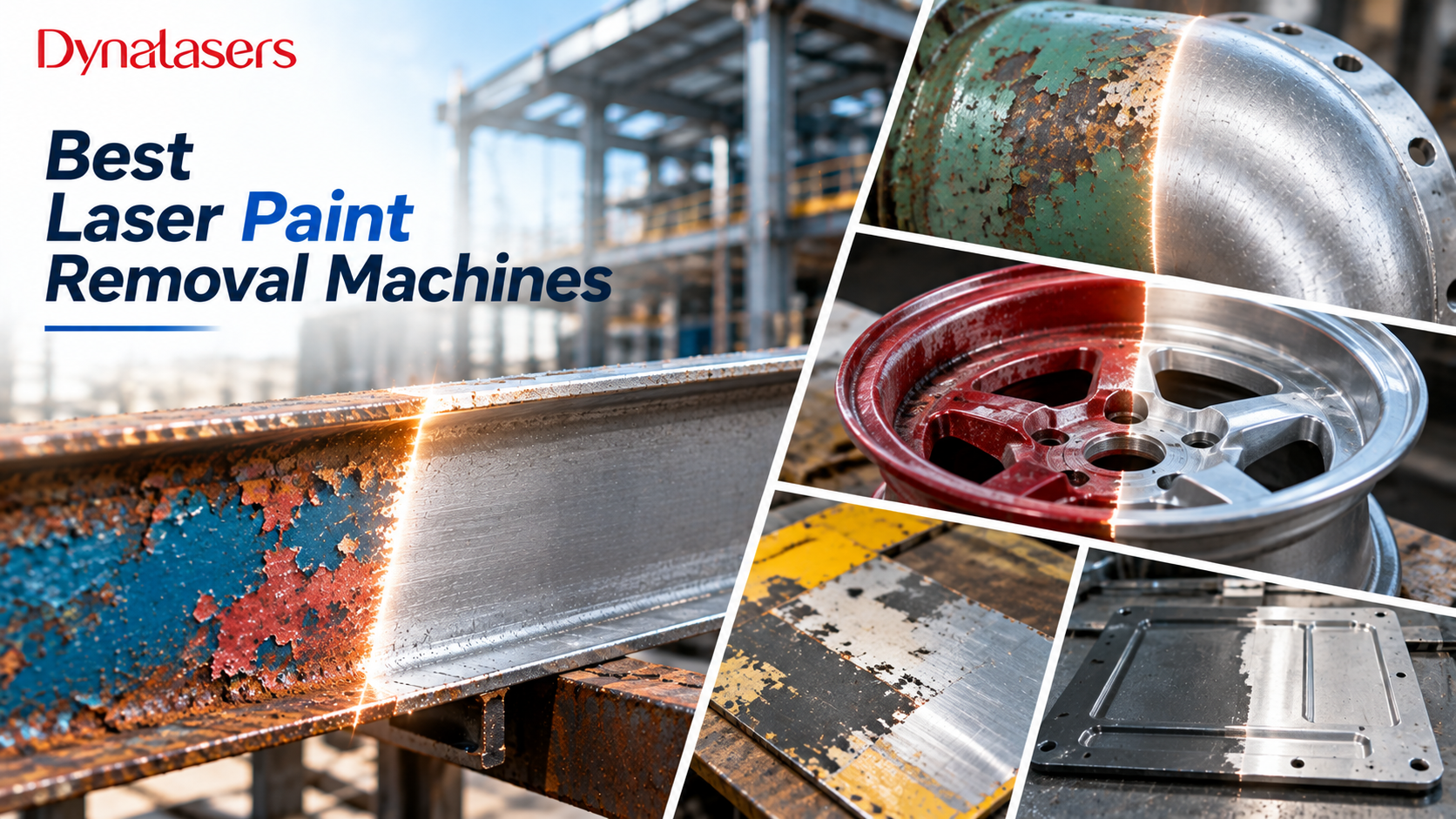
Laser paint removal is useful when coatings need to come off without abrasive blasting or chemical stripping. It can be particularly effective for localized repairs, weld preparation, and metal components that are difficult to move.
But not every paint layer behaves the same way. Powder coatings, primers, and aged industrial paints respond differently to laser energy. I would start with the coating and substrate before comparing equipment. Dynalasers offers two approaches through its M75 CW cleaner and P300 MOPA pulsed system.
7 Best Laser Paint Removal Machines Compared
| Manufacturer | Representative System | Laser Technology | Main Strength | Suitable For |
| Dynalasers | M75 / P300 | CW / MOPA pulsed | Compact air-cooled options | Industrial coating removal |
| Laserax | LXQ-HP Series | High-power pulsed fiber laser | Automated process integration | Production-line decoating |
| cleanLASER | CL1000iF | High-power laser cleaning | Industrial coating removal | Metal surface preparation |
| P-Laser | QF Series | Pulsed laser | Adjustable cleaning process | Selective coating removal |
| SENFENG | HC Series | CW / pulsed options | Broad industrial power range | Workshop paint stripping |
| GWEIKE | LC Series | Fiber laser cleaning | General-purpose surface treatment | Metal restoration |
| Laser Photonics | CleanTech CF-1030 | Fiber laser finishing | Portable surface processing | Localized coating removal |
The best laser paint removal machine depends on whether the task involves removing paint from a large steel surface or stripping a small section without disturbing the surrounding finish.
More laser power helps with some high-volume jobs, but accurate control becomes more important when the substrate or remaining coating must be preserved.
Where Dynalasers Fits

Dynalasers develops compact laser paint removal equipment for industrial cleaning and maintenance. Its M75 and P300 use different laser technologies rather than relying on one process for every coating.
The M75 focuses on higher-throughput continuous-wave cleaning. The P300 uses controlled MOPA pulses for more selective surface treatment.
Dynalasers M75 for Large-Area Paint Removal

The Dynalasers M75 continuous laser cleaner is the more practical starting point when removing coatings from large metal components.
It delivers continuous-wave output up to 1800W, weighs less than 43 kg, and includes a 10-meter cable. With the F800 lens, its maximum cleaning width reaches 300 mm.
I would consider the M75 for painted steel frames, machinery, fabricated structures, and surface preparation before repainting.
A wider cleaning path is helpful on flat surfaces, but it does not guarantee a faster finished job. Thick coatings may require several passes, and corners or weld seams often need a narrower scan pattern.
For industrial laser paint removal, the goal is to remove the specified coating without overheating the metal or leaving residues that interfere with the next manufacturing step.
Dynalasers P300 for Selective Paint Stripping

The P300 pulse laser cleaner is designed for applications where surface control matters more than maximum removal speed.
It uses a 300W MOPA pulsed fiber laser and weighs less than 25 kg. Adjustable pulse characteristics and dual-axis scanning make it suitable for testing localized coating removal on precision components and smaller surfaces.
Consider a painted component that needs a clean metal contact point for electrical assembly. Removing the coating from the required area without unnecessarily disturbing the surrounding finish is more important than cleaning a large surface quickly.
That is the type of application where I would investigate the P300.
However, pulsed cleaning is not automatically damage-free. Coating chemistry, pulse energy, overlap, and substrate absorption still determine the result.
Different Paint Coatings Need Different Settings
One common mistake with a laser paint removal tool is treating every coating as a uniform layer.
Industrial components may have primers, topcoats, protective finishes, or several layers applied over years of maintenance. Some coatings release cleanly, while others leave carbonized residues or require repeated passes.
| Coating Condition | Main Challenge | What to Check |
| Thin paint on steel | Avoiding excessive substrate heating | Power, speed, and overlap |
| Thick industrial coating | Removing material through multiple layers | Pass count and cleaning rate |
| Powder-coated metal | Controlling coating decomposition | Surface temperature and residue |
| Multi-layer paint | Removing the intended layers | Depth control and inspection |
| Paint near weld seams | Reaching irregular geometry | Scan width and working angle |
| Coated aluminum | Limiting changes to the base metal | Pulse settings and surface finish |
For multi-layer systems, the required endpoint should be defined before cleaning. Removing only a topcoat is a different task from exposing bare metal.
I would also identify the coating composition whenever possible. Old industrial coatings may contain hazardous pigments or other substances that require additional controls during removal.
M75 vs. P300: Which Works Better for Paint Removal?
The difference between CW and pulsed cleaning becomes clearer once the coating thickness and required surface condition are known.
| Requirement | M75 CW | P300 MOPA Pulsed |
| Large painted steel surfaces | Preferred | Usually slower |
| Thick coating removal | Preferred starting point | Application-dependent |
| Small localized paint removal | Suitable | Preferred |
| Selective coating removal | Requires careful testing | Better control potential |
| Thin metal components | Higher thermal risk | Preferred starting point |
| High-throughput industrial cleaning | Preferred | Depends on coating |
| Precision surface preparation | Application-dependent | Preferred |
The M75 is generally more suitable when large quantities of coating must be removed from robust metal surfaces.
The P300 is worth considering when the cleaning area is smaller, the substrate is sensitive, or the process requires selective removal.
Neither machine should be selected solely from the table. Even two painted steel parts can need different settings when coating thickness, adhesion, or chemistry changes.
Laser Paint Removal vs. Traditional Stripping Methods
A laser paint remover does not require abrasive blasting media or liquid stripping chemicals at the point of cleaning. That can simplify certain maintenance and manufacturing operations.
However, it does not eliminate waste handling or make conventional methods obsolete.
| Factor | Laser Cleaning | Abrasive Blasting | Chemical Stripping |
| Localized removal | Good control | Often requires masking | Depends on application method |
| Large surface areas | Equipment-dependent | Often productive | Process-dependent |
| Substrate impact | Depends on laser settings | May alter surface profile | Depends on chemical compatibility |
| Consumables | Optics and extraction filters | Abrasive media | Stripping chemicals |
| Waste management | Captured particles and fumes | Spent media and coating debris | Chemical waste and residues |
Laser cleaning is particularly attractive for selective removal or parts where abrasive contact is undesirable.
For very large steel structures, conventional blasting may still be more economical, especially when the next coating requires a defined anchor profile.
What I Would Test Before Buying
A supplier demonstration should use the actual painted component. A clean test plate with a thin coating does not tell much about removing several layers of aged industrial paint.
Before selecting a laser paint removal machine, I would check:
- Coating identification: What materials and layers are present?
- Removal requirement: Must all paint be removed, or only selected layers?
- Substrate condition: Is discoloration or texture change acceptable?
- Cleaning rate: How many passes and how much time are required?
- Final surface: Is additional preparation needed before repainting?
I would also ask for the cleaning parameters used during testing. Recording power, scan width, speed, and pass count makes the process easier to repeat.
Fume extraction deserves particular attention. Laser stripping can generate hazardous particles and decomposition products. Unknown coatings should be assessed before processing, especially where lead, chromates, or other hazardous substances may be present.
High-power laser equipment also requires suitable beam containment, access control, protective equipment, and operator training.
FAQs
Can laser paint removal leave the primer intact?
Yes, selective removal is possible with suitable coating systems and carefully developed parameters. However, reliably preserving a primer requires testing and process control. It should not be assumed for every multi-layer coating.
Can a laser remove paint from galvanized steel?
It may be possible to remove selected coatings without unacceptable damage to the zinc layer, but the process needs careful validation. Excessive energy can alter or remove the protective zinc coating.
Does laser paint stripping work on curved surfaces?
Yes, provided the cleaning head maintains suitable focus and scan coverage. Tight curves, deep recesses, and obstructed areas may require repositioning or multiple passes.
Can metal be repainted immediately after laser cleaning?
Sometimes, but the surface must meet the coating manufacturer’s requirements. Cleanliness, roughness, residual contamination, and time before recoating all need consideration.
Conclusion
The best equipment for laser paint removal depends on coating thickness, cleaning area, and how much change the underlying material can tolerate.
Dynalasers offers two approaches: the M75 for larger industrial stripping jobs and the P300 for controlled, localized cleaning. Before investing, test the actual coating and confirm that the finished surface meets the next production or maintenance requirement.







2 thoughts on “7 Best Laser Paint Removal Machines for Industrial Metal Cleaning”
Comments are closed.