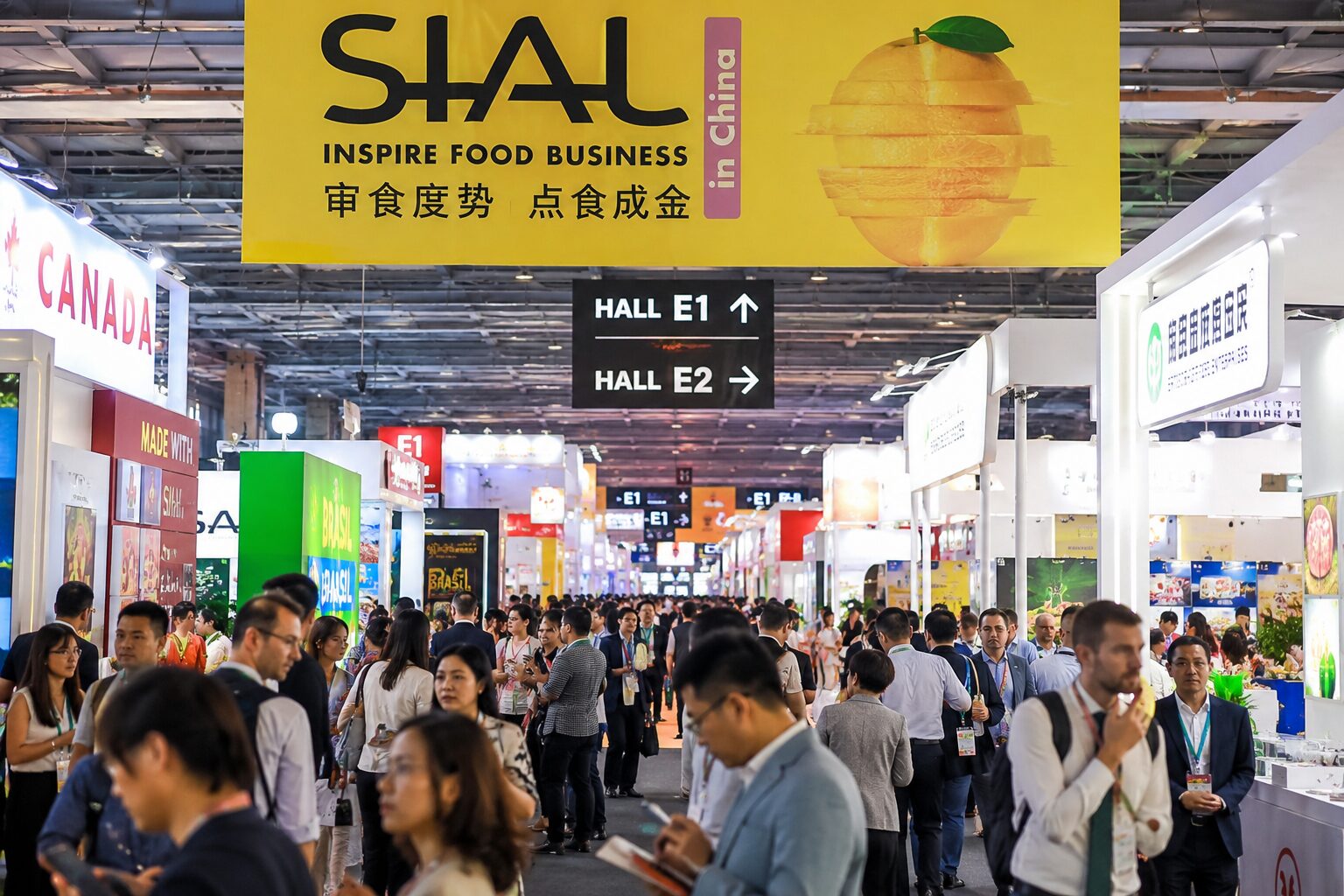
For years, food industry trade shows have largely followed the same basic pattern. Companies display products, buyers walk through exhibition halls, and business discussions develop around booths, meeting rooms, and networking events. That model remains useful, but the scale of international food sourcing has created a new challenge. When thousands of professionals and a large number of suppliers are present at the same event, simply bringing people into one location does not automatically mean that the most relevant people will find each other.
SIAL Guangzhou 2026 is approaching that problem from a different direction. The event is being designed not only around exhibition space, but around the quality and relevance of business connections taking place within that space. Its official platform combines an AI-enhanced Match Me system, an International Top Buyer Programme, curated networking, innovation activities, regional market insights, and an online marketplace that allows visitors to preview exhibitors and products before arriving. The 2026 event is scheduled for September 3 to 5 at the Guangzhou Poly World Trade Center Expo.
This creates an interesting shift in the role of a modern food exhibition. Instead of measuring an event primarily by the number of booths or visitors, the emphasis increasingly moves toward what happens between those participants. SIAL Guangzhou's planned 60,000-square-metre exhibition, 1,500-plus exhibitors, and expected 65,000 F&B professionals create a very large pool of potential connections, making targeted matchmaking particularly important.
The Problem With Simply Making More Connections
A large exhibition can create an unusual problem: too many possible connections. A buyer looking for several specific categories may encounter hundreds of companies during a few days, while an exhibitor may speak with dozens of visitors without knowing which conversations represent genuine sourcing opportunities. The traditional approach depends heavily on preparation, timing, and sometimes simple coincidence.
The problem becomes more obvious when international sourcing is involved. A buyer may need to consider product specifications, purchasing volumes, distribution channels, export experience, target markets, and business requirements before deciding whether a supplier deserves further attention. A short conversation beside an exhibition stand may introduce two companies, but it does not necessarily establish whether their requirements actually match. This is why the quality of the connection can matter more than the raw number of introductions.
Why SIAL Is Moving Toward Precision Matchmaking
SIAL Guangzhou describes Match Me as a precision-driven trade service that facilitates pre-qualified face-to-face meetings through an AI-enhanced system. The purpose is to move beyond completely open networking and help create meetings between participants whose requirements have a stronger potential fit.
The interesting part of this approach is that the technology is being used before the actual business conversation rather than replacing it. AI can assist with identifying potential matches, but the final interaction still happens between buyers and suppliers. This preserves one of the most important advantages of a physical exhibition: people can examine products, ask detailed questions, discuss requirements, and decide whether there is enough common ground to continue the relationship after the event.
Why Human Meetings Still Matter in a Digital Sourcing Environment
Online sourcing platforms have made it much easier to discover suppliers from different countries, but discovery is only one part of the process. A company may look suitable on a website and still prove unsuitable when its product range, production capacity, documentation, packaging requirements, or target-market experience are discussed in detail.
A physical meeting allows both sides to clarify those issues much faster. Buyers can explain exactly what they are searching for, while suppliers can respond to questions that may never appear in an online product listing. The meeting therefore becomes a form of qualification. Instead of spending weeks exchanging basic messages simply to determine whether two companies are relevant to each other, the first discussion can establish a much clearer starting point.
The International Top Buyer Programme Creates a More Selective Environment
SIAL Guangzhou's International Top Buyer Programme is specifically designed for senior decision-makers and professional buyers with active sourcing requirements. The programme targets purchasing roles including procurement directors, purchasing managers, senior buyers, category managers, and other sourcing professionals, while participating companies can include importers, distributors, retailers, manufacturers, foodservice operators, HORECA businesses, and e-commerce platforms.
The programme is structured around different buyer levels. The Hosted Buyer tier, for example, includes a minimum of 18 scheduled one-to-one meetings, while Key Buyers are expected to attend at least 12 meetings. VIP Buyers receive access to the online matchmaking platform and selected networking opportunities. These requirements demonstrate how the event is attempting to turn sourcing from an unstructured exhibition activity into a scheduled process with specific objectives.
What Makes a Qualified Buyer Different From an Ordinary Visitor
Not every professional attending an exhibition has the same purchasing responsibility. Someone may attend to study market trends, explore potential opportunities, represent a company, or simply research a category. A procurement decision-maker, however, may arrive with an active purchasing requirement and a defined list of products or suppliers they need to evaluate.
SIAL's buyer programme is built around that distinction. Applicants are asked about their company, business channels, existing product portfolio, purchasing cycle, purchasing expenditure, product categories of interest, and target countries or regions. This information gives the buyer team a more detailed understanding of what the participant is actually looking for.
Guangzhou Gives the Matchmaking Model a Regional Purpose
The location of the event is also part of the strategy. SIAL describes Guangzhou as a gateway connecting the Greater Bay Area with Southeast Asian markets and positions the exhibition as a sourcing platform for Southern China. The event's 2026 edition is moving to the Guangzhou Poly World Trade Center Expo, where it will occupy four exhibition halls.
This regional positioning means the event is not simply trying to connect international buyers with individual Chinese companies. It is also attempting to connect different parts of a wider Asian food and beverage ecosystem. Buyers from Southeast Asia, South Asia, Japan, South Korea, Mongolia, Hong Kong, Macau, and Taiwan are among the markets specifically targeted by the International Top Buyer Programme.
Why the Greater Bay Area Matters to Food Sourcing
The Greater Bay Area provides an important commercial setting for an event focused on cross-border sourcing. Guangzhou is surrounded by a wider network of manufacturing, logistics, wholesale, distribution, and consumer markets, creating multiple routes through which food products can move.
For international buyers, this can make the exhibition useful beyond the individual suppliers they meet. A buyer may be researching Chinese products for domestic distribution, looking for export-ready products for another Asian market, or investigating opportunities connected with Southeast Asia. The event's regional positioning gives these different objectives a common physical meeting point.
The 2026 Guangzhou Food Expo Is Being Built Around More Than Booths

The guangzhou food expo taking place in September 2026 is expected to bring together more than 1,500 global exhibitors and 65,000 F&B professionals across approximately 60,000 square metres. The official event information also identifies six Highlight Villages covering areas such as organic food, Chinese food and beverage, international food and beverage, international meat, pulses and grains, and bakery and confectionery.
That organization is important because the food industry is not one single market. A buyer interested in imported packaged food may have completely different priorities from a distributor searching for ingredients, a retailer exploring snacks, or a foodservice operator looking for new products. Creating identifiable areas allows visitors to move through the exhibition according to their commercial interests rather than treating every product category as equally relevant.
The Online Marketplace Extends the Exhibition Before Visitors Arrive
One of the more useful aspects of SIAL Guangzhou's structure is its Online Marketplace. The official Guangzhou page describes it as a 365-day digital portal where visitors can preview exhibitors and products and pre-target their sourcing goals.
This changes the relationship between online and physical exhibition activity. Instead of arriving without knowing what is available, a buyer can research companies and products beforehand and potentially use the physical event for conversations that have already been narrowed down. The exhibition then becomes the place where research turns into direct interaction rather than the place where all research begins from zero.
Matchmaking Can Reduce the Time Lost on Irrelevant Meetings
Time is one of the biggest constraints at a large international exhibition. Even three days can disappear quickly when visitors have to navigate multiple halls, meet suppliers, attend activities, and evaluate products.
A structured matchmaking system can reduce some of that inefficiency by helping participants prioritize meetings. The goal is not necessarily to eliminate spontaneous conversations, because unexpected discoveries are part of the appeal of exhibitions. Instead, scheduled matches can provide a reliable core of relevant meetings around which visitors can explore the wider exhibition.
What the Top Buyer Programme Says About Sourcing Behaviour
The requirements of the Hosted Buyer and Key Buyer categories reveal how seriously the organizers are treating scheduled meetings. Hosted Buyers are expected to attend at least 18 one-to-one meetings, while Key Buyers have a minimum of 12 meetings with different exhibitors.
These numbers suggest that the programme is designed around active sourcing rather than passive attendance. Participants are expected to arrive with specific commercial interests and engage directly with suppliers. That changes the atmosphere of the event because meetings become part of the structure rather than something left entirely to chance.
SIAL Elite Hour Creates a Different Type of Networking
The event's networking strategy goes beyond scheduled buyer-supplier meetings. SIAL Elite Hour is an invitation-only gathering for selected key buyers, leading F&B companies, and industry decision-makers. The programme combines curated product showcases, buyer recognition, and private business conversations.
A private environment can serve a different purpose from an exhibition booth. The exhibition floor is designed for discovery and movement, while a smaller networking environment can make longer conversations easier. For companies already identified as relevant participants, this creates another opportunity to discuss market information, products, and potential partnerships without the constant activity of a busy exhibition hall.
Innovation Becomes Another Way to Filter the Market
A major food exhibition can contain so many products that identifying genuinely interesting developments becomes difficult. SIAL addresses this challenge through innovation-focused activities including SIAL Innovation Awards, SIAL in China Awards, SIAL Snacking Awards, the SIAL Cup Barista Challenge, and the SIAL Chic & Tea Contest.
These programmes provide another layer of organization. Rather than expecting visitors to independently identify every emerging product, innovation activities draw attention toward products, concepts, and categories that reflect changing market interests. SIAL also describes its innovation programming as a way of helping visitors understand new developments and consumer trends in the global food industry.
Regional Consumer Trends Are Becoming Part of the Exhibition
The 2026 Guangzhou programme highlights several trends that organizers say are shaping food consumption across Asia, including healthier snacks, functional foods, clean-label products, premium beverages, ready-to-drink products, tea-based drinks, specialty coffee, convenience foods, and products aimed at the growing silver economy.
This makes the event useful as a market-observation platform as well as a sourcing environment. Buyers can compare what suppliers are offering against broader consumer movements, while exhibitors can see how their own categories fit within a changing Asian market. The exhibition therefore provides information about demand patterns as well as individual products.
Halal Food Shows How Regional Demand Influences Exhibition Design
The 2026 event also places attention on international Halal markets, including dedicated Halal-related participation and suppliers targeting global Halal demand. SIAL connects this focus with growing consumer demand across Southeast Asia, South Asia, and the Middle East.
This is an example of how a regional exhibition can adapt its structure to the needs of international buyers. Rather than presenting every food category in exactly the same way, dedicated areas can make it easier for participants with specific sourcing requirements to find relevant companies and products.
The Exhibition Can Also Function as a Research Environment
A buyer does not necessarily need to place an order for an exhibition visit to be useful. Walking through the event can reveal which product categories are expanding, what packaging styles companies are using, which products are receiving innovation recognition, and what kinds of suppliers are targeting international markets.
For businesses considering future expansion, this information can be valuable even when purchasing decisions are months away. Market research conducted through direct observation can complement formal industry reports because visitors can see actual products and discuss them with the people responsible for developing or selling them.
Why Cross-Border Relationships Need More Than Product Discovery
Finding a product is only the beginning of an international sourcing relationship. Businesses still need to understand production capacity, documentation, packaging requirements, shipping arrangements, purchasing cycles, and the ability to serve a particular target market.
This is why direct conversations remain central to SIAL's model. Matchmaking can identify potentially relevant participants, but the business relationship still has to be developed through human discussion. Technology can improve who gets introduced to whom, but it cannot independently establish the trust and understanding required for a long-term commercial relationship.
The Event Is Becoming a Layered Business Ecosystem
When Match Me, the Top Buyer Programme, the Online Marketplace, SIAL Elite Hour, innovation activities, and dedicated category areas are considered together, the structure looks considerably different from a basic product exhibition. Each element performs a different function.
The Online Marketplace supports research before arrival. Match Me supports targeted meetings. The Top Buyer Programme focuses on qualified procurement professionals. Innovation activities highlight emerging products and trends. Elite Hour provides a more private networking environment. Together, these layers create a system in which discovery, qualification, meetings, and networking can happen within the same broader event ecosystem.
A More Focused Exhibition Could Change How Businesses Measure Success
The success of a trade event has traditionally been associated with visitor numbers, exhibitor numbers, floor space, and sales generated during the show. Those measurements remain useful, but a matchmaking-focused model introduces another question: how many of those participants were actually relevant to each other?
A smaller number of highly relevant meetings may be more useful to a buyer than dozens of random conversations. Likewise, an exhibitor may value several serious sourcing discussions more than hundreds of brief visits. SIAL Guangzhou's structured programmes indicate a move toward measuring the quality of interactions alongside the overall scale of the exhibition.
The Future May Combine AI With More Human Interaction, Not Less
It is easy to assume that greater use of AI in business events will reduce the need for human interaction. The model being developed at SIAL Guangzhou suggests almost the opposite. AI is being positioned primarily as a way to improve the starting point for human conversations.
The technology helps identify possible matches, while the actual value still comes from people discussing products, requirements, markets, and opportunities. If this model proves effective, future exhibitions may use more intelligent systems to organize participants while preserving the face-to-face interactions that make physical trade events different from ordinary online marketplaces.
What Makes SIAL Guangzhou's Model Different
- AI-assisted Match Me: Designed to facilitate pre-qualified face-to-face meetings between relevant participants.
- International Top Buyer Programme: Focused on qualified procurement decision-makers with active sourcing needs.
- Online Marketplace: Allows visitors to preview exhibitors and products before the physical event.
- SIAL Elite Hour: Provides invitation-only networking for selected buyers and industry leaders.
- Innovation programmes: Help identify new products, market developments, and emerging consumer trends.
- Regional focus: Connects Southern China's F&B ecosystem with the Greater Bay Area and Southeast Asian markets.
These elements work together rather than functioning as completely separate attractions. Their combined purpose is to make the movement from product discovery to qualified business conversation more organized.
Final Thoughts
SIAL Guangzhou's 2026 model reflects a broader change in how large professional exhibitions can approach business networking. The challenge is no longer simply bringing buyers and suppliers into the same building. With thousands of participants, the bigger challenge is helping relevant participants find each other without removing the possibility of unexpected discovery. AI-assisted matchmaking, buyer qualification, scheduled meetings, and online preparation provide several ways to address that problem.
The Guangzhou event is particularly interesting because its strategy is tied to a specific regional commercial environment. The Greater Bay Area, Southern China, and Southeast Asian markets provide the geographic context, while the International Top Buyer Programme, Match Me, Online Marketplace, and SIAL Elite Hour provide different mechanisms for turning that regional access into business conversations. The planned 60,000-square-metre event with more than 1,500 exhibitors and 65,000 professionals demonstrates why such systems become increasingly important as exhibition scale grows.
The larger lesson may be that the future of food exhibitions will not necessarily be defined by replacing physical events with digital platforms. Instead, the more interesting direction is combining digital intelligence with physical interaction. Research can happen online, potential matches can be identified through technology, meetings can be scheduled in advance, and relationships can then be developed face to face. SIAL Guangzhou provides a useful example of how that model is beginning to take shape in the international food and beverage sector.
FAQs
What is SIAL Guangzhou 2026?
SIAL Guangzhou 2026 is an international food and beverage trade platform scheduled for September 3 to 5, 2026, at the Guangzhou Poly World Trade Center Expo. It is positioned as a gateway to Southern China's F&B market and connects the Greater Bay Area with Southeast Asian markets.
How does Match Me work?
Match Me is SIAL Guangzhou's AI-enhanced matchmaking service designed to facilitate pre-qualified, face-to-face meetings between relevant buyers and exhibitors. Its purpose is to make business meetings more targeted than relying entirely on spontaneous booth visits.
Who can participate in the Top Buyer Programme?
The programme is intended for qualified purchasing decision-makers and influencers, including senior buyers, procurement managers, category managers, importers, distributors, retailers, manufacturers, HORECA businesses, foodservice operators, and e-commerce platforms with active sourcing interests.
What is SIAL Elite Hour?
SIAL Elite Hour is an invitation-only networking reception for selected key buyers, leading F&B companies, and industry decision-makers. It includes curated product showcases, buyer recognition, and opportunities for private business conversations.
Can visitors research exhibitors before attending?
Yes. SIAL Guangzhou provides an Online Marketplace that allows visitors to preview exhibitors and products and pre-target sourcing objectives before the physical exhibition.