

–
What is a memorial keepsake for ashes? It is a small urn, a piece of jewellery or another crafted object made to hold a portion of a person’s cremated remains rather than all of them. A full-size urn is built to contain everything one person leaves behind. A keepsake holds a fraction — and that single difference reshapes almost every decision that follows.
The short version, before the detail:
- What it holds: a small portion of cremated remains, or in some cases a personal token instead of ashes.
- Why families buy them: so that more than one person, in more than one place, has something tangible to keep.
- How much space that takes: very little. Some retailers sort keepsakes into capacity bands, with example ranges such as one to two, three to five, five to ten or ten to twenty cubic inches — against a full adult urn of roughly 183 to 213 cubic inches.
- How to narrow the field fast: decide first whether the piece will live on a shelf, be worn on the body, or travel. Those three uses point to very different objects.
Cremation has, for many families, rearranged the geography of mourning. Instead of one grave in one town that everyone visits, relatives now face a harder question: where is the person now? The honest answer is frequently plural. Some remains are scattered, some stay at home, some travel. Keepsakes are the objects that make that plurality workable, and they deserve more thought than a line item on an arrangement form.
Keepsake, miniature urn, full-size urn: three different jobs
The vocabulary matters, because these objects answer different questions.
A full-size urn is a capacity problem before it is a design problem. For one adult it generally needs an internal volume of roughly three to three and a half litres — about 183 to 213 cubic inches — because an average adult’s cremated remains weigh somewhere between four and eight pounds, an amount often estimated at around 3.5% of the person’s original body weight. That is a real volume, and it needs a permanent home.
A miniature urn applies the same logic at reduced scale: a familiar silhouette, less capacity, usually intended to sit beside the main vessel or to stand in for it.
A keepsake is a different proposition altogether. Its capacity is symbolic rather than functional — it holds only a small portion of remains, or in some cases a personal token instead. The example capacity bands above give a sense of the order of magnitude, not an industry standard; sizes vary from seller to seller and nothing obliges them to agree. At the far end of the scale, one memorial maker working in fused glass and jewellery states that each finished piece contains about half a teaspoon of ash, incorporated into the material itself. Treat that as one maker’s practice rather than a general rule, but it does illustrate how little is physically involved.
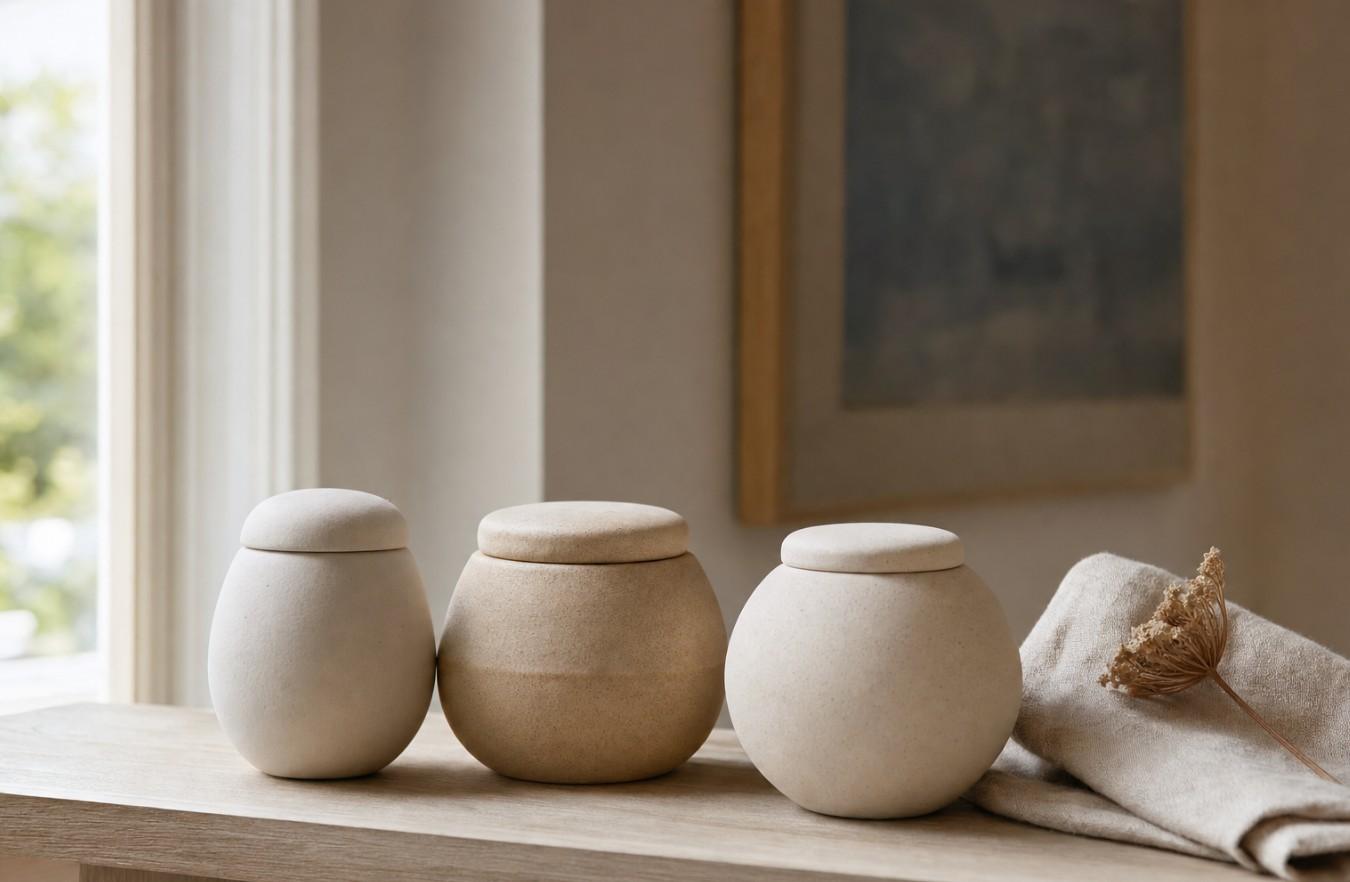
Release a vessel from the obligation to hold everything and something interesting happens. It stops being a container with a design applied and becomes an object designed on its own terms. The Italian ceramics maker FeniceTek, for instance, currently lists six in-stock pieces under memorial keepsakes for ashes — designs named for silk, water, flora and time rather than by cubic inches, with prices shown only after login, a reminder that much of this category still reaches families through funeral professionals rather than through open retail. That professional channel is easy to overlook when you are searching alone at midnight, and it is often where the better-made work sits.
Distributed remembrance: why one memorial is often not enough
The reason families reach for keepsakes is unglamorous and rarely said out loud in the arrangement room: more than one person wants something.
Three adult children live in three cities. A second marriage leaves two households with an equally legitimate claim on the same grief. A friend of forty years has no standing in the paperwork and the deepest attachment of anyone in the room. A grandchild is eleven and needs something small and concrete rather than a service they will only half remember. In those situations the alternative to keepsakes is rarely elegant restraint. It is a negotiation — and sometimes a resentment that outlives the funeral by years.
Sharing a small portion of remains, or a personal token, across several objects is commonly described in the trade as one of the ordinary options after cremation. Ordering a keepsake alongside a full-size burial or scattering urn is frequent precisely because each keepsake needs so little. The result is a network of small memorials rather than one fixed point: one on a bedside table, one in a study, one that travels twice a year.
There is a quieter reason too, and it is worth stating as observation rather than fact. A large urn asks to be placed and then left largely alone; it becomes furniture with a solemn duty. A keepsake can be picked up. Some people find that weight in the hand does something a photograph does not. Others want no object at all, and that is not a failure of feeling.
What changes when the memorial becomes small
Designing at this scale is not shrinking. Four things behave differently.
Presence versus trinket. The failure mode of a small memorial is looking like a souvenir. What tends to separate a keepsake from a knick-knack is mass and stillness: a base that feels planted, proportions that resist decoration, an absence of fussy detail. A useful test before buying is whether the piece could hold a shelf on its own, without a cluster of other objects around it to explain what it is.
Tactility. At close range, finish is most of the experience. A matte glaze can read as calm and tends to hide fingerprints; a high gloss reads as more formal and shows every touch. Weight, temperature and surface texture all register differently in the palm than they do in a product photograph — which is why, when it is possible, handling a piece before choosing is worth the trip.
Closure. This is the detail that separates objects you trust from objects you never quite relax around. Threaded bases, sealed plugs, gaskets and discreet screws all behave differently. Anyone planning to carry a keepsake, or to let a child hold it, should establish before purchase exactly how it opens, how it is sealed, and whether that seal is intended to be permanent or reopenable. Ask the maker or the funeral director directly; the answer is rarely on the label.
Legibility of meaning. Small objects struggle to carry literal symbolism without tipping into sentimentality. The more convincing contemporary work uses form and surface instead — a fluted profile, a botanical relief, a texture that suggests fabric or moving water. Meaning arrives obliquely, which may be the only way it survives being looked at every single day.
The formats, and what each asks of the person who keeps it
Rather than another catalogue, it helps to think about what each format demands of you.
- Keepsake vessels. Ceramic, stone or metal forms for a shelf, a bedside table, a private corner. They suit remembrance tied to a place in the home and a repeated moment. They ask almost nothing day to day, and they are the easiest format to share as a matched set.
- Wearable keepsakes. Pendants, rings and glass pieces with ash incorporated into the material. Maximum closeness, maximum exposure: they are worn through showers, sleep, arguments and airport queues, and they can be lost. Handmade memorial jewellery is also a commissioned process rather than a purchase — one maker’s published process, for example, asks you to post the inclusions and quotes roughly six to eight weeks before the finished piece arrives. Lead times of that order matter if you are hoping to have something in hand for a first anniversary, so ask before you assume.
- Pieces made with other inclusions. Some makers work not only with ashes but with dried flowers from the service, a lock of hair or fur, or a fragment of fabric. Strictly speaking these are memorial objects rather than keepsakes for ashes, and for anyone who finds the idea of handling remains distressing they are not a lesser option. Frequently they are the right one.
- Matched sets. One design language across several pieces, so that siblings hold variations of the same object rather than four unrelated purchases. It is the format most likely to prevent friction, and the one most often overlooked.
Portioning: the part families dread
Filling a keepsake is a short task that people imagine as an ordeal. The single most useful move is to raise it early, while arrangements are still being made rather than after everything has been sealed and handed over. Ask your funeral director what they can do, whether any of it carries a cost, and how many keepsakes you should plan for; practice differs from provider to provider, and the answer you get locally is worth more than anything you read online. If several people want a piece, say so at the outset. Deciding once is simpler than revisiting the question a year later.
On quantity, the reassurance is genuine. Keepsakes in the smallest capacity bands take very little, and a fused-glass or jewellery piece may use less than a teaspoon. Choosing one, or four, does not require visibly diminishing the main memorial — which is the fear that stops most people from asking in the first place.
Travel and security: the rules people discover too late
Portability is a large part of the appeal, so the actual rules are worth knowing before the object is chosen rather than at a security checkpoint.
In the United States, TSA guidance permits cremated remains in both carry-on bags, with special instructions, and checked bags. Two points matter enormously for keepsake buyers. Screening officers will not open a container of cremated remains, even if the passenger asks them to. And if the container is made of a material that produces an opaque image, officers cannot determine what is inside, and it will not be allowed through the checkpoint. To facilitate screening, the TSA suggests a temporary or permanent crematory container in a lighter-weight material such as wood or plastic.
Read plainly, that rewards planning. Some travellers keep a modest secondary container for flights and leave the designed piece at home — a personal solution, not a requirement, but a sensible one. Airlines also set their own policies on top of security screening, and the TSA itself notes that some do not allow cremated remains in checked bags, so the carrier needs to be checked separately.
Keeping ashes at home: what is generally allowed
One of the most searched anxieties on this subject is whether keeping ashes at home is permitted at all. In much of the United States the answer is straightforward: remains may be kept in a cremation urn or another container at home, or placed in a crypt, niche or grave. Scattering is where the variation lies. Each state sets its own laws, and following local state rules alongside federal guidance is the responsible route before scattering anywhere public. New York illustrates the pattern: one state guide notes that there is no statewide law governing the storage or scattering of ashes there, and recommends checking city or county offices for local rules.
Religious guidance is a separate question from legal permission. It differs by tradition and by clergy, and anyone for whom it matters will be better served by their own community than by a search engine.
Care over time
The lifespan question people ask about ashes turns out, on inspection, to be a question about the container. Cremated remains are inert; the object around them is what ages.
Most of the realistic risk is mechanical rather than chemical — a shelf away from edges, pets and slamming doors is worth more than any cleaning ritual. Beyond that, follow the maker’s instructions rather than general advice, because they know the specific glaze, alloy or finish and you do not. If a piece arrives without care guidance, ask for it; a maker who cannot answer is telling you something.
Wearable pieces need the most attention, since they live a physical life. Check bails and clasps periodically, remove rings for manual work, and read the repair terms before buying rather than after a setting works loose. At least one jewellery maker backs its pieces with a lifetime warranty, which says more about confidence in the construction than any adjective on a product page — and it is a reasonable thing to ask any maker about, whether or not they advertise it.
When keepsakes help — and when they complicate things
Not everyone wants one. That should be uncontroversial, and often isn’t.
Keepsakes work when they are chosen by the person who will keep them, for a reason that person can articulate, even privately. They work badly when they are handed out like favours at the end of a service, or when one relative decides on everyone’s behalf that the remains will be divided. Consent is not a formality here. Some people experience dividing remains as an act of care; others experience it as an intrusion. Both reactions are legitimate, and neither is settled by majority vote.
Two habits keep this civil. Talk about it before anything is divided, not after. And put the ash-free alternative on the table openly — an engraved object, a small sculpture, a piece made with hair or fabric — so that declining a keepsake never feels like declining to grieve properly.
Craft as the quiet part of the argument
Here is an opinion rather than a fact, offered as such. Small-batch making tends to leave evidence of decision: a glaze that pools slightly at the foot, a weight that seems resolved by hand. Held often, that evidence can read as intention, and intention is much of what a memorial object is for. Mass-produced pieces can be entirely respectful and are frequently the sensible choice for a budget, but they are more likely to communicate a category than a person.
What seems to be shifting, at least among the more design-led makers, is that keepsakes no longer have to announce themselves as funeral goods. Pieces coming out now would not look out of place among ordinary objects in an ordinary room — which is rather the point. A memorial that has to be explained to every visitor tends, eventually, to migrate to a cupboard. One that simply looks like something you own stays where you put it, and gets picked up.
Small, designed, portable, plural. None of those are concessions in remembrance. For families spread across cities, second marriages and time zones, they are frequently the terms on which remembrance survives at all — and an object asked to carry that much deserves as much thought as the words said at the service.










5 thoughts on “More than miniature urns: keepsakes bring design and personal meaning to modern memorials”
Comments are closed.