Most fire door failures on inspection day come down to one small piece of metal or a few square inches of embossed text. The fire door label is the only thing that proves a door left the factory as a listed assembly. If it is missing, painted over, or doesn’t match the frame, the inspector has nothing to go on, and the door gets written up no matter how heavy it feels.
This is a practical guide to reading those labels on commercial swinging doors in the US, whether they are YUNNGD fire doors or another brand. It covers where to find them, what each line means, and the three things a label cannot prove on its own.
Where the Labels Are, and Why There Are Two
A fire rated opening normally carries at least two labels. One is on the door leaf and one is on the frame. They are separate because the leaf and the frame are usually separate listings, made and inspected under their own programs.
The leaf label sits on the hinge edge in most cases. The frame label is typically on the hinge jamb, between the top and middle hinge, or on the head.
Labels come as metal plates, high temperature labels, or marks embossed or stamped into the steel. All of them do the same job. What matters is that they are readable and still attached. NFPA 80 does not allow labels to be painted over or removed, and an unreadable label is treated much like a missing one.
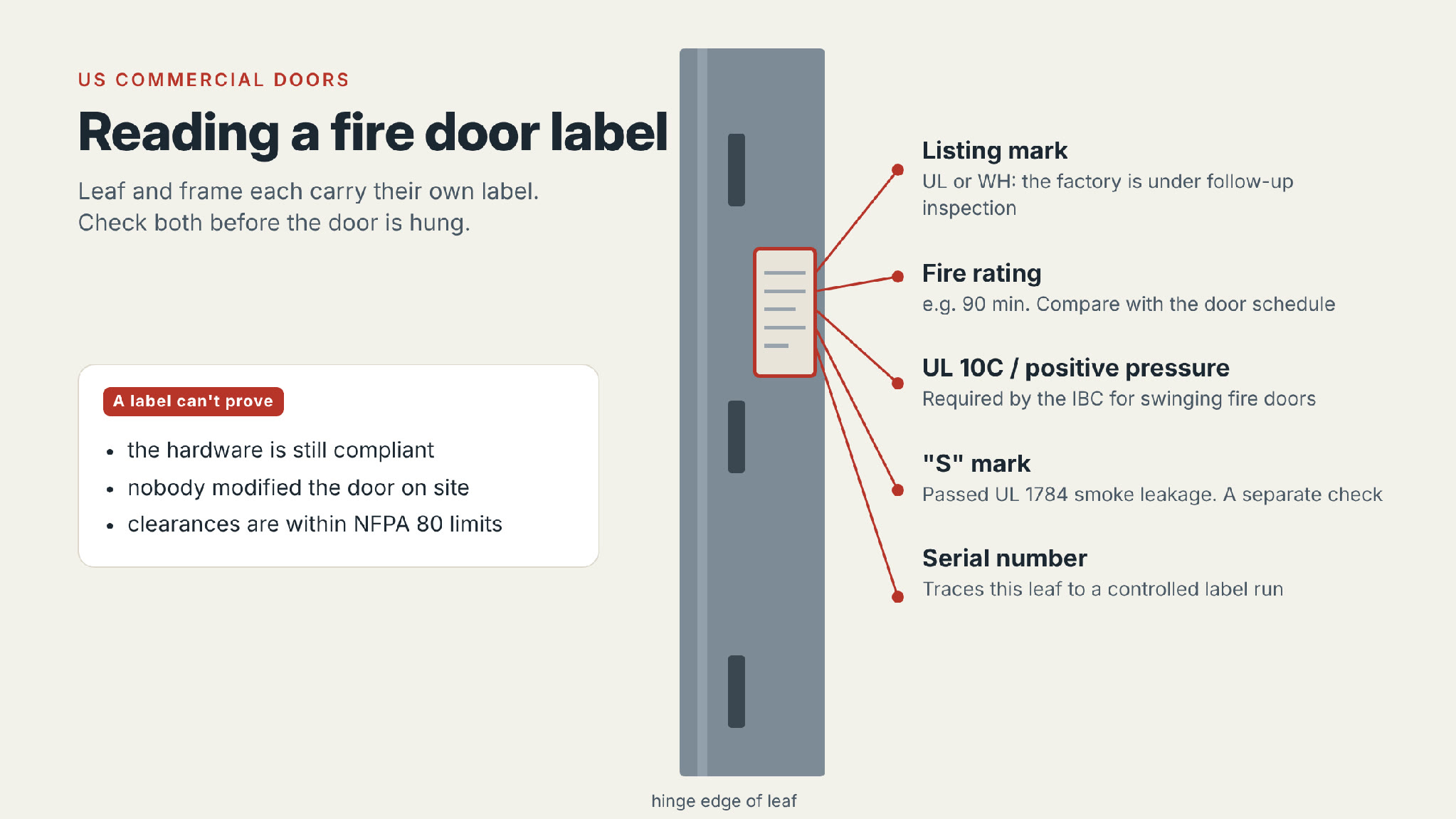
Reading the Leaf Label Line by Line
The layout changes with the listing body. UL and Intertek’s Warnock Hersey mark are the two you will see most. A leaf label usually carries these lines:
| What you see | What it means |
|---|---|
| Listing mark (UL, WH) | The product is covered by that body’s follow up inspection program at the factory |
| Fire rating in minutes or hours | How long the assembly lasted in the furnace test, such as 90 min or 3 hr |
| Standard references | UL 10C or UBC 7 2 means the door was tested under positive pressure, which the IBC requires for swinging fire doors |
| “S” mark | The assembly also passed UL 1784 air leakage, which is needed where codes call for a smoke and draft control door |
| Temperature rise (if shown) | Maximum heat on the unexposed face at 30 minutes, required on some stair enclosure doors |
| Manufacturer and serial number | Lets you trace the door back to the listing file |
The serial number is the line people skip and inspectors don’t. Listing bodies control how many labels each factory gets. So a serialized label ties that specific leaf to a specific production run. A product page for UL listed steel fire doors from one manufacturer shows how the file number, listed designations, size range, and the separate S labeled smoke model sit together in one place.
Rating vs. Listing: Two Different Questions
A label answers one question: what was this door tested to achieve? It does not answer the second one: is this door allowed in this wall? That comes from the building code and the drawings.
Door ratings are usually lower than the wall they sit in. Under the IBC opening tables, a 2 hour shaft or exit enclosure wall typically takes a 90 minute door. Many 1 hour corridor walls need only a 20 minute door.
A 3 hour door in a corridor wastes money. A 20 minute door in a stair enclosure fails the inspection.
Check the rating on the label against the door schedule, then against the wall rating it sits in. When the numbers disagree, the schedule is usually wrong, not the door.
The S Label and Positive Pressure in Plain Terms
Positive pressure testing (UL 10C) puts the neutral pressure plane low in the furnace. Hot gas then pushes through the gaps at the top and sides of the door. That is closer to a real fire than the older neutral pressure test, and it is why intumescent edge seals or listed gasketing are now part of most assemblies.
The S label is a different thing. It covers smoke leakage, measured in cubic feet per minute per square foot of door opening at low pressure differences, starting at 0.10 inch of water.
A door can have a 90 minute fire rating and no S label. That same door is the wrong product for a smoke partition opening. Treat the fire rating and the smoke rating as two separate checks.
Three Things a Label Cannot Prove by Itself
That the hardware is still compliant
The listing covers the door with hardware of a listed type. That means latching hardware, closers, and hinges with the right count and size. Swap in a non latching push plate, or remove the closer because it was “slamming,” and the label is still on the door. The opening no longer complies.
That nobody modified the door on site
NFPA 80 allows only a short list of small job site preparations. Cutting a new lock pocket, adding a large vision lite, or trimming the bottom by more than allowed takes the door outside its listing. Bigger changes need written authorization from the listing body or a field labeling service.
That clearances are within limits
For swinging doors, NFPA 80 sets edge clearances: 1/8 in. at the head and jambs for most steel doors, with a tolerance. It also caps the gap under the bottom of the door at 3/4 in. A door that has dropped on worn hinges can fail the clearance check with a perfect label.
This is why an annual fire door inspection under NFPA 80 is an opening by opening walk with a feeler gauge and a checklist. It is not a label hunt.
What to Ask a Supplier Before the Doors Arrive
Labels are decided at the factory, so the cheapest fixes happen before shipment. Here is a short list we’d send any supplier, domestic or imported:
- The listing file number for both the leaf and the frame, so you can look them up in UL Product iQ or the Intertek directory yourself.
- The size range the listing covers. A 48 x 96 in. leaf is fine on some listings and outside others.
- Whether the label will carry the S mark, if the schedule needs smoke and draft control.
- Which hardware types are listed for use with the door, especially if a different vendor supplies the hardware.
- A photo of a production label before the order ships, so the label format is known before it reaches site.
A good product sheet gives you the UL file number, the listed designations, the size range, and the separate S labeled smoke model in one place. That is the level of detail to expect before you sign a purchase order. If a supplier can’t give you those numbers in writing, the label that arrives won’t be a pleasant surprise either.
A Two Minute Label Check at Delivery
When doors arrive on site, open a few crates and check:
- Leaf label and frame label are both present and readable
- Ratings on leaf and frame match each other and the schedule
- The S mark is there on doors scheduled as smoke and draft doors
- Serial numbers are present
- No factory applied paint or primer covers the label
It takes two minutes per crate and saves a punch list item at the end of the job. Doors that fail this check are much easier to send back before they are hung.